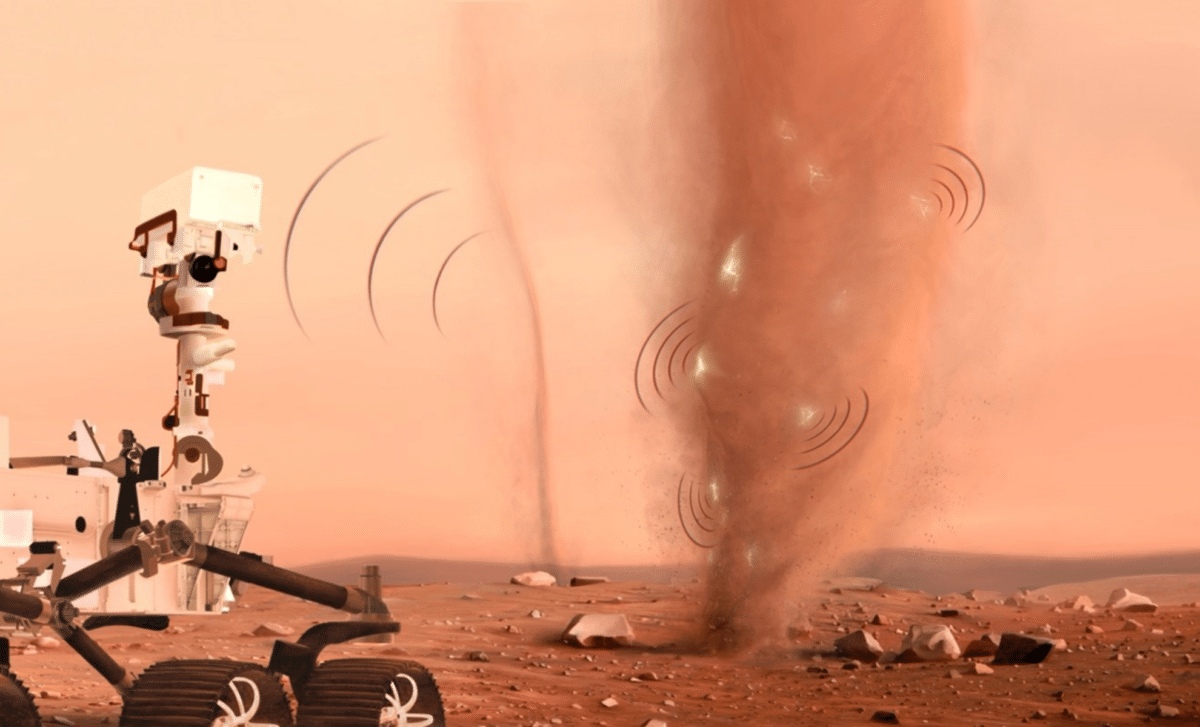
Mars is often described as silent, barren, and still. But beneath its dusty surface and cold skies, something unusual has been happening, something that no spacecraft had ever sensed before. As NASA’s Perseverance rover rolled across the ancient terrain of Jezero Crater, one of its instruments picked up a strange and unexpected signal hidden in the howling Martian wind. At first, it seemed like a glitch. Then it happened again. And again. What the rover had stumbled upon wasn’t just a sound, it was a scientific mystery decades in the making, and its implications could stretch far beyond what anyone had predicted.
NASA’s Perseverance Rover Records Electrical Activity in Martian Dust Devils
In 2021, NASA’s Perseverance rover touched down in Jezero Crater equipped with a suite of sophisticated instruments designed to study Mars’ geology, climate, and potential for ancient life. Among them, the SuperCam system featured something unprecedented: a microphone, the first to record sound directly from the Martian surface.
Soon after its arrival, this microphone began picking up anomalous acoustic patterns during dust devil activity. These are whirling mini-storms that sweep across Mars’ dry surface. The signals stood out from the background wind noise. Upon closer analysis, the strange sounds were accompanied by electromagnetic signals, indicating the presence of electrical sparks inside the storms. This discovery provided the first direct evidence of electricity in the Martian atmosphere, a phenomenon previously theorized but never confirmed.
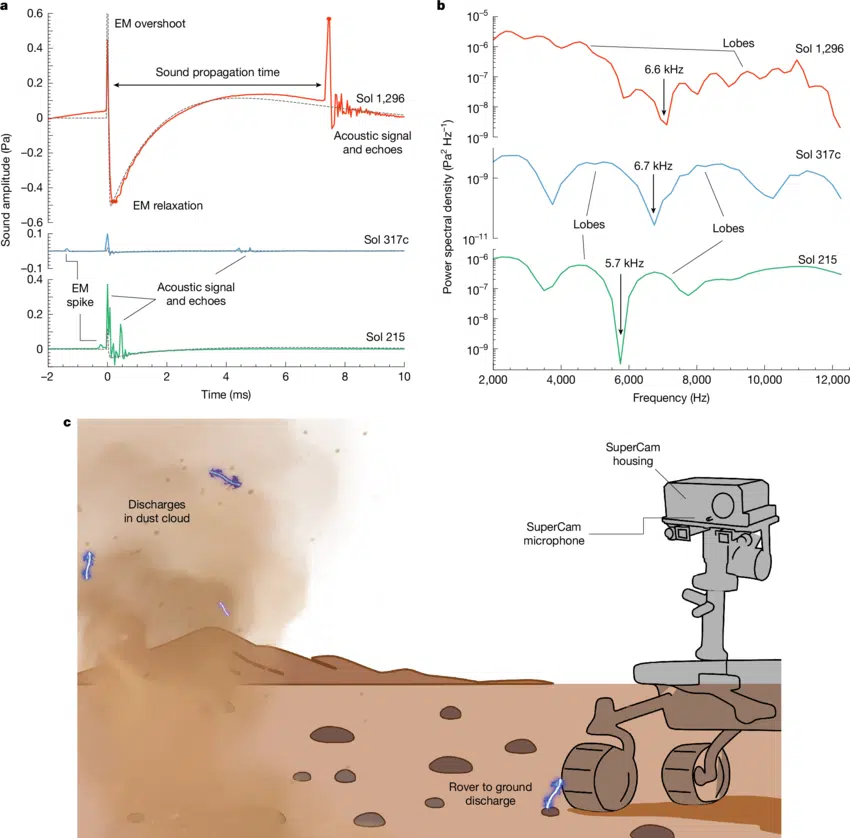 Microphone signals of triboelectric discharges a, Time series showing the electromagnetic (EM) features (overshoot, relaxation and spikes) and the acoustic contributions (direct wave and echoes) for events detected in Sols 1,296, 317 and 215. The start time for each recording is defined as the onset of the overshoot. The solid lines are the Mars data and the grey dashed line is the electronic response model, which simulates the overshoot and the relaxation (Methods section ‘Microphone response to an electromagnetic discharge’). b, Frequency spectra showing the destructive interference gap induced by the acoustic reflection on the structure of SuperCam (arrows). The colour code corresponds to the events presented in a. c, Scheme of the geometry of the SuperCam microphone integrated on top of the mast of the Perseverance rover.
How Martian Dust Becomes Electrically Charged
Dust devils on Mars function much like their Earth counterparts but with some dramatic differences. As they move across the planet’s surface, fine dust particles collide and rub together, producing friction-based electric charges. The separation of these charges creates an unstable environment inside the swirling vortex.
Mars’ thin atmosphere, comprised mostly of carbon dioxide and about 1 percent the density of Earth’s, lowers the threshold for electrical discharge. This means that micro-sparks just a few centimeters long can form with relatively little energy. Each of these sparks emits a small shock wave, detectable by the SuperCam microphone. What makes this extraordinary is the fact that Earth’s thicker atmosphere suppresses such discharges, making them rare in terrestrial dust devils, while they appear to be common on Mars.
Why the Sparks Matter: Atmospheric Chemistry and Methane Mysteries
Beyond the novelty of sound recordings from another world, these electric discharges carry significant implications for Mars’ atmospheric chemistry. When dust particles collide and discharge, they can generate highly reactive oxidizing agents. These compounds are capable of breaking down organic molecules, which directly affects how long certain chemicals, like methane, can survive on the Martian surface.
This discovery might finally help solve one of Mars’ enduring mysteries: the disappearance of methane. Despite repeated detections, methane seems to vanish from the atmosphere much faster than scientific models predict. The electric sparks inside dust storms may be responsible for accelerating the breakdown of methane, offering a plausible explanation for the phenomenon.
This insight, backed by a study published in Nature, strengthens the case for considering electrochemical reactions in Martian climate and habitability models.
Implications for Future Missions to Mars
The presence of charged dust and electrical discharges is not just a scientific curiosity. It represents a real engineering challenge for future missions. On Earth, dust is already a well-known hazard for electronics and optics. On Mars, that hazard becomes magnified.
The discovery that dust storms carry electrical charge means future human missions may need to account for the risk of electrostatic interference with sensitive equipment. For robotic spacecraft, insulation and shielding might need to be reengineered to prevent malfunction or data corruption. Furthermore, electrical discharges could impact solar panel efficiency or degrade scientific instruments over time.
This finding allows engineers and mission planners to design better-protected systems, ensuring safer and more reliable exploration as humans prepare to set foot on the Red Planet.
Mars Is No Longer Silent, Thanks to Perseverance’s Microphone
Before Perseverance, scientists had to rely solely on images and atmospheric sensors to study Martian weather. The rover’s audio recordings have opened a new sensory frontier. From the rustling of Martian winds to the buzzing of Ingenuity’s helicopter blades, and now, to the faint crackle of electric sparks, Mars is no longer silent.
Over 30 hours of sound have already been recorded by the SuperCam microphone, and scientists expect more insights as data continues to stream back from the Martian surface. These sounds help scientists understand atmospheric phenomena in real time and offer a new way to detect weather patterns, like dust devils and wind gusts, which could affect both current and future missions.
The findings led by the Institut de Recherche en Astrophysique et Planétologie (IRAP) demonstrate the power of multidisciplinary instruments, combining acoustics, electromagnetism, and chemistry to reveal hidden aspects of planetary environments.