
The global economy showed remarkable resilience in 2025 despite significant trade tensions and policy uncertainty related to US tariffs.
The impact of Washington’s protectionist pivot has still to fully play out while the US’s mammoth bet on artificial intelligence (AI) has divided commentators.
We’ve picked six economic pressure points to watch out for in 2026.
The US economy
The trajectory of the US economy is perhaps the most watched trend in the global economy right now.
That’s because of the contradictory nature of Donald Trump’s economic agenda. He is trying to address an “affordability” crisis while imposing tariffs on key imports.
Tariffs should in theory elevate prices at expense of domestic consumers and businesses. Increased costs for businesses should also dampen hiring.
There is evidence of both these trends in the US economy, but they’re not as amplified as many critics of the US president had forecast.
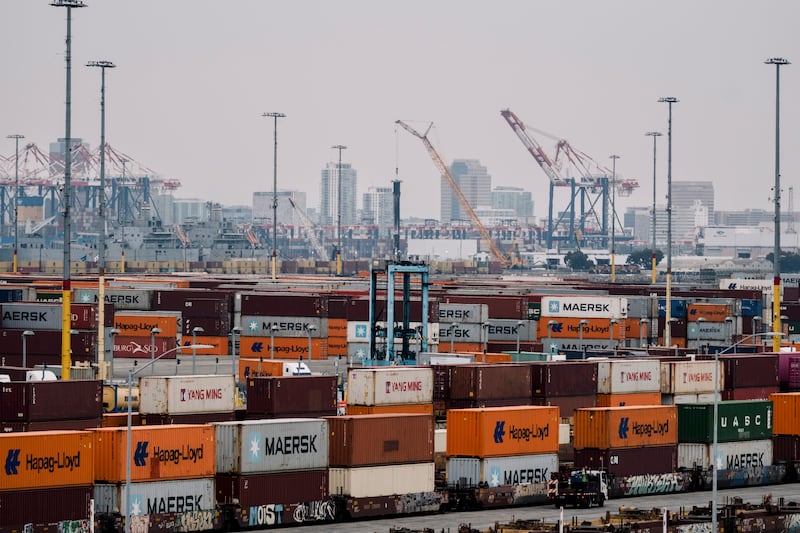 Is the US economy proving more resilient than many predicted? Photograph: Mark Abramson/The New York Times
US growth driven by consumer spending and spending on AI also remains relatively strong.
But is this the lag before the storm (tariffs take time to percolate through the system) or is the US economy proving more resilient than many predicted? The year 2026 will perhaps answer this question.
Federal Reserve chair Jerome Powell describes the US economy as “very unusual” with policymakers facing a rare combination of tariff-driven goods inflation and a labour market that might be weaker than official data suggest.
[ US economy grew at 4.3% rate in third quarterOpens in new window ]
An added complication relates to the recent federal shutdown which has backed up the flow of data relating to prices and the labour market.
The Fed cut interest rates for the third consecutive meeting in December despite the elevated level of US inflation, but the move was framed as defensive to support the labour market. Powell says the official payroll figures – which have slowed sharply since the summer – may be overstating jobs growth by roughly 60,000 a month.
Last time the US Bureau of Labor Statistics (BLS) revised down its jobs growth data, Trump fired the chief statistician and he has had it in for Powell since to coming to office. Trump’s man on the board of the Fed, Stephen Miran, pushed for a larger half point cut in December.
Even the soothsaying bond markets are giving out mixed signals. The yield on 10-year US bonds – in effect the US government’s borrowing costs – is rising, not what you would expect when the Fed is cutting rates.
This could mean several things: investors are worried about US debt levels; they are worried the elevated rate of inflation; or conversely they believe the US economy is doing better than expected and therefore the Fed won’t cut rates to the same extent as previously thought.
Many analysts complain they’re “flying blind” when it comes to the US economy.
 Bearish investors have been talking about “stretched valuations” of AI firms. Photograph: Andriy Onufriyenko/Getty The AI bubble
Not unrelated to the health of the US economy is the potential for a blowout on US stock markets linked to the current glut of investment in artificial intelligence (AI). US firms, led by the so-called hyperscalers (Alphabet, Amazon, Meta, Microsoft), have invested $350 billion (€297 billion) in AI and AI-related infrastructure in the past year alone and are forecast to spend $400 billion in 2026.
Bearish investors have been talking about “stretched valuations” for two years, but the bull run on markets continued apace in 2025 with indices, including the bellwether S&P 500, reaching record highs.
The S&P surge is, however, being increasingly driven by a small number of large stocks: today just eight stocks – the so-called Magnificent 7 of Alphabet, Amazon, Apple, Meta, Microsoft, Nvidia and Tesla, plus Broadcom – account for almost 40 per cent of the value of the index. This level of concentration is significantly higher than usual, and has only been seen once before, at the peak of the dotcom boom in 2000.
 Investors could seek out more attractive valuations and earnings growth. Photograph: Michael Nagle/Bloomberg Will 2026 be the year when things go bang?
Barry Glavin, head of equities at Amundi, Europe’s largest asset manager, says the market is trying gauge how attractive the return on this huge AI investment will be.
“These companies – until recently – have been able to grow earnings without having to invest a huge amount of capital.
“But now – all of sudden – they’ve become really capital intensive and it’s not clear what the return on this capex [capital expenditure] is going to be,” he says.
The timeline to delivery is unclear because of energy bottlenecks in the US while the commercial model is also uncertain. “What are clients going to pay to access this processing power?” he says.
“There are big unknowns for a spend of this magnitude,” he says.
Glavin also notes these companies are going to have to depreciate all this capital expenditure – and that’s going to be a drag on future profitability.
“What we do know is that businesses that deploy AI will get huge productivity gains,” he says.
“At the moment it’s not very expensive to buy and integrate … but I’d prefer to be an investor in users of AI rather than the providers of processing power.
“The roll-out of telco infrastructures in the late 1990s and early 2000s wasn’t very profitable for the people who provided the capital.
“The same for canals, the same for the railways … whereas the users of these infrastructures have been massive beneficiaries.”
Despite the unknowns, he says his firm does not see a “huge bubble bursting” in 2026. Instead he believes there will be a rotation out of the concentrated, high-value part of the market into other parts that offer more attractive valuations and earnings growth.
Ireland’s tax windfall
As recently as 2018, Ireland’s annual haul from corporation tax was €10 billion. The exchequer collected €10 billion in November alone in 2025.
Is this a bubble that will one day burst? Perhaps but the short-term outlook remains favourable.
The Department of Finance is expecting receipts to climb again in 2026, to a record €34 billion.
 The Department of Finance is expecting receipts to climb again in 2026. Photograph: Nick Bradshaw
That may be an underestimate. The Irish Fiscal Advisory Council (IFAC) is predicting receipts will rise by a further €5 billion from 2026 onwards as additional revenue from the new minimum tax rate of 15 per cent flows into the exchequer.
But this tax bonanza comes at the expense of huge concentration risk with just 10 firms, including Apple, responsible for 60 per cent of receipts.
This concentration is also evident in our exports with ingredients for Eli Lilly’s two bestselling weight-loss drugs – Mounjaro and Zepbound – driving a surge in Irish exports and gross domestic product (GDP) in the first part of 2025.
Globally, the financial zeitgeist is debt – dangerously high levels of it – but Ireland sits in a tax-rich ivory tower insulated from the trend.
And the sectors responsible for the country’s tax gold-rush remain – for the moment – outside Trump’s tariff dragnet.
But there’s a moral hazard to have this tax largesse, spending has ballooned. Between 2019 and 2024, it rose from €67 billion to €104 billion, an increase of €36.7 billion or 54 per cent, equating to an average annual growth rate of 9.4 per cent.
[ The Irish Times view on the IFAC report: budgeting like there is no tomorrowOpens in new window ]
IFAC chairman Seamus Coffey has accused the Government of spending like “there’s no tomorrow”.
To staunch the bleeding, Minister for Finance Simon Harris has promised, as part of new medium-term spending plan, to keep annual expenditure increases – over the next five years – to an average of 6 per cent.
Irish governments have a poor record when it comes to keeping spending in check.
Budgets are drawn up and delivered every October only to be torpedoed by spending overruns and supplementary estimates the following year. Spending for 2025 is already €4 billion beyond what was outlined in the budget last year. IFAC calls it “fiscal gimmickry”.
Four years ago the Government adopted, then quickly abandoned, a 5 per cent spending rule. Will it adhere to the new one?
 Recruits rest after drills at a training ground in the Zaporizhzhia region, Ukraine. Photograph: Andriy Andriyenko/AP Ukraine war
The fate of the Donbas region in eastern Ukraine, Kyiv’s frontline against Russia, might be discussed in purely political terms, but the economic fallout could be just as seismic.
Russian leader Vladimir Putin wants any peace deal to include Moscow getting full control of the Donbas. For Ukraine, this would be a harsh pill to swallow as it would in effect reward Russia’s military aggression.
The dithering position of European leaders on everything from Trump to seized Russian assets doesn’t bode well.
The coal-rich, heavily industrialised Donbas region is crucial to Ukraine’s economy. It is rich in critical minerals such as lithium (important for batteries), tantalum, caesium and strontium, which are essential for the green energy and defence sectors.
A second factor is the region’s strategic value. Its port of Mariupol provides Black Sea access.
The London-based Centre for Economic and Business Research estimates that the Donbas region accounted for almost 16 per cent of Ukraine’s GDP (gross domestic product) before 2014.
Ukraine is estimated to have lost more than €80 billion since Moscow’s occupation of the territory.
How all this plays out could have a big impact on global commodity prices, global supply chains and ultimately inflation. Russia’s initial invasion triggered an energy-price shock that is still percolating through the global economy.
“Control of Donbas gives Russia a massive economic and military advantage,” Elina Beketova, a fellow at the Centre for European Policy Analysis, told the UK’s Independent recently. “It’s not just resources, it’s a fortress line Ukraine has built up for years. If it falls, Russia can push deeper West unhindered,” she said.
The health of the Russian economy is also a variable in the equation. While western sanctions appear to have inflicted only limited damage on Russia’s energy-focused economy, the latest statistics show the economy there is cooling.
The initial economic boost caused by surging military spending appears to be over and activity has slowed markedly. An economic slump might force Putin’s hand.
 France is dogged by low growth and high debt. Photograph: iStock Another sovereign debt crisis?
Europe could soon be engulfed in another sovereign debt crisis, unless it adopts “bold” policy responses, the International Monetary Fund (IMF) warned recently.
The Washington-based organisation said public spending pressures in several European countries had put debt on a potentially “explosive path”.
“Elevated public debt, an increasingly difficult financing environment and new spending pressures are creating a fundamental sustainability challenge at a time when countries face political polarisation, dissatisfaction with cost of living and reform fatigue,” it said.
US economist Nouriel Roubini claims the global economy has become so saturated with debt that it now resembles Argentina, a country that has defaulted four times since the 1980s.
France, dogged by low growth and high debt (which amplify each other) and a sequence of short-lived, unstable governments, has taken over Italy’s mantle as the sick man of Europe.
[ Debt in several EU countries is on potentially explosive path, IMF warnsOpens in new window ]
The UK isn’t far behind. Both France and the UK have big budgetary gaps and face populist backlashes against proposed reforms.
“The next financial crisis is definitely coming,” German chancellor Friedrich Merz says. “It will be a sovereign debt crisis. We don’t know when it will come. We don’t know from where it will come from, but it will come.”
Merz warns that several European Union states, including France, Italy and Spain, now have debts that were bigger than the size of their annual economic output.
The lesson of the last 10 years is to expect the unexpected. Brexit, the pandemic, Russia’s invasion of Ukraine and the ensuing energy price shock were all unanticipated events.
According to historian Adam Tooze, we are living in the era of the polycrisis, where multiple, overlapping and compounding crises are challenging the way we live. The year 2026 promises more of the same.