
Tonight, as 2025 gives way to a new year, skywatchers across the Northern Hemisphere are entering a season marked by a rare astronomical spectacle. The weeks ahead will offer crisp views of Jupiter at opposition, the return of Venus to the evening sky, and a brief but dramatic lunar eclipse visible, at least in part, from every U.S. state.
This sequence of events, unfolding from the winter solstice to early March, creates ideal conditions for observing both well-known constellations and fleeting planetary movements.
Sirius Rings In the New Year in a Brilliant Spectacle
Just after midnight on January 1, Sirius, the brightest star in the night sky, reaches its highest point in the southern sky, standing 34 degrees above the horizon. Its cold, sharp glow makes it one of the easiest celestial beacons to spot, especially now, during the longest nights of the year.
On January 3 at 12:15 p.m. Eastern, Earth will reach perihelion, its closest point to the Sun, closing the gap to 91,403,637 miles, as reported by The Washington Post. This moment passes invisibly, but it serves as a quiet reminder of the elliptical nature of Earth’s orbit.
Full Moons and a Rare Total Lunar Eclipse
Between now and the spring equinox, skywatchers can expect three full moons, scheduled for January 3, February 1, and March 3. The third will deliver the season’s most dramatic moment: a total lunar eclipse, partially visible across the entire U.S.
In Washington, D.C., and other eastern cities, the Moon will enter Earth’s umbral shadow at 4:50 a.m. on March 3, with totality beginning at 6:04 a.m. The midpoint of the eclipse will occur at 6:34 a.m., just minutes before moonset at 6:40 a.m., cutting the experience short for East Coast observers.
As stated by the same source, the only way to witness the spectacle in full from start to finish will be to travel as far west as Colorado or beyond. For D.C.-area skywatchers, this will be the last total lunar eclipse with any visibility until June 2029.
Bright Planets Dominate the Evening Sky
Right now, Jupiter is one of the most commanding objects in the night sky. Already visible in the eastern sky just after sunset, it will reach opposition on January 9, rising at sunset and setting at sunrise, meaning it will shine from dusk to dawn. The gas giant sits prominently above the constellation Orion, anchoring the familiar pattern of the Great Winter Circle.
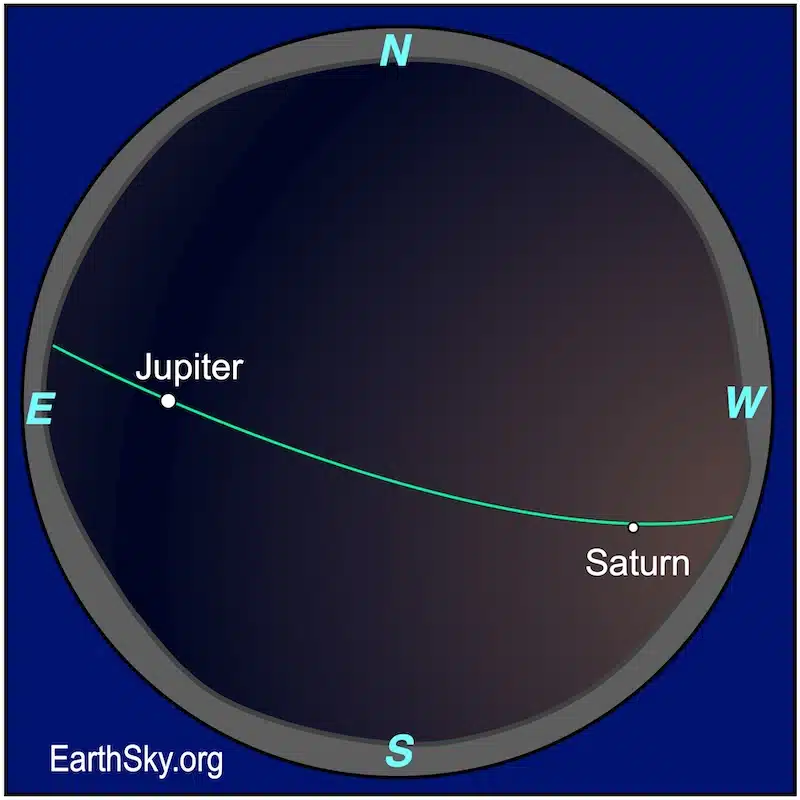 Jupiter and Saturn tracing slow arcs across the night sky, bound by celestial motion. Credit: EarthSky.com
To the southwest, Saturn glows faintly in the early evening, easy to pick out thanks to the low density of stars in that region of the sky. Between February 15 and 25, Mercury will appear low in the western twilight, 12 degrees below and to the right of Saturn. Spotting it will require a clear horizon and binoculars, as this fleeting spectacle vanishes quickly with the fading light.
Venus, meanwhile, is on its way back to the evening sky. Its bright reflection will become more noticeable in late February, and on March 8, it will pair briefly with Saturn in a striking conjunction low in the western sky after sunset.