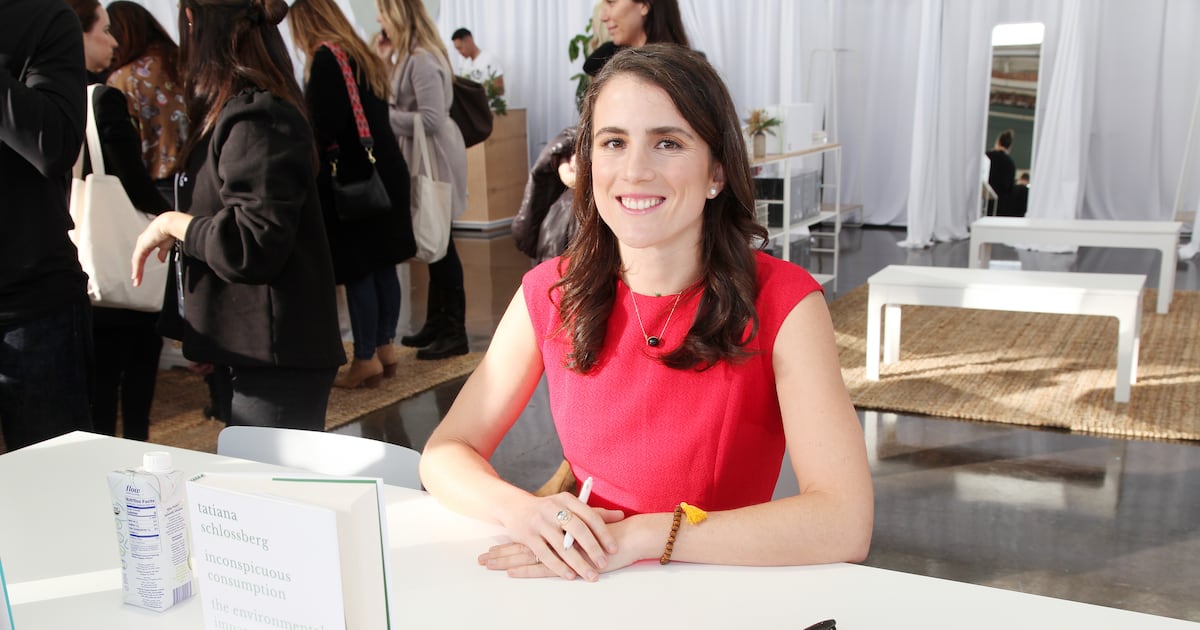
Tatiana Schlossberg, an environmental journalist and a daughter of Caroline Kennedy – and granddaughter of former US president John F Kennedy – has died aged 35.
Her death was announced in an Instagram post by the John F Kennedy Library Foundation, signed by her family. It did not say where she died.
Schlossberg’s harrowing essay about her rare and aggressive blood cancer, published in The New Yorker magazine in November, drew worldwide sympathy and praise for Schlossberg’s courage and raw honesty.
Titled “A Battle With My Blood,” the essay appeared online on November 22nd, the 62nd anniversary of her grandfather’s assassination. (It appeared in print in the December 8th issue of the magazine with a different headline, “A Further Shore.”)
In it, Schlossberg wrote of how she learned of her cancer after the birth of her daughter in May 2024. There was something off about her blood count, her doctor noticed, telling her: “It could just be something related to pregnancy and delivery, or it could be leukaemia.”
It was leukaemia, with a rare mutation. Schlossberg had a new baby, and a two-year-old son.
“I did not – could not – believe that they were talking about me,” she wrote. “I had swum a mile in the pool the day before, nine months pregnant. I wasn’t sick. I didn’t feel sick. I was actually one of the healthiest people I knew. I regularly ran five to 10 miles in Central Park. I once swam three miles across the Hudson river – eerily, to raise money for the Leukemia and Lymphoma Society.”
She added: “This could not possibly be my life.”
She wrote of months of chemotherapy and a post-partum haemorrhage, from which she almost bled to death, followed by more chemo and then a stem cell transplant – a Hail Mary pass that might cure her. Her older sister, Rose Schlossberg, was a match and would donate her cells. Her brother, Jack Schlossberg, now running for Congress in New York’s 12th district, was a half-match; nonetheless he pressed the doctors, asking if a half-match might be good enough. Could he donate, too? (He could not.)
[ JFK files: What do they reveal about John F Kennedy’s assassination?Opens in new window ]
After the transplant, when Schlossberg’s hair fell out, Jack shaved his head in solidarity. She wore scarves to cover her bare scalp; when her son came to visit her in the hospital, he did, too.
She was never able to fully care for her daughter – to feed, diaper or bathe her – because of the risk of infection, and her treatments had kept her away from home for nearly half of her daughter’s first year of life.
“I don’t know who, really, she thinks I am,” Schlossberg wrote, “and whether she will feel or remember, when I am gone, that I am her mother.”
She went into remission, had more chemo, relapsed and joined a clinical trial. There were blood transfusions, another stem cell transplant, from an unrelated donor, more chemo, more setbacks. She went into remission again, relapsed, joined another clinical trial and contracted a form of the Epstein-Barr virus. The donated cells attacked her own, a condition called graft-versus-host disease. When she came home after a stint in the hospital in October, she was too weak to pick up her children.
Her oncologist told her that he thought he could, maybe, keep her alive for another year.
“For my whole life, I have tried to be good,” she wrote, “to be a good student and a good sister and a good daughter, and to protect my mother and never make her upset or angry. Now I have added a new tragedy to her life, to our family’s life, and there’s nothing I can do to stop it.”
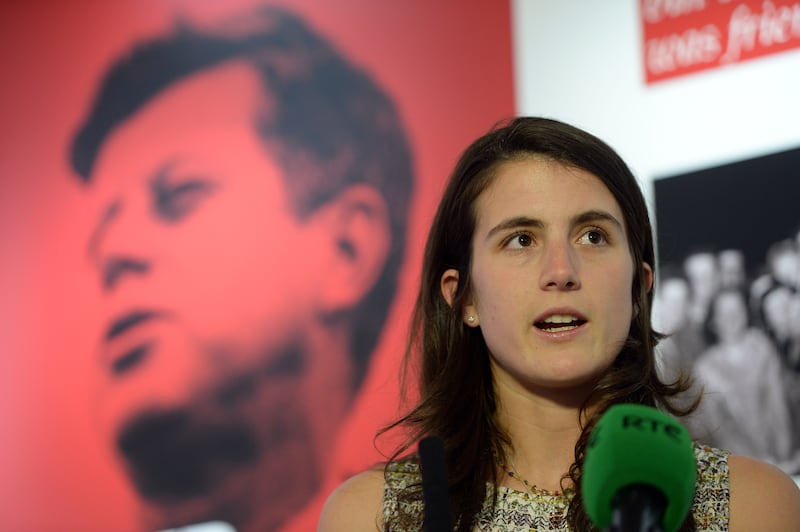 Tatianna Schlossberg pictured speaking at the launch of the JFK Homecoming Multimedia Exhibition at the National Library of Ireland, on the 50th anniversary of his visit to Ireland in 1963. Photograph: Alan Betson/ The Irish Times
Tragedy has trailed the Kennedy family for decades. Caroline Kennedy, a former ambassador to Australia and Japan, was just five when her father was assassinated on November 22nd, 1963; she was 10 when her uncle Robert F Kennedy, a presidential candidate in the Democratic primary of 1968, was murdered. Her brother, John F Kennedy jnr, died in 1999, when the plane he was piloting crashed off Martha’s Vineyard, killing him, his wife, Carolyn Bessette Kennedy, and her sister, Lauren Bessette. He was 38 years old, and Tatiana had been a flower girl at his wedding three years earlier.
Having grown up in the glare of her parents’ glamour, and her family’s tragedies, Caroline Kennedy largely succeeded in giving her own children a life out of the spotlight – a relatively normal, if privileged, upbringing, along with a call to public service that was the Kennedy legacy.
Tatiana Celia Kennedy Schlossberg was born on May 5th, 1990, in Manhattan, the middle child of Caroline Kennedy and Edwin Schlossberg, an interactive digital designer. She attended the Brearley School and then Trinity School, private schools in Manhattan. She studied history at Yale University, graduating in 2012, and earned a master’s degree in history from Oxford University in 2014.
In between, Schlossberg, who had been the editor of The Yale Herald, worked at The Record of northern New Jersey, where she covered a range of subjects, from doughnut wars and stolen puppies to gun violence and Hurricane Sandy. In 2012, she was named Rookie of the Year by the New Jersey Society of Professional Journalists. She joined The New York Times in 2014, working first on the metropolitan desk and then as a science and climate reporter.
In a first-person essay in the Times in 2015, she described herself as a bit of a nerd. She had been covering a rash of overdoses at Wesleyan University that year when her editors sent her back to the Middletown, Connecticut, campus to investigate the drug scene there. She was 24, and they thought she might blend in.
“Even when I was in college, I had never really wanted to go to parties,” she wrote, “and now I was going to have to spend a Friday night trying to find out where parties were at a school where I didn’t go and didn’t know anyone? Nightmarish.”
[ US fascination with JFK endures almost 60 years after assassinationOpens in new window ]
She continued, “Also, no one had ever really offered me drugs in college, so I had no idea how I was supposed to find them. I told my younger and much cooler brother I had to go to Wesleyan to report on drugs. He answered: ‘Why are they sending you? You’re practically a narc’.”
On the metro desk, Schlossberg covered grisly murders as well as lighter fare, including a nun on a path to sainthood, the ice-breaking boats of New York Harbor, the decline of the bodega and the mysterious discovery of a dead black bear cub in Central Park in 2014. Ten years later, The New Yorker reported that the carcass had been left there by her cousin Robert F Kennedy jnr as a peculiar prank.
“Like law enforcement,” she told the Times then, “I had no idea who was responsible for this when I wrote the story.”
In her essay in The New Yorker, she called out her cousin for his actions as secretary of Health and Human Services, describing him as “an embarrassment to me and my immediate family”.
Under his tenure, she noted, funding for medical research was being cut at institutions like Columbia University, where her husband, George Moran, a urologist, is an assistant professor, and she feared that his job, and those of his colleagues, were at risk. She wrote of the horror she felt when Kennedy cut a half-billion dollars for research on mRNA vaccines, a technology that is also deployed against some cancers.
After her post-partum haemorrhage, she was given misoprostol, a drug used for medical abortions; she pointed out that her cousin had directed the Food and Drug Administration to review the drug after decades of safe use.
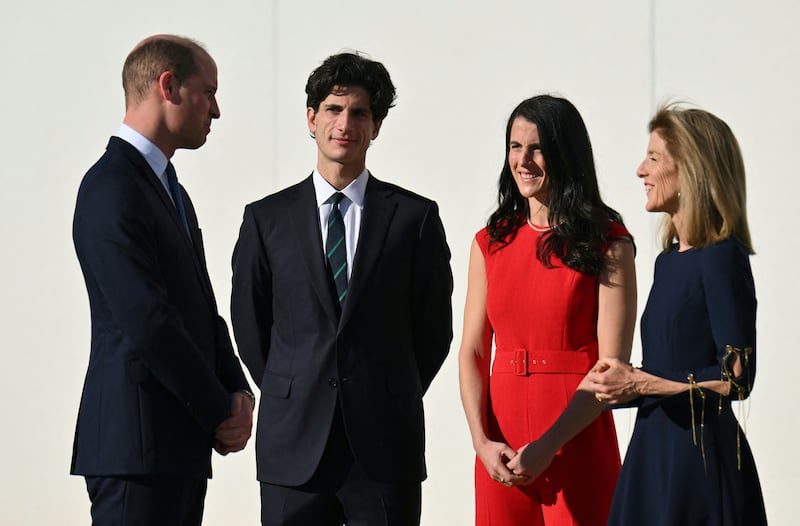 Britain’s Prince William was welcomed by US Ambassador to Australia, Caroline Kennedy, Jack Kennedy Schlossberg and Tatiana Kennedy Schlossberg to the John F Kennedy Presidential Library and Museum in 2022. Photograph: Angela Weiss/ AFP via Getty Images
“Suddenly,” she wrote, “the healthcare system on which I relied felt strained, shaky”.
Schlossberg was the author of “Inconspicuous Consumption: The Environmental Impact You Didn’t Know You Had” (2019), a kind of consumer’s guide to the ways in which human behaviour adversely affects the climate. In 2020, the Society of Environmental Journalists honoured the book with the Rachel Carson Environment Book Award. Schlossberg hoped her book would help people make changes in their behaviour and buying habits, rather than being overwhelmed by climate anxiety and fatalism.
“We don’t have to keep living like this, in fear of the future and with guilt about the past, because change is possible,” she wrote.
Schlossberg is survived by her parents, her siblings and her husband, whom she met at Yale and married in 2017, along with their two young children.
Before her illness, she had been preparing to begin reporting for her second book, focused on climate change and the world’s oceans. She learned that one of her chemotherapy drugs, cytarabine, was derived from a type of sea sponge first synthesised by scientists at the University of California, Berkeley, in 1959. Those scientists, she wrote, “almost certainly relied on government funding” – the very thing, she added, that her cousin had cut.
“At its heart, climate change is a justice issue,” Schlossberg wrote in the preface to a 2022 edition of “Inconspicuous Consumption”.
“It exacerbates inequality within and between countries. We need to save the polar bears, sure, but we also need to save the people. Actually, we can’t save the polar bears if we don’t save the people.”
This article originally appeared in The New York Times.