The Earth’s orbit around the Sun is slightly elliptical, causing our planet’s distance from the Sun to change throughout the year.
NORFOLK, Va. — The earth’s journey around the Sun is not a perfect circle. Instead, our planet follows a slightly oval-shaped path called an ellipse, meaning our distance from the Sun changes throughout the year. This weekend marks one of those key moments in Earth’s orbit.
On Saturday, January 3, 2026, at 12:15 PM EST, Earth reaches perihelion, the point in its orbit when it is closest to the Sun. At that time, our planet will be about 91.4 million miles away. By comparison, Earth will reach aphelion—its farthest point from the Sun—in early July, when the distance increases by more than 3 million miles.


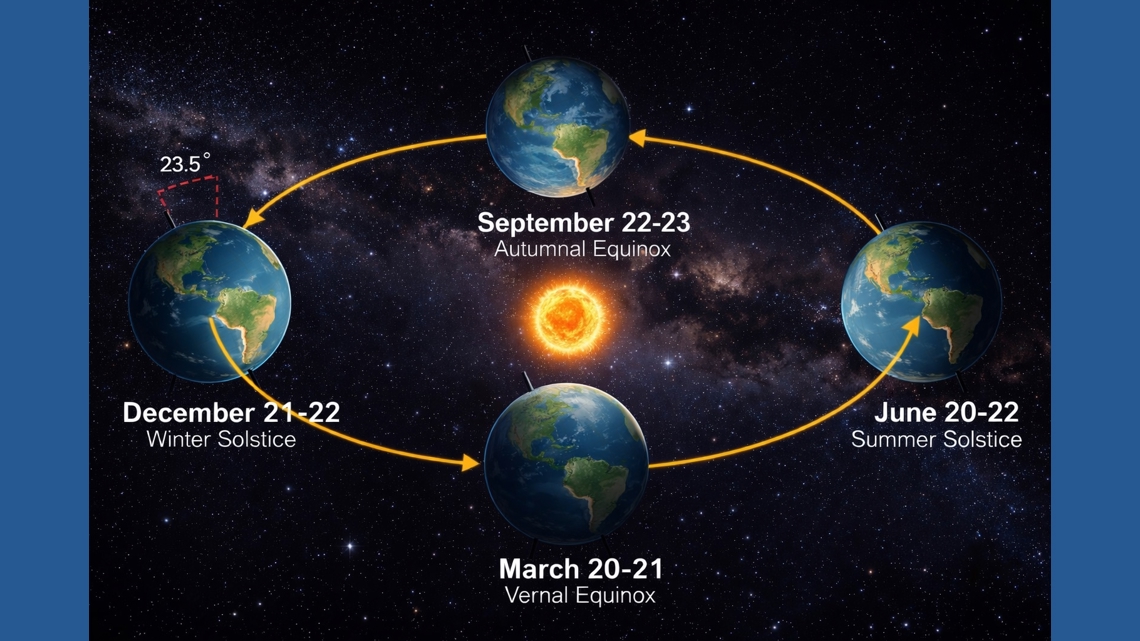
Despite being closest to the Sun in early January, this time of year is firmly in the heart of winter across the Northern Hemisphere. That may seem counterintuitive, but Earth’s distance from the Sun is not what causes the seasons.
The real driver of our seasons is the tilt of Earth’s axis, which is angled about 23.5 degrees. During winter in the Northern Hemisphere, Earth is tilted away from the Sun. As a result, sunlight strikes the surface at a lower angle, spreading energy over a larger area and reducing its intensity. Days are also shorter, limiting the amount of time the Sun can warm the surface.
Meanwhile, the Southern Hemisphere is tilted toward the Sun during January, experiencing summer with more direct sunlight and longer days. This seasonal contrast happens every year, regardless of Earth’s slightly changing distance from the Sun.

Perihelion and aphelion are fascinating reminders that space geometry plays a role in Earth’s motion—but when it comes to temperatures and seasons, it’s the tilt, not the distance, that makes all the difference.