Unlock the Editor’s Digest for free
Roula Khalaf, Editor of the FT, selects her favourite stories in this weekly newsletter.
“Elizabethans knew herbs like we know aspirin for pain relief,” says gardener and “queen of herbs” Jekka McVicar. Blends of marshmallow and comfrey or milk thistle, borage and fennel were used to create tisanes for birth and breastfeeding, while archangelica, a tall, biennial herb named for the archangel Gabriel — who was said to have revealed it to a dying monk along the banks of the Thames — was used to treat the bubonic plague.
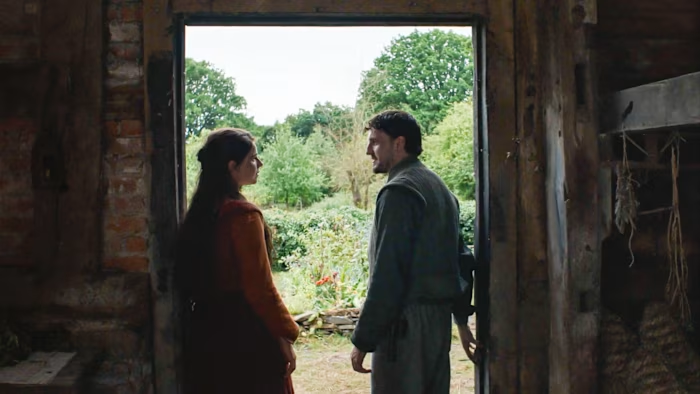
Alongside Kim Walker, a consultant at the Economic Botany Collection and the Antonelli Lab at the Royal Botanic Gardens, Kew, McVicar advised on various botanical elements in Chloé Zhao’s new film adaptation of Hamnet, based on novelist Maggie O’Farrell’s imagined account of William Shakespeare’s family and the loss of his 11-year-old son. Forest and plant life are central to the film, but they also shine a light on oft-forgotten remedies.
The film’s opening scene takes us deep into the forest, shot near Lydney, on the border of England and Wales. It is here we are introduced to Shakespeare’s future wife Agnes Hathaway, played by Jessie Buckley, lying peacefully among the trees. At the base of one monumental tree trunk there is a deep, black hole; according to set decorator Alice Felton, this is where the earthly world meets something unknown, almost mythic.
 A team of decorators and florists planted eight raised beds on the lot of Elstree Studios © Amanda Willgrave
 Flower crowns made from yarrow and St John’s Wort used in the film
The forest is a place that Agnes, called the “child of a forest witch” by locals, associates with her late mother, who also had a strong connection to nature. But it is also where she falls in love, births her first child and seeks deep healing for her family. At multiple points, she is caught reciting a passage from “The Nine Herbs Charm”, a healing spell from the 10th-century Anglo-Saxon manuscript Lacnunga (“Remedies”), praising the properties of mugwort (Artemisia vulgaris): “Una, the oldest of herbs / you have power against three and against thirty, you have power against poison and against air disease / you have power against the horror who stalks the land”. Her mother sang it to her, and she to her own children.
Shakespeare’s complete works make reference to more than 50 types of flower. Hamlet’s Ophelia delivers a monologue about their myriad associations: rosemary for remembrance, pansies for thought, fennel/columbine for flattery/infidelity, rue for sorrow, daisies for innocence, violets for faithfulness — several of these are woven into Hamnet.
 Herbs and flowers being dried for the film © Amanda Willgrave
A team of decorators and florists planted eight raised beds on the lot of Elstree Studios. Cuttings were taken each morning. “A lot of the herbs mentioned in the script — and the book — are not grown and sold commercially,” says head florist Amanda Willgrave, whose film credits span Frankenstein, Wonka and Wonder Woman. “But planting the garden wasn’t just for growing herbs that would work aesthetically, it also felt more true to the story.”
“The Romans brought hundreds of herbs to this country, both as their mainstay for health but also for animals,” says McVicar, who laments our increasing “divorce from nature”. Among them was wormwood (Artemisia absinthium), used in absinthe, and during the Elizabethan period treated a dozen complaints, from digestive issues to low-grade fevers. Horehound (native to the mint family) was commonly used for coughs, while comfrey (otherwise known as “knitbone” or “boneset”) was deployed for bone fractures and sprains, pummelled into topical ointments for the skin. Modern medicine is a miracle, but “we’ve lost our sense of balance,” she says of the generosity of which pills (with synthetic ingredients) can be prescribed.
McVicar grows individual herbs including tansy and woad at her family-run herb garden in Bristol, and sells peat and pesticide-free “pocketfuls” for planting (£12.99) alongside gardening kits (from £18) and seed subscriptions (£14). “Most herbs will grow quite happily in typical garden soil, as long as it has good drainage,” she advises; her site Jekkapedia shares information on the best soil conditions for more than 400 types of herb (for outdoor sowing, woad thrives in early summer, in light, well-drained soil — thin to 45cm apart).
 Jacobi Jupe, who plays Hamnet, wearing one of the crowns © Amanda Willgrave
When shooting in locations including private woodland and National Trust properties, “every plant had to be suited to the landscape, ideally foraged locally or chosen from species native to the area,” says Felton. Beckie Stockley, one of the on-set florists, would arrive on location days ahead of the crew to source multiple specimens of flowers and grasses, from old man’s beard to yarrow and St John’s Wort. “You can pumice [St John’s Wort] down and put it on old wounds, but if you put the fresh flowers in a jar of olive oil and leave it in direct sunlight for about three to six weeks, it will turn blood red, which is when you know it is doing something magical,” she says. In the film, it is used alongside yarrow to furnish flower crowns for Agnes’s children.
“The audience might not consciously identify each herb, but [they can] feel the layered symbolism they bring,” says Felton. The final scene, which ends on stage at the Globe theatre for Shakespeare’s first production of Hamlet, has a luscious green backdrop that harks back to the first scene in the forest, the deep, black hole echoed by a blacked-out stage entrance. Adds Willgrave: “Nature isn’t just scenery, it’s a living presence”.
Five medicinal herbs for planting
Meadowsweet (Filipendula ulmaria)
A sweet-smelling wild flower used to flavour tea and celebrated for its anti-inflammatory properties.

Mugwort (Artemisia vulgaris)
A bitter herb historically used as a digestive aid and to stimulate menstruation.

Rosemary (Salvia rosmarinus)
The cooking favourite is thought to boost cognitive health, in particular focus and memory.

Yarrow (Achillea millefolium)
The white-flowering plant, also known as woundwort, was historically a remedy to staunch bleeding.

Valerian (Valeriana officinalis)
Valerian, a traditional mild sedative, can promote relaxation and improve sleep.
Find out about our latest stories first — follow @ft_houseandhome on Instagram