As the United States withdraws troops from Europe and continental capitals prepare for the concrete possibility of a war with Russia without the support of Washington, what does it mean for Europe’s remaining neutral states?
They are fewer in number now that traditionally non-aligned Finland and Sweden have joined Nato, and long-standing member Denmark dropped its rejection of European Union defence co-operation, part of a tidal shift in Scandinavia in response to Russia’s invasion of Ukraine.
Malta and Ireland stand out for their similarities: islands that adopted neutrality as a way to assert independence after British rule, and which have tended to see low defence spending and neutrality as interlinked.
This differs from the conception of neutrality elsewhere.
Switzerland, neutral since the Napoleonic wars, has mandatory military service and a substantial arms industry, driven by the idea that neutrality means that the country must rely entirely on itself for its own defence.
Traditionally non-aligned Cyprus and neutral Austria both also maintain long-standing mandatory military service for men. The invasion of Ukraine prompted both to overhaul their military readiness and declare the aim of increasing defence spending to the traditional Nato minimum of 2 per cent of GDP.
European officials are careful to appear respectful and understanding of the neutrality policies of individual countries, whatever their private views, aware that this is an issue in which overseas criticism would be deeply counterproductive.
However, Russian activity close to the vital undersea cables in Irish waters, and drones interference during the visit of Ukrainian president Volodymyr Zelenskiy, have highlighted that hybrid attacks target neutral and non-neutral countries alike.
[ Neutral but fully armed: Switzerland looks to its own defenceOpens in new window ]
International criticism of security weaknesses and low defence capabilities – if not the separate, related issue of neutrality itself – is decidedly on the increase.
How are Europe’s remaining neutral and non-aligned countries reconciling their policies to what a recent report described as a “now dangerous world”? Naomi O’Leary
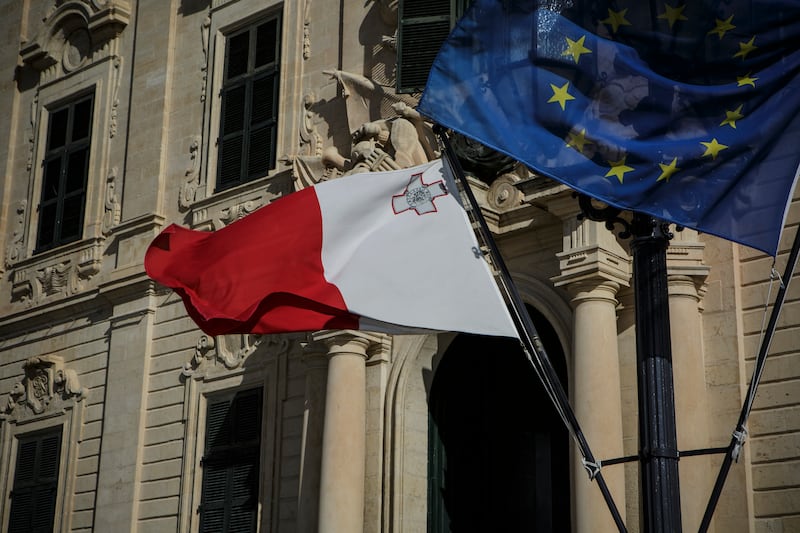 Neutrality was written into the Maltese constitution in a cross-party deal in 1987. Photograph: Emanuele Cremaschi/Getty Images Malta: Ireland’s Mediterranean twin
Before becoming independent from Britain in 1964, Malta’s economy was shaped around its use as a naval base. After initial explorations of Nato membership didn’t progress, neutrality was established as a way to ensure political independence. It joined the non-aligned movement, standing apart from either side during the Cold War, and neutrality was written into the Maltese constitution in a cross-party deal in 1987.
The wording states that no foreign military base is permitted in Malta and that its shipyards “will be denied to the military vessels of the two superpowers”, a wording reflecting the Cold War context of the time.
Since then, debates have broken out periodically in Malta about how to reconcile its neutrality with new developments. When Malta joined the European Union in 2004, a Declaration on Neutrality was affixed to its accession treaty, reiterating that EU decisions would be taken in accordance with all members’ “constitutional requirements”. The fall of the Gaddafi regime in Libya – a sometime ally – required delicate handling in 2011, and since then Maltese politicians have adopted similar language to Ireland, saying their country is ‘militarily, but not politically neutral’. The formulation is used to explain Malta’s participation in support for Ukraine. Like Ireland, it opts out of military aid while contributing to strictly non-lethal support.
The two countries also have in common very low defence spending: Ireland and Malta have the lowest and second-lowest levels in Europe.
Neutrality remains a rare issue with cross-party support in Malta’s deeply polarised politics and enjoys overwhelming public backing. This does not preclude a majority of the public also supporting more spending on defence both by Malta, and by the European Union as a whole, according to polling this year.
Is the position of neutrality under pressure? “The impression that I get from discussions is that there is sometimes, not really diplomatic pressure, but maybe diplomatic questioning,” said Dr Valentina Cassar of the University of Malta, who has written extensively on the topic. She believes Malta’s neutrality is less under pressure now than at other times in the past.
When it comes to defence weaknesses, Ireland is more in the spotlight. “There are similar vulnerabilities,” Cassar said, “but Ireland’s vulnerabilities, I think, are recognised a bit more directly at the moment, with the cables and the Russian fleet and so on. In Malta, which is on the Mediterranean migration route, “migration is the greater concern”. Naomi O’Leary
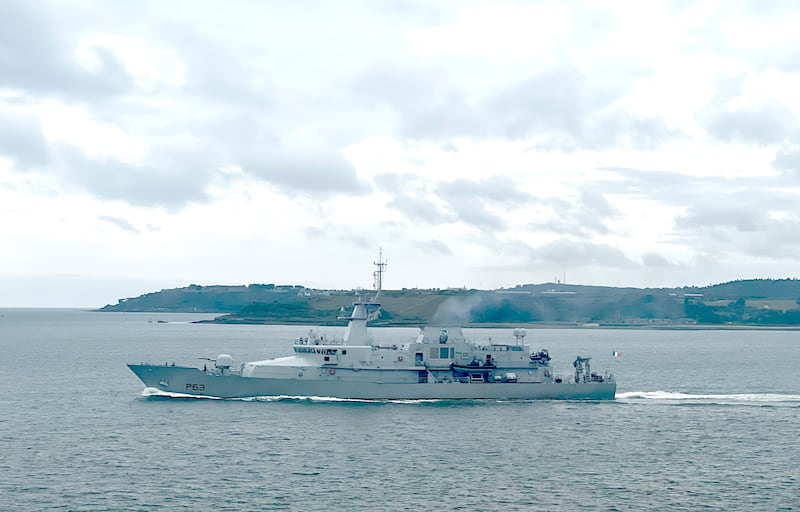 The Irish Naval ship LÉ William Butler Yeats. Photograph: Collins Photos Ireland: Unarmed neutrality
Irish neutrality emerged as a way for the newly independent state to assert its autonomy from Britain in the early years of the Republic. Ireland declared neutrality at the outset of the second World War, though the State quietly co-operated with the Allies, and an estimated 70,000 citizens of the Republic volunteered to fight in the British forces.
Neutrality was maintained throughout the Cold War, with Ireland neither joining Nato, the Warsaw Pact, or the Non-Aligned Movement. Politically, Ireland leaned towards the United States, with which it had cultural ties, and there was anti-Soviet sentiment among the public influenced by the powerful role of the Catholic Church.
During a time of heightened US-Soviet tensions in 1952, the Irish State entered into a long-standing agreement with Britain that the Royal Air Force could enter Irish airspace to intercept hostile aircraft, as Ireland does not have the capacity to do so.
The Dáil record shows that descriptions of Ireland as “militarily neutral” but not politically neutral go back to the late 1950s. Ireland’s membership since 1999 of Nato’s Partnership for Peace programme is an occasional flashpoint for criticism by pro-neutrality campaigners, as is the long-standing use of Shannon Airport as a transit hub by the US military.
Public support for European Union membership has long been tempered by the concerns of critics that it could compromise Irish neutrality, and opposition has been framed on that basis from the referendum to join the European Economic Community in 1973 onwards.
This was part of the context to the public’s rejection by referendum of the Nice Treaty in 2001, and the Lisbon Treaty in 2008. To temper these worries, Ireland secured an opt-out from EU defence, added a sentence reflecting this to the Irish constitution, and revived an old rule known as the “Triple Lock”.
This means that 12 Irish troops or more can only be deployed overseas if authorised by the Dáil, the Government, and the UN Security Council. The current Government has proposed removing the third lock, arguing that it gives security council members Russia and China an effective veto over Irish decisions.
Neutrality is an emotive issue in public debate, there is a public perception that Ireland is under pressure to abandon it. In advance of her decisive victory this autumn, left-wing unity candidate President Catherine Connolly was presented by campaigners as a “defender of neutrality”.
Fine Gael and Fianna Fáil hold that Ireland can select what aspects of EU defence co-operation to take part in, in a way that respects Irish neutrality. They give the example of Ireland’s contribution of strictly non-lethal support for Ukraine, opting out of military aid.
There is more scepticism of this among left-wing parties, and a tendency to see investment in national defence, or even discussion of it, as an attack on neutrality. This contrasts sharply with other neutral countries in Europe, which aside from Malta tend to see neutrality as requiring a high state of military readiness.
Nevertheless, while polls show neutrality has the strong majority support of the public, a majority also supports increasing defence spending.
Ireland’s defence spending was named as the lowest among 38 European countries in a report this year at 0.24 per cent of GDP. The Government has pledged to increase it, though the promised amount of €1.5 billion amounts to about 0.26 per cent of 2024 GDP, far off a projected EU average of 2.1 per cent this year.
The presence of Russian ships near to crucial transatlantic cables in Irish waters has brought the State’s security shortcomings into international focus. In a recent report, business leaders warned of “considerable” concern that Ireland lacked the capacity to defend against hostile hybrid attacks during the EU presidency in 2026. They urged for the debate about security and defence to be “decoupled” from the issue of neutrality. Naomi O’Leary
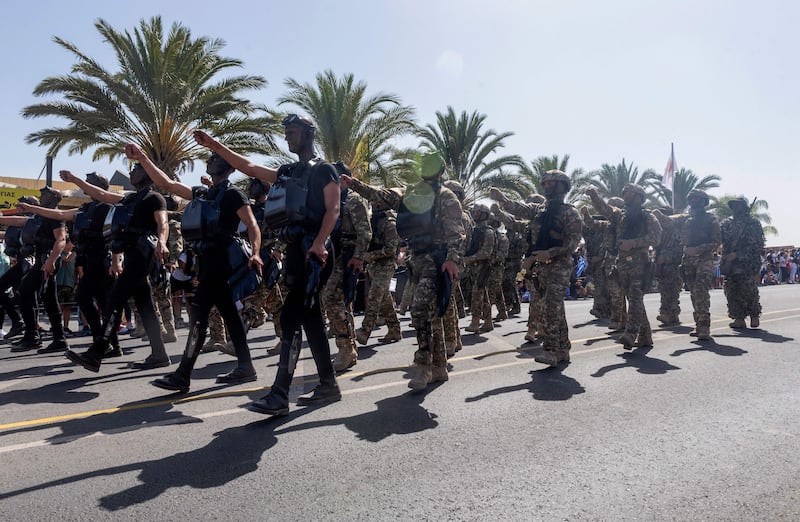 Soldiers parade on Independence Day in the Cypriot capital, Nicosia. Photograph: Iakovos Hatzistavrou/AFP Cyprus: Aspiring Nato member
Foreign policy in the Mediterranean island is usually viewed through the prism of what they call the “Cyprus problem”.
That is the euphemistic phrase used to describe the continued occupation of a northern section of the island by troops from Turkey, a conflict that has remained unresolved for more than 50 years.
Cyprus, traditionally a neutral member of a non-aligned cohort of states, has expressed a desire in recent times to join the Nato military alliance. However, Turkey, an existing Nato member, would veto its entry.
Believing a solution to the ongoing Turkish occupation lies in having allies on the United Nations security council, Cyprus has cultivated relations with both the US and Russia at different times.
Due to the frozen conflict on the island, Cyprus spends a lot of money on defence, the sixth most in the EU as a percentage of total economic output, according to figures from 2023.
The state bought a fair amount of military equipment from Russia in the past, before the invasion of Ukraine. It has since cut off those close economic ties and “de-Russified”, pivoting closer to the US and fully siding with western powers.
The current government hopes closer co-operation on defence spending within the European Union, which Cyprus joined in 2004, will help lay the groundwork for future Nato membership some day. It has applied for loans from a €150 billion EU “rearmament” fund to boost military capabilities.
“We are not a Nato member state; however, in matters of defence, our strategic outlook is closely aligned with that of the alliance,” one Cypriot official said.
Cypriot-Turkish relations are expectedly fraught and have been since Turkey’s 1974 invasion of the Mediterranean island. Efforts to find some political resolution to the conflict between the Greek-Cypriot majority and the Turkish-Cypriot minority, who are backed by Ankara, stalled in 2017. As part of a 1960 independence deal, the UK retained two sovereign military airbases on the island, which it still controls today.
Harry Tzimitras, professor of international law and international relations, said Russia’s invasion of Ukraine prompted a significant shift that saw Cyprus “join the West in an unequivocal way”. Jack Power
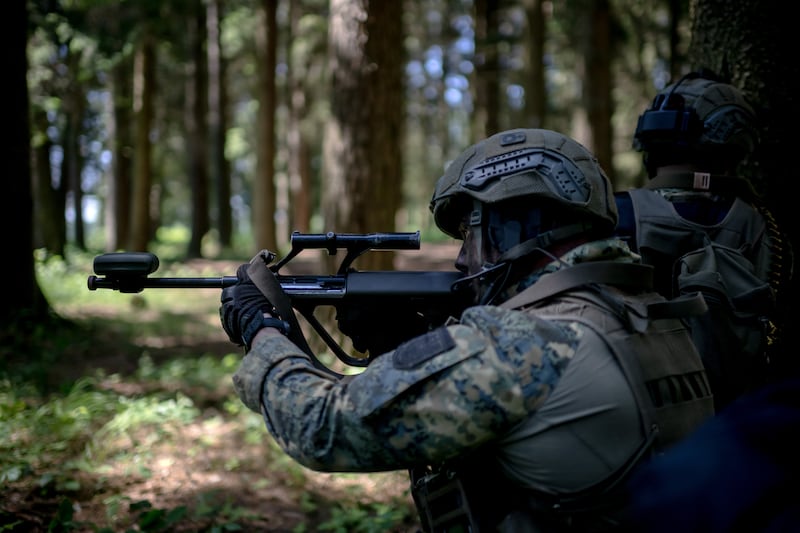 Austrian armed forces participate in a military exercise. Photograph: EPA Austria: ‘Perpetually neutral’
In October, Austria marked the withdrawal of postwar occupying powers in 1955, ending a decade of Allied rule and, before that, the seven-year Nazi annexation.
But the restoration of Austria’s independence in 1955 came with a caveat: under pressure from Moscow, the new republic made a commitment to “perpetual neutrality” and non-alignment.
What began as an external imposition, however, has become part of modern Austrian DNA. An October poll saw 69 per cent of respondents opposed to joining Nato, with 13 per cent in favour and 19 per cent undecided or unsure.
At the same time, in a 2024 poll, three quarters of Austrians conceded their country was “not at all” or “rather not” able to defend itself. In a shifting European security situation, Austrian chancellor Christian Stocker warned in October that democracy was “not a given” and that “neutrality does not mean indifference”.
Meanwhile foreign minister Beate Meinl-Reisinger has revived talk of a European army “given the kind of threat” she sees from Russia. The right-wing populist Freedom Party (FPÖ) sees such talk as a “betrayal” of neutrality by Austrian “flunkeys of foreign interests”.
But the genie is out of the bottle. Nearly four years after Russia’s invasion of Ukraine, with renewed talk of how far Austria can go under the 1955 agreement to “maintain and defend” its neutrality “with all means at its disposal”.
Defence spending will more than double in the next seven years from today’s 0.8 per cent of gross domestic product to 2 per cent of gross domestic product – the old Nato minimum.
Amid all this, supporters of Austrian neutrality fear a death of non-alignment by degrees. They are furious at Nato equipment passing through their territory and were alarmed when Austria joined the 24-country European Sky Shield Initiative, a plan to defend EU airspace with ballistic missiles.
In echoes of the Irish debate, Prof Martin Senn, an international law expert at the University of Innsbrück, warned in the Die Presse daily last October that myths surrounding neutrality hinder debate on what it actually means “considering Austria is acting now in a very different world”.
Despite concerns by some that Austria is on a slippery slope towards military alignment, a leading Vienna think-tank still placed their country beside Ireland on the naughty step of European “strategische schnorrer” – strategic freeloaders – who benefit from others’ security spending.
[ How Russia recruits Ukrainians to attack their own countryOpens in new window ]