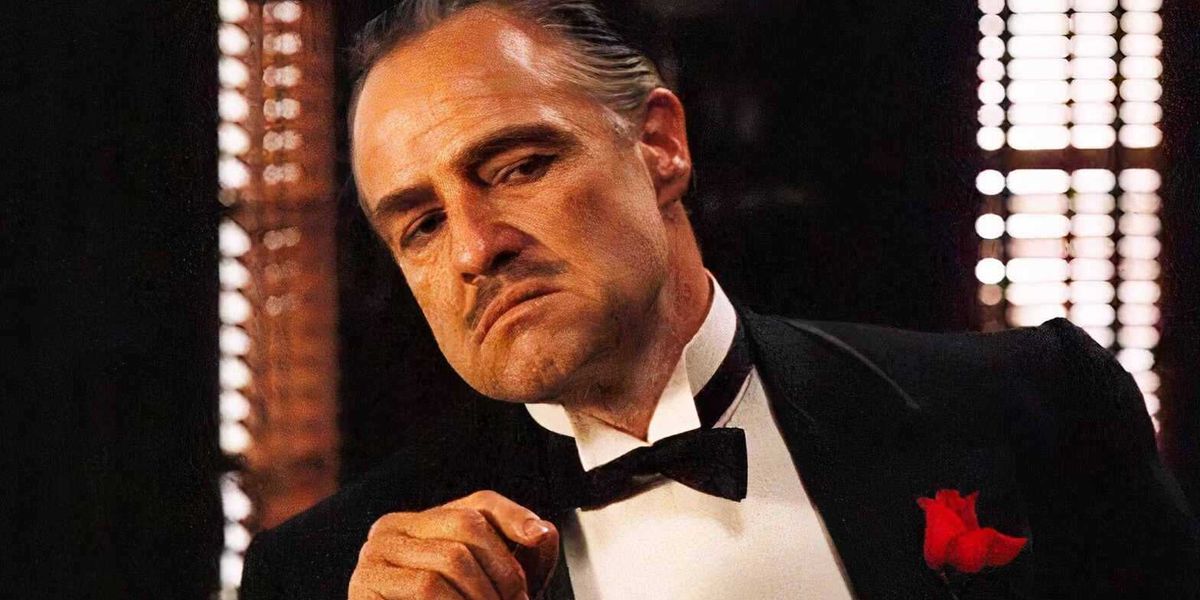
Myths are written into every legend, and charismatic legends like Marlon Brando cannot possibly be an exception. In fact, the tales of his once-in-a-generation talent, difficult behavior, eccentricity, and his “bad-boy” image were all staples of the cinema gossip during his lifetime and continue to surface even decades after his death.
One of the most chewed-over gossips is that he refused to learn his lines while filming The Godfather (1972), a film itself considered a cinematic marvel. This claim still pops up in interviews, film forums, and casual conversations, and people confirm it as if it were written in stone. And our morbid fascination with the unruliness of larger-than-life personalities immediately makes it a fact.
Also, the longevity of myths lies in the fact that they offer a cleaner narrative than the truth. That, and Brando’s reputation, might be the reason why this small, behind-the-scenes detail kept evolving and took shape.
But before we accept this claim, it would be wise, and a favor to Brando’s legacy, to step back and get the whole picture of what exactly happened.
The Origins of the “Refusal to Learn Lines” MythEarly Stories from the Set
Early accounts of the production days mention “cue cards.” Cue cards are visual aids with text written on them to help actors deliver their lines smoothly during a scene. This ensures they stay on track without breaking their character, and it also helps avoid multiple takes. Think of it as the early teleprompters.
The crew members informed that they witnessed Brando leaning on cue cards while filming scenes. They were taped to walls, lamps, other props, and even on the forehead of Brando’s co-stars. The oddity of this claim caused it to spread quickly. Brando’s renowned for whimsical behavioral traits, and his history of avoiding rehearsals fueled it further. Journalists, especially tabloid journalists, are known for putting their spin on the facts to make them more sensational. So once they got hold of this claim, the narrative quickly shifted from “Brando used cue-cards” to “Brando refused lines entirely.”
Why the Story Appealed to Fans and Critics
We like characters like mad scientists, right? They are enormous fun to watch. Brando was somewhat like a mad scientist. People knew him as a Hollywood genius who hated Hollywood culture and constantly rebelled. This reputation was a fertile ground for this myth to sprout and grow immediately. The journalists didn’t need to make a case for their claim; the audience was already ready to accept it word-for-word. Also, it reinforced the legend around his talent: “He tossed the script away and still nailed it. That’s so Brando!”
The simplicity of the claim turned it into an anecdote that was easy to repeat again and again. Film circuits reward messy, bold stories, and they did. As time passed by, the convenience replaced accuracy, and a practical choice turned into a crazy star tantrum.
What Actually Was At the Root of ThisBrando’s Process and His Memory Limitations
Marlon Brando was trained under Stella Adler, who emphasized using the actor’s imagination rather than emotional memory. However, he also adopted the Stanislavski Method, which supported using the actor’s personal memories, aided by imagination, to create naturalism. As a result, Brando preferred spontaneity. This was one of the two reasons why he disliked learning his lines by heart. It made his performance stiff.
The other reason was that he had trouble remembering lines. He claimed he forgot lines minutes after learning them. Francis Ford Coppola—who had fought tooth and nail with the studio to hire Brando—was sympathetic to his predicament and deliberately designed the set in ways that would support Brando’s way of working.
This proves that it was not so much a star tantrum as it was a combination of artistic process and genuine memory challenges.
How Coppola and the Cast Adapted
As we established earlier, the cue cards were placed strategically to allow Brando to maintain eye contact without disturbing his natural rhythm. Robert Duvall, who plays Vito Corleone’s informally adopted son, Tom Hagen, said the cue-card method never worked for him personally, but for Brando, it allowed spontaneity and allowed him to keep his performance fresh. It was not a hassle for the cast, and instead of getting frustrated by it, they saw it as a part of working with and learning from an erratic but remarkably intuitive actor.
All the adjustments the production made to accommodate Brando significantly paid off. He delivered exactly what the movie’s vision demanded: a controlled and quiet presence of Vito Corleone.
Piecing Together the Evidence
There exist several production notes, Coppola’s interviews, and testimonials from the cast, and they all point to a simple reality: Brando didn’t refuse to learn his lines out of arrogance.
In fact, Brando’s casting was a contentious topic between Coppola and the studio. Brando was deemed an unemployable actor because of his difficult personality and on-set demands. So when he was hired, his assurance of good behaviour was written into the contract. Also, at this point, Brando’s last significant hit was On the Waterfront (1954); that was almost two decades ago. So, regardless of how egotistical, eccentric, and difficult he was, Brando knew he desperately needed a big hit. This makes it unlikely to believe he refused to learn his lines out of a whim.
There are first-hand accounts of cue cards being used on the set, and that’s pretty much it. He relied on them because his creative process demanded it and because he struggled with memory. As evidence shows, this collaborative process was shaped by practicality and necessity, not rebellion.
Conclusion
We like trashing influential people. It’s a little entertaining and a little satisfying. Many times, considering the over-inflated egos in Hollywood, it’s even justified. This may even be true in many other instances concerning Brando himself—I mean, come on, he was no saint. But we must not ridicule or demonize a genuine creative process that ultimately gave us one of the most striking movie characters of all time.
The idea of a difficult actor being difficult is fascinating and dramatic, but in this case, the truth sits in a quieter place. It was nothing more than a passionate actor trying to find his method so he could do his best work.