The artist Duane Linklater says that in Cree the phrase for “How old are you?” would be directly translated as “How many winters are you?” He likes the idea that each of us is half winter.
That is his explanation for a 2022 series of oversized cotton and linen hide-shaped hangings stained and marked with geometric patterns. They are a reference to the winter count, a method of pictographic record-keeping among the Plains nations: Annually a single important event was depicted on a hide, with a year beginning at the first snowfall and continuing to the first snowfall of the next one.
Linklater’s hangings form an impressive centrepiece in Winter Count: Embracing the Cold, a large exhibition at the National Gallery of Canada in Ottawa that features Indigenous, Canadian and European art, both historic and contemporary.
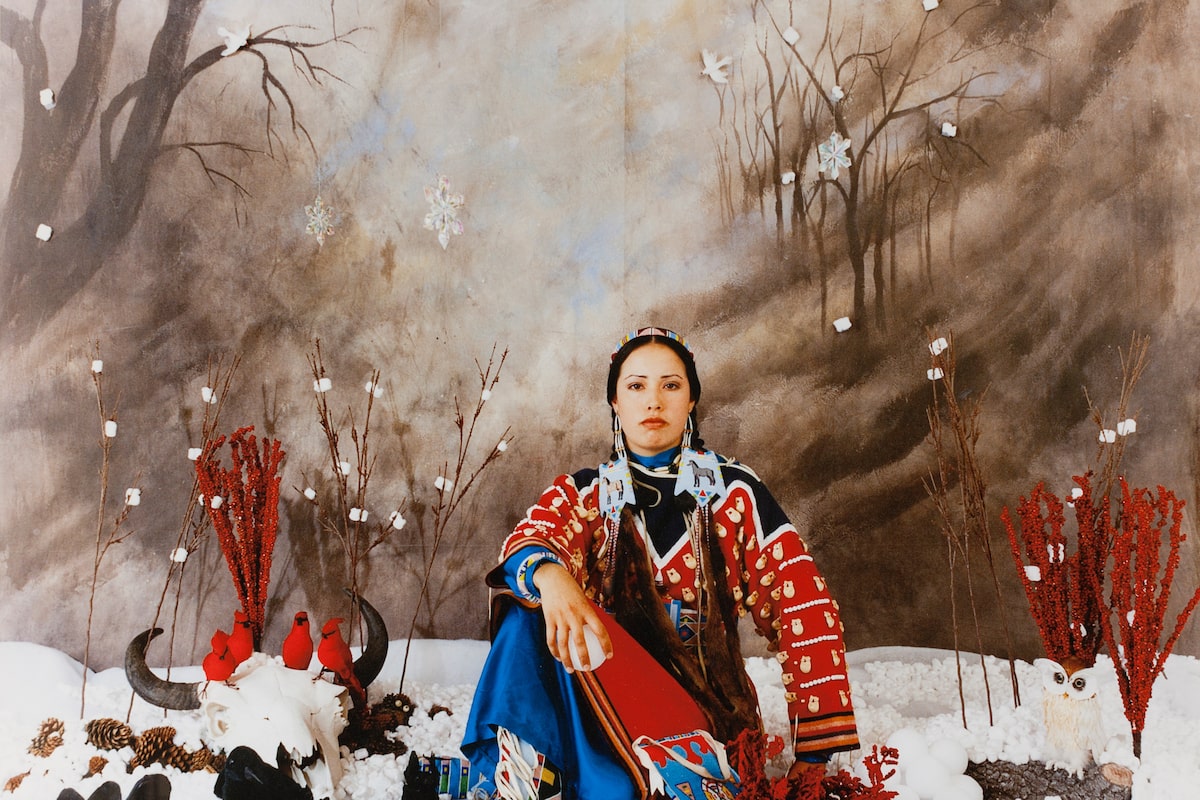
The show begins by emphatically establishing Indigenous precedence in the wintry land now called Canada with a section on storytelling. It includes a few settler images of winter, most notably Cornelius Krieghoff’s dramatic genre scene Crossing the Ice with the Royal Mail, Quebec and William Kurelek’s The Ukrainian Pioneer, no. 5 showing small figures against a vast white field. In contrast, the Apsáalooke photographer Wendy Red Star depicts herself as winter, countering tropes of exotic “Indians” with a proud reclamation of Indigenous iconography.
Wendy Red Star, Winter, 2006, one of four images, archival pigment print, 53.3 × 60.9 cm.Wendy Red Star /Minneapolis Institute of Art/Na/Supplied
The point is made more viciously by Kent Monkman in Charged Particles in Motion, a satirical painting that demolishes Paul Kane’s Winter Travelling. It’s a mid-19th-century dog-sled scene by an artist who romanticized his depictions of First Nations and Métis people, and hangs nearby. In Monkman’s version, his gender fluid alter-ego Miss Chief Testickle dashes through the landscape with her dog team, knocking over a pathetic European trapper whose three dogs include a French poodle.
The show, organized by a team of National Gallery curators from the Canadian, European, and Indigenous Ways and Decolonization departments, then switches gears in its second room. Many visitors will have come specifically for this big-name display in which Quebec winter scenes by Marc-Aurèle de Foy Suzor-Coté, Maurice Cullen and James Wilson Morrice face off against a series of rare Impressionist snowscapes by Claude Monet and Camille Pissarro.
You might be doubtful that Monet, the man who painted water lilies, knew much about the topic but both the occasional hard winter in the Paris region and an 1895 trip to Norway gave him opportunities to observe effects of light on snow and ice.
Claude Monet, The Pond, Snow Effect, 1874–75, oil on canvas, 46.4 × 68.6 cm.Claude Monet/Hasso Plattner Coll/Supplied
Perhaps not surprisingly, the Canadians come off stronger but what is really notable about this section – and the exhibition in general – is the range of work the National Gallery has assembled from a large number of institutions. Only 48 of the 164 pieces in the show are drawn from the gallery’s permanent collection, with significant loans from private collections and Scandinavian and American museums.
In the Impressionist gallery, there is also a work by the Norwegian artist Frits Thaulow who shows the Seine in Paris under an unusually large amount of snow in 1893. He was profiting from the weather to export his talent for snowscapes to the eager French, who also loved Quebec snow scenes by artists such as Morrice and Clarence Gagnon.
Somewhere in here there is another show about that triangle: Impressionism in France, Impressionism in Canada, and the contrast between Scandinavian and Canadian approaches to landscape. There are comparisons made with the Group of Seven: Most notably Lawren Harris’s Snow II hangs beside Winter Brook by the Swedish painter Gustaf Edolf Fjæstad’s. It is one of several instances where the Scandinavians’ more pointillist, more detailed, or often simply more naturalistic work, is overshadowed by the Group’s stronger commitment to modernism.
Gustaf Edolf Fjæstad, Winter Brook, after 1908, oil on canvas, 86 × 110 cm.Gustaf Edolf Fjæstad/National G/Supplied
But if Winter Count is a show about the formal aspects of painting winter – effects of light; snow at night; the Northern lights; the drive to abstraction – it is also, a bit separately, a show about the social and cultural aspects of winter as reflected in art.
In a section on community and isolation, a suite of Inuit prints and drawings about winter games faces street scenes of urban Quebec and, from suburban Ontario, Jack Chambers’s masterful piece of what he called perceptual realism: Sunday Morning No. 2. On loan from a private collection, the work from 1968-70 shows his sons watching TV in their pyjamas with a view of snowy streets outside their window. It’s a unique opportunity to see in the flesh a painting that perfectly captures the way the hard light of a winter morning enters a house.
Here, Indigenous and settler works are speaking to each other. The most provocative room in the show is one where Harris’s Snow II and Fjæstad’s Winter Brook face a series of Métis winter coats and a spectacular floral Inuit parka. With their insistence on the human body – and the practical realities of keeping it warm – the elaborate clothes feel like a retort to the exalted quote from Harris painted high up on the wall: “We are on the fringe of the great North and its living whiteness, its loneliness and replenishment, its resignations and release, its call and answer, its cleansing rhythms.”
The exhibition ends by considering the move toward abstraction – and snowscapes do lend themselves to the obliteration of naturalistic detail – with the inevitable Harris view of icebergs nicely balanced by Doris McCarthy’s Iceberg Fantasy Before Bylot, a landscape glimpsed through transparent bergs.
Lawren S. Harris, Snow II, 1915, oil on canvas, 120.3 × 127.3 cm.Lawren S. Harris/National Galler/Supplied
And, in what exhibition would one expect to encounter works by Canadian Anne Savage hung alongside Wassily Kandinsky? He is often considered the first true abstractionist and is represented here by the pivotal Murnau with Locomotive from the Saint Louis Art Museum. Savage’s Laurentian scene of 1922-24 shares the same surprising colour palette of pinks and oranges as his Winter near Urfeld, on loan from a private collection.
If you had been wondering what the National Gallery has been up to in recent years, as it has seemed more busy manufacturing political scandals than exhibition programming, the answer is surely planning this vast, ambitious show. When its two separate concepts are working together, it is a powerful thing.
Winter Count continues at the National Gallery of Canada in Ottawa to March 22.