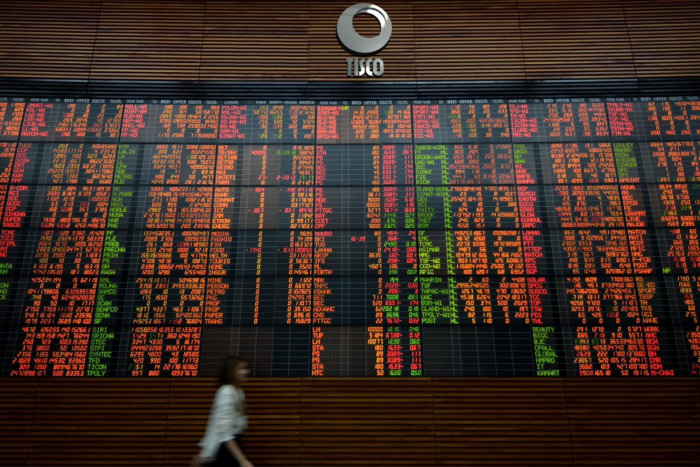
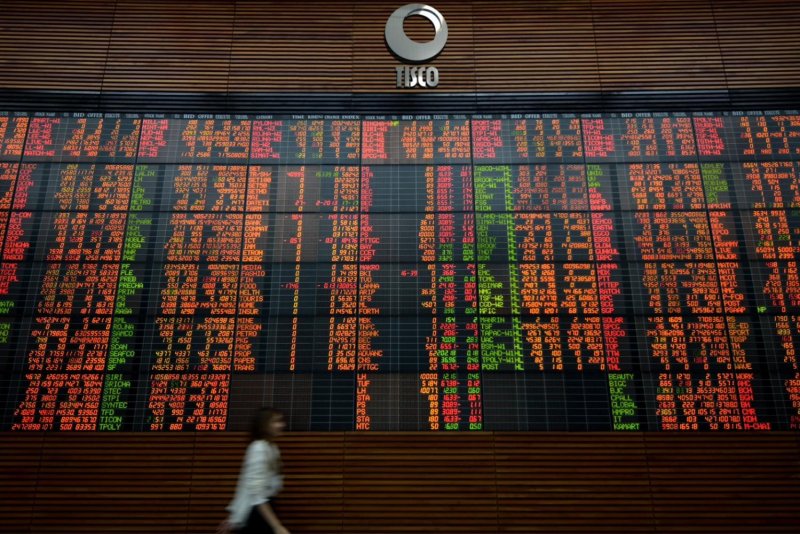
A woman strolls past an electronic trading board at the Stock Exchange of Thailand displaying live share prices. Market participants suggest there is an urgent need to restore investor confidence and improve the competitiveness of the Thai bourse.
The Stock Exchange of Thailand (SET) continues to face significant structural and cyclical challenges this year, after posting the weakest performance in the region in 2025.
With the index falling more than 10% over the first 11 months of 2025, market participants see an urgent need to restore investor confidence and improve the competitiveness of the Thai bourse.
Multiple factors have contributed to the SET’s underperformance, including prolonged domestic political uncertainty, the impact of US tariff policies, ongoing global trade tensions, geopolitical risks, concerns over corporate transparency and governance, and disruptions from natural disasters.
The combined effect of these factors eroded the attractiveness of Thai equities compared with regional peers.
Market liquidity has deteriorated sharply, with average daily trading value shrinking to 30-40 billion baht from nearly 100 billion baht at its peak. As a consequence, Thailand lost its position as the most liquid equity market in the region.
The decline in turnover has put pressure on securities firms, with more than half expected to post operating losses, raising the likelihood of industry consolidation in 2026.
Foreign investors have continued to sell Thai equities, with net outflows exceeding 100 billion baht in 2025 and cumulative outflows of more than 300 billion baht over the past three years. Attracting foreign capital has become increasingly difficult amid global uncertainties.
SET president Asadej Kongsiri said the exchange remains focused on attracting high-quality investors across all segments, but stressed that the core challenge lies in making Thai listed companies more attractive.
The bourse has therefore launched the Jump+ programme, a flagship initiative under its three-year strategic plan to enhance corporate value, governance and long-term competitiveness.
Meanwhile, US equities attracted massive inflows in 2025, driven by technology stocks and artificial intelligence trends, while earnings of listed Thai companies have weakened overall, dampening investor sentiment, noted Mr Asadej.
According to Rongrak Phanapavudhikul, senior executive vice-president of the SET, structural weaknesses are also reflected in Thailand’s shrinking presence in global indices. MSCI has reduced Thailand’s weighting to just 19 stocks, while initial public offering (IPO) activity has dropped sharply.
Once a regional leader, Thailand’s IPO fundraising in 2025 is expected to total only US$348 million, the lowest in Southeast Asia, he said.
Although investor confidence has shown signs of stabilisation since mid-2025, Mr Rongrak noted improving sentiment does not necessarily translate into immediate investment inflows. Another major challenge is the changing investor demographic.
“The market is shifting from Generation X investors, who favour dividend income and long-term holdings, to Generation Y and Z, who prefer higher growth and more volatile assets such as cryptocurrencies,” he said.
Younger investors also have greater access to overseas investments through instruments like depositary receipts, leading to capital outflows from domestic equities, said Mr Rongrak.
Looking ahead, he identified four major challenges for the Thai stock market in 2026. The first is Thailand’s relatively weak economic growth compared with Asean peers, which has caused the SET index to lag global markets in recent years.
Unresolved global trade conflicts and geopolitical risks remain a persistent threat. Thirdly, some Thai companies may increasingly choose overseas listings.
Finally, the market must strengthen trust, confidence and corporate governance to meet international standards, particularly those set by the Organisation for Economic Co-operation and Development (OECD), which Thailand aims to join, noted Mr Rongrak.
According to Mr Asadej, OECD assessments have highlighted a “tick-the-box” approach to governance among Thai companies, stressing that genuine governance must be embedded in corporate culture through continuous effort.
To tackle these challenges, he said the SET plans to move forward with its 2026 strategy to enhance the attractiveness of the Thai capital market, built on four pillars — quality demand, attractive supply, a trusted market and a supportive ecosystem — aimed at restoring confidence and ensuring long-term market sustainability.