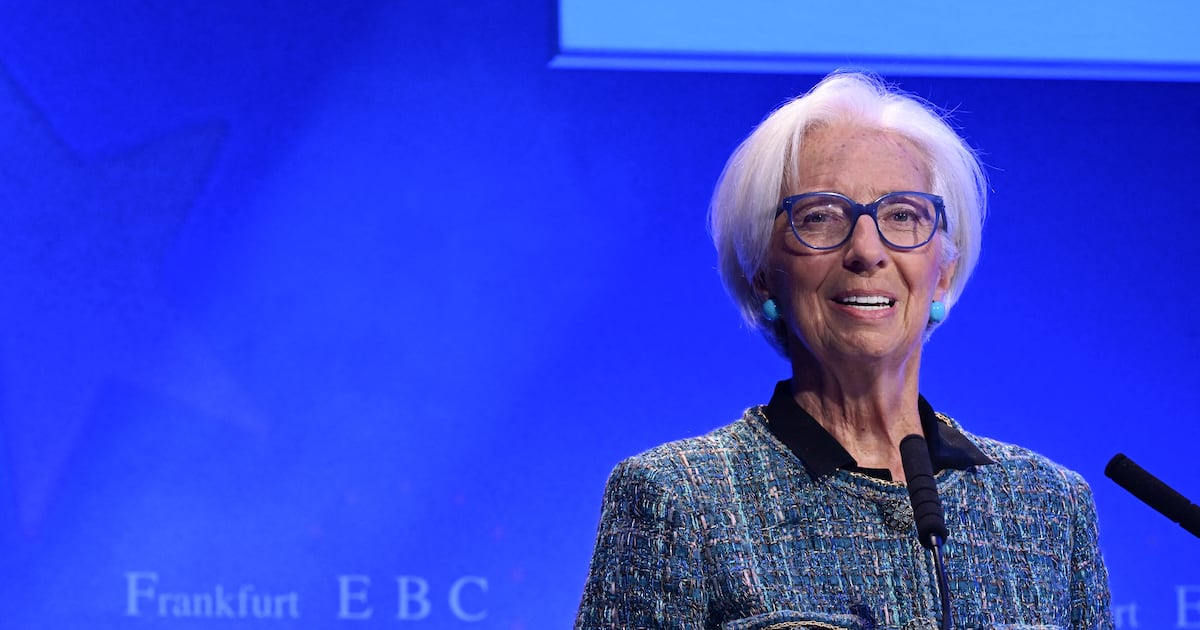
European Central Bank president Christine Lagarde’s full pay is more than 50 per cent higher than her disclosed salary, according to a Financial Times analysis.
The head of Europe’s monetary authority earned a total of about €726,000 in 2024, according to the FT’s calculations, some 56 per cent higher than the “basic” salary of €466,000 disclosed by the ECB in its annual report.
This means Ms Lagarde earns nearly four times more than the chair of the US Federal Reserve, Jay Powell, whose salary is set by federal US law and is currently capped at $203,000 (€172,720).
While Ms Lagarde’s full pay is modest compared to the chief executives of large EU companies, the analysis exposes how limited pay disclosure remains at the ECB.
The central bank is not subject to the same strict rules as listed companies in the bloc, which dictate they must give a “full and reliable picture of the remuneration” of each of their directors.
[ Christine Lagarde says ECB will probably lift growth forecastsOpens in new window ]
Fabio De Masi, MEP and chair of Germany’s populist-left party BSW, said it was “scandalous” that Deutsche Bank chief executive Christian Sewing “provides the public with more detailed information about his pay than Madame Lagarde does”. Sewing earned €9.8 million in 2024.
Mr De Masi urged the ECB to adopt a similar standard to the European pay disclosure laws for listed companies. “The president of the ECB and highest-paid EU official should represent the gold standard of accountability,” he said.
Ms Lagarde’s basic salary alone makes her the best paid official in the EU. European Commission president Ursula von der Leyen’s annual basic pay is 21 per cent lower.
On top of her basic salary, Ms Lagarde receives an estimated €135,000 in fringe benefits for housing and other matters, according to the FT’s analysis. The ECB’s annual report does not offer individual disclosure of executive board members’ fringe benefits.
Ms Lagarde also earns an estimated €125,000 for her position as one of the 18 members of the board of directors of the Bank for International Settlements — known as the “bank for central banks”. The ECB annual report does not reference Lagarde’s BIS salary. The BIS itself only discloses aggregate pay for all its board members.
Mr Powell was not paid for his role on the BIS board due to US law that bans officials from receiving a salary from non-US entities, the Fed told the FT.
Due to a lack of detailed and consolidated data, the FT’s calculations are based on the annual reports of both the ECB and BIS, as well as a technical document spelling out the “terms and conditions” of top ECB officials’ pay. The estimate does not include the ECB’s contributions to Ms Lagarde’s pension and the cost of her health plan and insurances due to a lack of available data.
The FT shared the methodology, assumptions and results of its calculations in detail with the ECB. It declined to comment on the analysis, but said in a statement that the president’s salary was set by a remuneration committee and its governing council “at the start of the ECB”, which was founded in 1998. “The only change to salary since then, for all presidents, has been the annual salary adjustment that applies to all ECB staff,” it said.
The central bank said its disclosure “is in line with many other international public institutions”, adding that it had “increased the level of transparency over time”.
The BIS declined to comment.
Academic research stresses that the personal financial independence of central bankers is a crucial part of the wider autonomy required to successfully fight inflation.
A 2004 IMF survey on central bank governance concluded that a senior central banker should be paid at levels comparable to the private sector, and protected from pay cuts during their tenure “to avoid undue influence”.
The level of Ms Lagarde’s total pay is “what I would have expected”, said Guido Ferrarini, emeritus professor of law at Genoa University in Italy and one of Europe’s leading remuneration experts, pointing to the “level of responsibility at institutions like the ECB and the need to attract talent”.
But he added that the ECB’s executive pay disclosure was of “rather poor quality” and “there are many components that must be better disclosed”. He stressed that the far more detailed disclosure by listed companies “is the right reference” point.
Due to additional one-off payments and potential transition payments for the two years after her term, which will depend on her next role, Ms Lagarde can expect a total payout of up to €6.5 million for her eight years as ECB president, equalling about €810,000 for each year.
From 2030, she can expect an annual pension of about €178,000 from the ECB, the FT analysis found. – Copyright The Financial Times Limited 2026