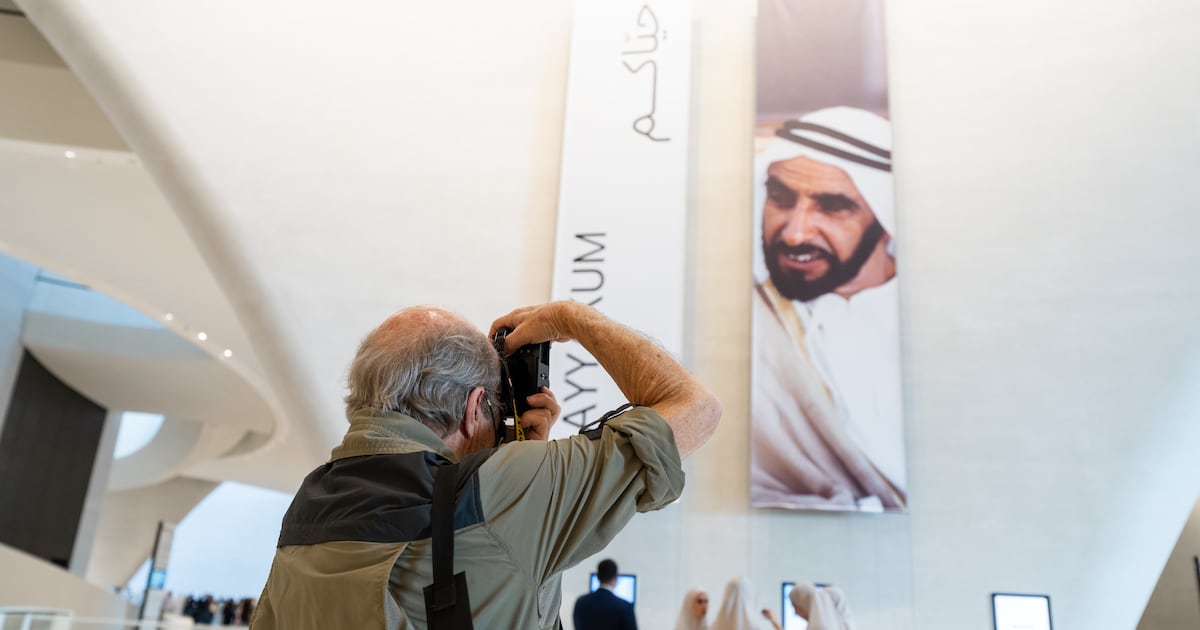
In Abu Dhabi, French photographer Jack Burlot, 78, stands inside the newly opened Zayed National Museum, confronted with a past he did not expect would resonate so deeply. Seeing his photographs of UAE Founding Father, the late Sheikh Zayed bin Sultan Al Nahyan, displayed within a national institution proved more powerful than anticipated.
“I had goosebumps,” he tells The National. “I was almost crying.”
The museum on Saadiyat Cultural District traces the story of the UAE as both land and nation, drawing on artefacts contributed largely by Emirati families and local institutions.
For Burlot, what matters most is not scale or spectacle, but intent. The experience also brought his personal journey with the UAE, and his connection to Sheikh Zayed, into sharper focus.
He reflects on Sheikh Zayed’s Bedouin heritage and vision for the UAE, noting that while oil played a role in the nation’s development, it was leadership that truly shaped its course. “He could see the future of his country,” says Burlot.
That clarity left a lasting impression. Burlot says leadership such as Sheikh Zayed’s is rare, and the photographer often reflects on how different the world might be if more leaders shared that vision. Whenever he returns to Abu Dhabi, he visits Sheikh Zayed’s resting place, something that’s become a personal ritual, not simply a symbolic gesture.
Burlot’s relationship with the UAE began in 1974, when he arrived in Abu Dhabi at a moment when the city – and the country around it – was still taking shape. He did not come as a documentarian of history, but as a young photographer awaiting clearance to take up a role recording work in the oil sector.
“I started taking photographs in the street, just to have something to do,” he says.
What he encountered quickly shifted his focus. The people he met were unlike anywhere else, he says. Their openness, rhythms of daily life and willingness to engage drew him in. Burlot spent long days observing the city, meeting people and photographing what unfolded naturally around him.
In those early years, Burlot recalls curiosity rather than resistance. People were often unsure what a camera meant or what would become of the images. “They were surprised, but not afraid,” he says.
Language was a barrier. Most people did not speak English and Burlot did not speak Arabic. Yet he describes the atmosphere as calm and non-confrontational. Photography, he says, simply was not part of everyday experience yet, which allowed moments to exist without self-consciousness.
Looking back, Burlot acknowledges how unusual some of those photographs now seem: fashion images made in public spaces; portraits captured without formal permission; scenes of daily life unfolding freely. He attributes the access he was given not to skill, but to circumstance. The society he encountered had not yet developed a relationship with the camera.
As his time in Abu Dhabi continued, Burlot’s work eventually brought him into contact with the country’s leadership, including Sheikh Zayed.
Back then, the photographer was a young man with long hair, well aware that he stood out. Sheikh Zayed, he says, found him amusing. Yet the absence of a shared culture did not prevent connection; Burlot describes a sense of immediate humanity, something he says he had not experienced with other heads of state.
Over time, his relationship with the UAE deepened beyond professional work. The people he met became friends. He recalls time spent in the desert, cooking over open fires and talking late into the night. Those experiences remain among his most meaningful memories.
Burlot says that as a photographer, he rarely thinks about legacy while working, but rather responds to what is in front of him. Only later does the meaning settle. Seeing his photographs now positioned as part of the country’s collective memory has allowed him to confront that reality.
Burlot is particularly struck by how the museum presents Sheikh Zayed’s life, from his early years in the desert to the formation of the modern state. That journey invites more reflection than celebration. It asks visitors to consider how nations are built, and what responsibilities come with that inheritance.
Today, Burlot sees a country transformed by technology, business and globalisation, but not disconnected from its roots. “People still go to the desert,” he says. “The approach is different, but the connection remains.”
For Burlot, the museum captures that continuity. It does not freeze the past, but situates it within a longer story. A quote attributed to Sheikh Zayed embedded within the museum – that a future cannot be understood without knowing the past – resonates deeply with him.
For a photographer who arrived by chance and stayed through connection, the recognition feels complete. His work now sits not just in archives, but within the narrative of the country itself.
“It’s an honour to be part of that remembrance,” he says.
More from Rashmee Roshan LallHow to avoid crypto fraud
- Use unique usernames and passwords while enabling multi-factor authentication.
- Use an offline private key, a physical device that requires manual activation, whenever you access your wallet.
- Avoid suspicious social media ads promoting fraudulent schemes.
- Only invest in crypto projects that you fully understand.
- Critically assess whether a project’s promises or returns seem too good to be true.
- Only use reputable platforms that have a track record of strong regulatory compliance.
- Store funds in hardware wallets as opposed to online exchanges.
Milestones on the road to union
1970
October 26: Bahrain withdraws from a proposal to create a federation of nine with the seven Trucial States and Qatar.
December: Ahmed Al Suwaidi visits New York to discuss potential UN membership.
1971
March 1: Alex Douglas Hume, Conservative foreign secretary confirms that Britain will leave the Gulf and “strongly supports” the creation of a Union of Arab Emirates.
July 12: Historic meeting at which Sheikh Zayed and Sheikh Rashid make a binding agreement to create what will become the UAE.
July 18: It is announced that the UAE will be formed from six emirates, with a proposed constitution signed. RAK is not yet part of the agreement.
August 6: The fifth anniversary of Sheikh Zayed becoming Ruler of Abu Dhabi, with official celebrations deferred until later in the year.
August 15: Bahrain becomes independent.
September 3: Qatar becomes independent.
November 23-25: Meeting with Sheikh Zayed and Sheikh Rashid and senior British officials to fix December 2 as date of creation of the UAE.
November 29: At 5.30pm Iranian forces seize the Greater and Lesser Tunbs by force.
November 30: Despite a power sharing agreement, Tehran takes full control of Abu Musa.
November 31: UK officials visit all six participating Emirates to formally end the Trucial States treaties
December 2: 11am, Dubai. New Supreme Council formally elects Sheikh Zayed as President. Treaty of Friendship signed with the UK. 11.30am. Flag raising ceremony at Union House and Al Manhal Palace in Abu Dhabi witnessed by Sheikh Khalifa, then Crown Prince of Abu Dhabi.
December 6: Arab League formally admits the UAE. The first British Ambassador presents his credentials to Sheikh Zayed.
December 9: UAE joins the United Nations.
Ten tax points to be aware of in 2026
1. Domestic VAT refund amendments: request your refund within five years
If a business does not apply for the refund on time, they lose their credit.
2. E-invoicing in the UAE
Businesses should continue preparing for the implementation of e-invoicing in the UAE, with 2026 a preparation and transition period ahead of phased mandatory adoption.
3. More tax audits
Tax authorities are increasingly using data already available across multiple filings to identify audit risks.
4. More beneficial VAT and excise tax penalty regime
Tax disputes are expected to become more frequent and more structured, with clearer administrative objection and appeal processes. The UAE has adopted a new penalty regime for VAT and excise disputes, which now mirrors the penalty regime for corporate tax.
5. Greater emphasis on statutory audit
There is a greater need for the accuracy of financial statements. The International Financial Reporting Standards standards need to be strictly adhered to and, as a result, the quality of the audits will need to increase.
6. Further transfer pricing enforcement
Transfer pricing enforcement, which refers to the practice of establishing prices for internal transactions between related entities, is expected to broaden in scope. The UAE will shortly open the possibility to negotiate advance pricing agreements, or essentially rulings for transfer pricing purposes.
7. Limited time periods for audits
Recent amendments also introduce a default five-year limitation period for tax audits and assessments, subject to specific statutory exceptions. While the standard audit and assessment period is five years, this may be extended to up to 15 years in cases involving fraud or tax evasion.
8. Pillar 2 implementation
Many multinational groups will begin to feel the practical effect of the Domestic Minimum Top-Up Tax (DMTT), the UAE’s implementation of the OECD’s global minimum tax under Pillar 2. While the rules apply for financial years starting on or after January 1, 2025, it is 2026 that marks the transition to an operational phase.
9. Reduced compliance obligations for imported goods and services
Businesses that apply the reverse-charge mechanism for VAT purposes in the UAE may benefit from reduced compliance obligations.
10. Substance and CbC reporting focus
Tax authorities are expected to continue strengthening the enforcement of economic substance and Country-by-Country (CbC) reporting frameworks. In the UAE, these regimes are increasingly being used as risk-assessment tools, providing tax authorities with a comprehensive view of multinational groups’ global footprints and enabling them to assess whether profits are aligned with real economic activity.
Contributed by Thomas Vanhee and Hend Rashwan, Aurifer
Avatar: Fire and Ash
Director: James Cameron
Starring: Sam Worthington, Sigourney Weaver, Zoe Saldana
Rating: 4.5/5
TRAP
Starring: Josh Hartnett, Saleka Shyamalan, Ariel Donaghue
Director: M Night Shyamalan
Rating: 3/5
The biog
Name: Shamsa Hassan Safar
Nationality: Emirati
Education: Degree in emergency medical services at Higher Colleges of Technology
Favourite book: Between two hearts- Arabic novels
Favourite music: Mohammed Abdu and modern Arabic songs
Favourite way to spend time off: Family visits and spending time with friends
Company Profile:
Name: The Protein Bakeshop
Date of start: 2013
Founders: Rashi Chowdhary and Saad Umerani
Based: Dubai
Size, number of employees: 12
Funding/investors: $400,000 (2018)
Four%20scenarios%20for%20Ukraine%20war
%3Cp%3E1.%20Protracted%20but%20less%20intense%20war%20(60%25%20likelihood)%3C%2Fp%3E%0A%3Cp%3E2.%20Negotiated%20end%20to%20the%20conflict%20(30%25)%3C%2Fp%3E%0A%3Cp%3E3.%20Russia%20seizes%20more%20territory%20(20%25)%3C%2Fp%3E%0A%3Cp%3E4.%20Ukraine%20pushes%20Russia%20back%20(10%25)%3C%2Fp%3E%0A%3Cp%3E%3Cem%3EForecast%20by%20Economist%20Intelligence%20Unit%3C%2Fem%3E%3C%2Fp%3E%0A
The chef’s advice
Troy Payne, head chef at Abu Dhabi’s newest healthy eatery Sanderson’s in Al Seef Resort & Spa, says singles need to change their mindset about how they approach the supermarket.
“They feel like they can’t buy one cucumber,” he says. “But I can walk into a shop – I feed two people at home – and I’ll walk into a shop and I buy one cucumber, I’ll buy one onion.”
Mr Payne asks for the sticker to be placed directly on each item, rather than face the temptation of filling one of the two-kilogram capacity plastic bags on offer.
The chef also advises singletons not get too hung up on “organic”, particularly high-priced varieties that have been flown in from far-flung locales. Local produce is often grown sustainably, and far cheaper, he says.