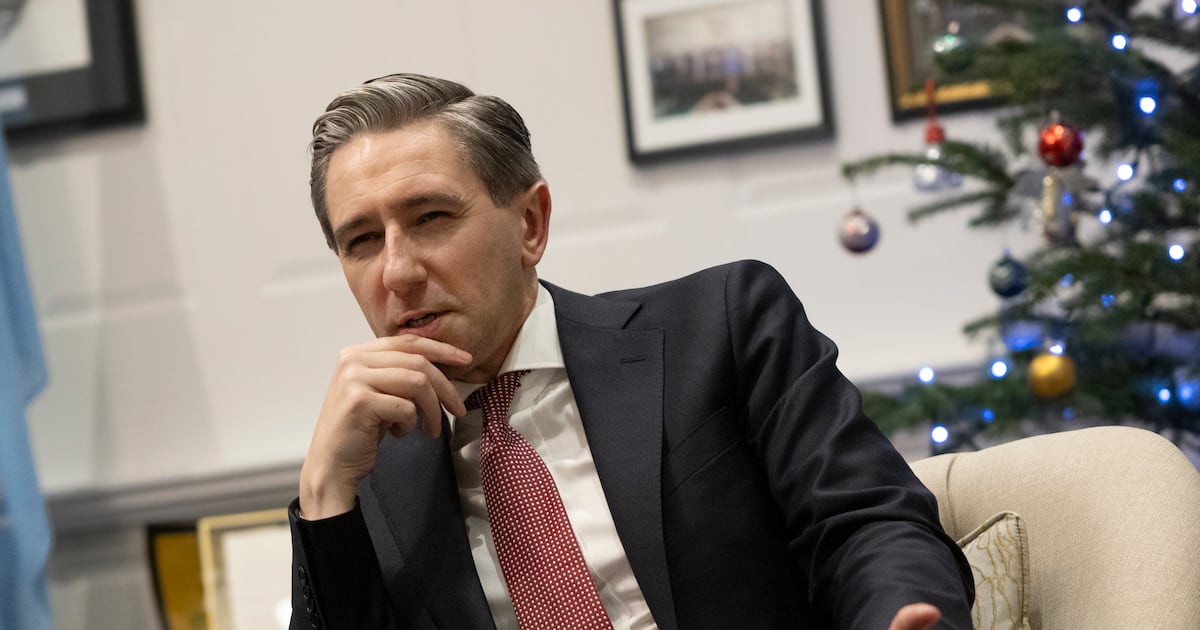
Tánaiste Simon Harris is rarely found wanting for a view to express on pressing public matters. For the humble civil servants who work to deliver his grand ideas, however, it is better – and, in fact, mandatory – to stay quiet.
In November, the Fine Gael leader’s short spell as Minister for Foreign Affairs was given the long-read treatment by Irish Times Europe Correspondent Jack Power, who asked sources in the department and in the diplomatic services how they rated their all-action boss.
Reviews were mixed: he was well-liked personally and communicated well, but seen to be overly concerned with how his messaging was landing in the press. “On trade he’d get a better mark than on the pure foreign policy side of things,” a “seasoned” official told our correspondent.
It wasn’t long after that message landed in the press that a letter was circulated to heads of mission and senior managers at the Department of Foreign Affairs from Paul Gleeson, the department’s director of communications, reading them a polite version of the riot act. He said it was “important to restate” that “officials at home or abroad should not agree to interviews with Irish media organisations or provide quotes or views to correspondents for Irish newspapers unless these have been cleared by the comms unit at HQ (and, by us, with the secretary general)” – a reference to the department’s highest-ranking civil servant, Joe Hackett, who directed the missive to be sent.
Good relations with journalists are sensible, he continued, but officials should “in all circumstances avoid making any comments of a political nature”. “It is critically important for the department that this policy is adhered to in all instances,” Gleeson wrote.
Zip it, in other words.
The letter was released under the Freedom of Information Act after The Irish Times learned of its existence from well-placed sources.
Please don’t stop the music
The National Concert Hall on Dublin’s Earlsfort Terrace is due a makeover. The storied venue, where erudite patrons can experience works of genius such as Reeling in the Showband Years, The Hits of Andrew Lloyd Webber and More Musical Magic in coming months, revealed a plan for a long-needed revamp in 2022.
It was expected, in its new “future-proofed” form, to be open to the public again in 2029. How likely is that? No official word, but the hall is currently selling tickets for events up to November 2026, and a spokeswoman confirmed that they’ll keeping filling the schedule through the season, taking them to May 2027.
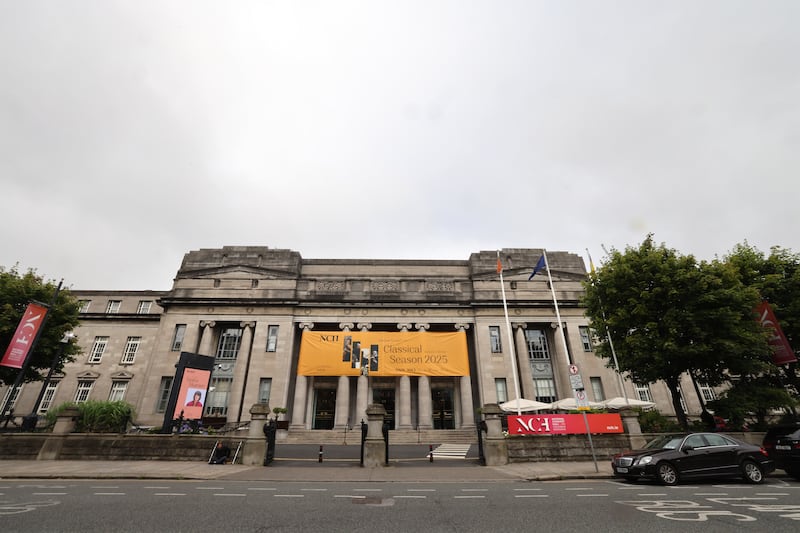 National Concert Hall at Earlsfort Terrace in Dublin. Photograph: Dara Mac Dónaill
There are rumblings in the industry that staff are beginning to look at bookings for the 2027-2028 season too, something not denied by the spokeswoman.
“Planning for the 2027-2028 season is at an early stage and will be informed by the timing of later phases of the redevelopment,” she said.
You can’t make an omelette without breaking a few eggs and you can’t do a once-in-a-generation revamp without actually stopping the music for a while. One suspects that if the tubas are still a-blowing in 2028, we could be looking at a delayed completion date.
The overall project, which is somewhat larger than a period-appropriate bike shelter but smaller than a world-class children’s hospital, will commence this month with NCH Discover Centre, a “new, purpose-built hub for music learning, participation and engagement at the heart of the NCH”. When that’s done, on to the concert hall – for sure.
Meanwhile, perhaps sniffing out a scandal akin to the art scanner the National Gallery bought without anywhere suitable to put it, Sinn Féin TD Aengus Ó Snodaigh asked the Minister for Tourism, Culture and Arts Patrick O’Donovan if the NCH had gone and bought a new organ before building works had even begun – and if so, where they were going to put it in the meantime.
Fear not, said O’Donovan: “No organ has been purchased at this stage”.
The existing organ is believed to be a few pipes short of a rank by now, to use the technical jargon we just looked up.
Seeking reassurance that the remaining pipes would continue to call in the interim, Overheard asked the NCH whether it actually works.
“The existing organ at the National Concert Hall, while in working order, requires substantial investment to maintain it at a standard suitable for regular concert performance,” the spokeswoman said. It won’t survive the refit.
Going nuclear
The release of the State Papers brought us back to the days when the plain people of Ireland were very actively engaged in campaigns about Sellafield, the large nuclear plant on the northwest coast of England, not far from the our saintly and then largely oil-, gas- and coal-powered isle.
As Ali Hewson (wife of U2’s Bono) organised a million postcards of protest, Bertie Ahern, ever responsive to popular sentiment, wrote with some alarm to Tony Blair seeking sight of British emergency plans for the Cumbrian site. No luck.
 Claire Gallery-Strong, the Co Clare woman awarded an MBE in the UK new year honours list for her services to the nuclear industry.
However, since 2003, some things have changed. Sellafield no longer generates power, focusing rather on treating nuclear waste. And overseeing some of that work until recently was an Irish person abroad. Claire Gallery-Strong was awarded an MBE in the UK new year honours list for her services to the nuclear industry, having served most recently at Nuclear Waste Services, the British state quango on a mission to become “the ‘one-stop shop’ for all radioactive waste management and disposal solutions for the UK”.
Gallery-Strong has been across the (concerningly narrow) water a long time, but she was born and raised near Miltown Malbay, Co Clare. She was educated in nearby Scropul at a rural national school that no longer exists, before advancing to the metropolis of Kilmihil (population 472) for secondary school and to Galway for university.
Overheard got in touch to ask if she misses anything from home, and she does: “The waves crashing against the beach at Spanish Point”, “the gentle pace of life in west Clare where everyone acknowledges each other as they drive past with a tilt of a finger”, and “Taytoes of course”.
Her honour recognises her “innovation and transformation” in the nuclear industry, and for rebuilding a mentoring network, and she is proud to be a role model for women in science, technology, engineering and maths (Stem), a cause she has also worked on for many years.
“Who would thought this of a farmer’s daughter growing up in west Clare from a home where my dad never got to go to secondary school?”