For nearly a decade now, the annual culture calendar has opened with the Mumbai Gallery Weekend. The event has evolved with time, increasing in scope and depth. It’s been an interesting journey, mirroring that of contemporary Indian art in the past 10-12 years, with art spaces opening up, existing practices maturing and newer voices being added. Now in its fourteenth year, the Mumbai Gallery Weekend is seeing a synergy between 39 art spaces in the city, with 33 of those presenting new shows and six ushering in the new year with ongoing exhibitions. Some of these presentations will continue beyond the duration of the event.
New year, new audiences
Opening on 8 January, the MGW has changed a couple of things, starting with its very structure. For one, it has expanded the ambit of art beyond Fort and Colaba. For Ayesha Parikh of Art & Charlie, and co-lead, Mumbai Gallery Association, this has been a much-needed change, given that most of the city’s population resides outside of these strongholds. “Keeping the art within South Bombay is not realistic for the growth of the art ecosystem in the city. A small change, for instance, has been to move our opening party to Lower Parel from Colaba. Next year, we hope to push the envelope further,” she says.
The team at the helm of affairs—Parikh and Sanjana Shah of Tao Gallery—too hail from non-Colaba galleries. This is a gesture to symbolise expanded access to art for audiences often left out of the conversation because of their location. This year too, the galleries will remain open on Sundays as well—the only time in the year when that happens. “As part of our structural change, we have decided to open all the art spaces on Thursday at noon itself. This allows for our walkthrough partners at Art & Wonderment, run by Alisha Sadikot and Nishita Zachariah, to conduct comprehensive tours across four days. The idea is to allow audiences to engage with all geographical clusters at leisure,” says Shah.
Also Read | How artist Zainab Tambawalla became a visual chronicler of Mumbai’s working life
The MGW 2026 will see a greater presence of international curators at the event to situate contemporary art from India within a global context. Some of them will also be part of the talks programme. The lineup of speakers includes Beatriz Cifuentes Feliciano, a London-based curator, who specialises in the Global South, Devika Singh, art historian and critic at the Courtauld Institute, and writer-broadcaster Ekow Eshun. As a theme, anti-caste art will be in focus especially at the collector-led socials. This includes performances by Yogesh Barve and Yalgaar Sanskrutik Manch, collective of artists and activists inspired by Dr. B.R. Ambedkar’s vision.
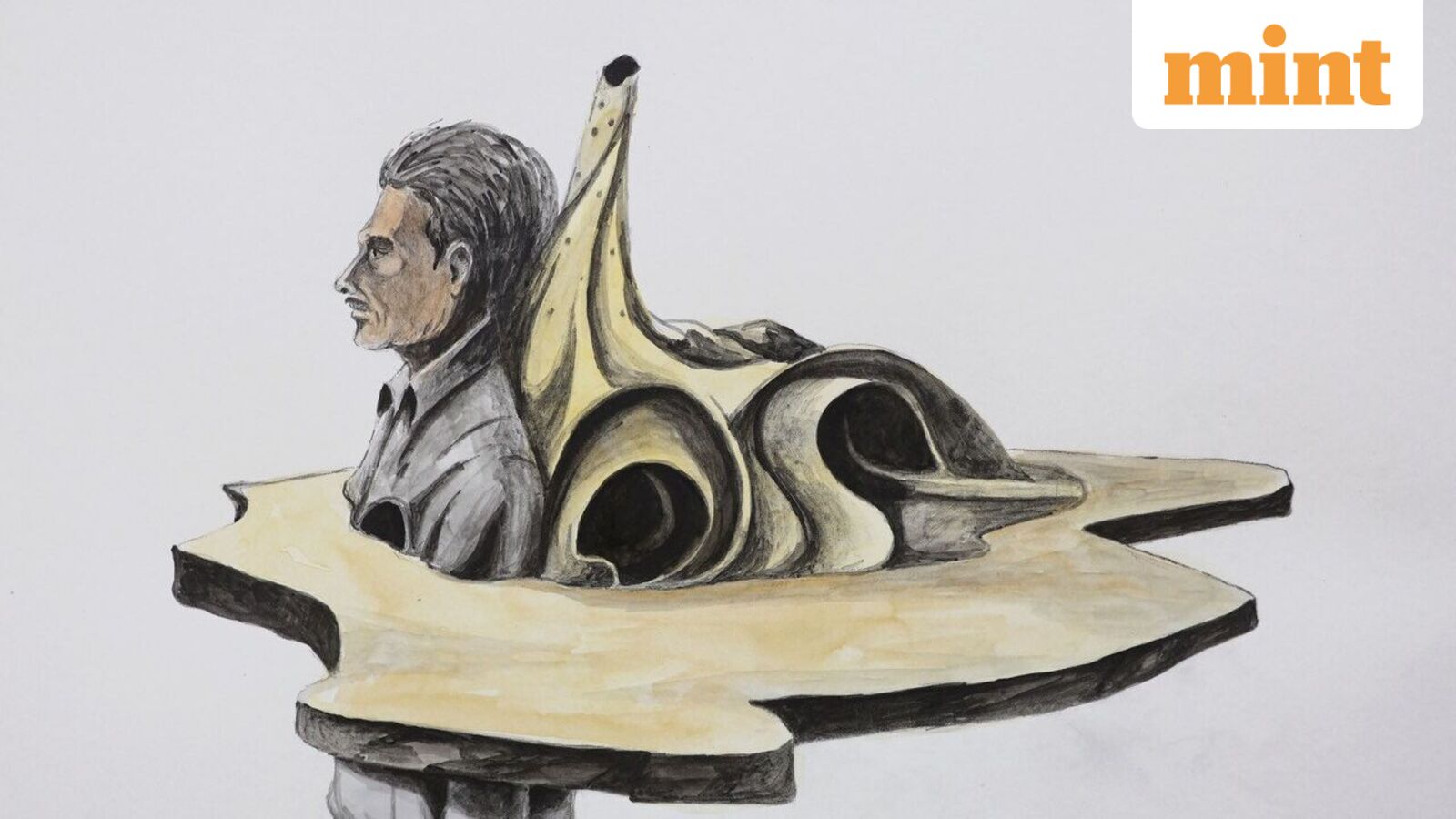
The galleries are presenting a mix of important solos and group shows to highlight the breadth of practices and visual vocabularies. The city of Mumbai is in firm focus in shows like Face to Face: A Portrait of a City at DAG, featuring 30 portraits that highlight the changing social and artistic landscape from the 19th to the 20th century. Through portraits of individuals and communities, the exhibition excavates layers of identity, power and migration through different portraiture styles. A highlight is V. B. Pathare’s portrait of Dr B. R. Ambedkar. “Anchoring Ambedkar within the city’s intellectual and political milieu, the portrait reflects his deep ties to Bombay through his studies at Elphinstone College,” states the curatorial note.
Chippa Sudhakar, ‘Changing Terrains’ (2025). Courtesy: Tao Art GalleryExisting practices in a fresh light
There are several solo shows that are presenting new chapters in the practices of artists such as Prabhakar Pachpute, Pratap Morey, Chippa Sudhakar, Lubna Chowdhary and Kamrooz Aram. Pune-based Pachpute, for instance, is showing a new body of sculptures and paintings as part of the show, Lone Runner’s Laboratory, at Experimenter Colaba. The artist has constantly examined the changes to landscapes brought about by mining. His work becomes even more pertinent right now with growing discourse around the irreversible alterations to ecologies caused by such human interventions. In this set of works, he is not just looking at the impact not just to the landscape but those residing in and around it. Lone Runner’s Laboratory is a result of a moment of pause and introspection as the artist assimilates observations and insights gleaned from years spent interacting with farmers and labour at their homes, rallies and demonstrations.
Especially interesting is the Length of a Dream series in bronze, which lies at the intersection of personal and public memory, conscious and the subconscious. The exhibition poses a set of significant questions. “What does it mean to inhabit dark nests while still searching for a ray of hope? How does one retain instincts of warmth and care, even when they may not serve one’s own interests? What forms of resistance can be embraced as personal virtues; and what kinds of shields must be forged to allow our lands to bloom?” states the gallery note.
Also Read | Trends that energised the art landscape in 2025
Viewers in Mumbai will get to view a new body of work by UK-based Lubna Chowdhary in Double Consciousness at Jhaveri Contemporary. In his essay, accompanying the show writer-curator Craig Burnett has mentioned how this set of works holds a sense of doubleness—emphasising legibility and sensuality—in a delicate balance. “If the forms of her Markers, Polytypes or Verso Recto works recall a journey to a modernist utopia or the pages of a sacred text, the layered glazes and bold forms entrance the senses. But if an artwork is doing its job well, there is a constant interflow between the two.”
Then there is Brobdingnag Paradox, Pratap Morey’s third solo at Tarq. The show continues his examination of contemporary city life albeit in a new lens. Take the Deceptive Allure collage, in which architectural forms are scattered like cosmic bodies across the vast expanse of the universe. The viewer sees a mix of familiar and unfamiliar elements in his abstract compositions, which play with perception and ‘spatial compression’. Morey experiments with scale—he compresses skyscrapers to the size of tiny insects, while small elements are magnified and exaggerated—to cast a new lens on the city. “Navigating through these vast structures often makes the artist feel tiny or less human, so there’s a peculiar satisfaction in rendering these massive forms into miniature ones… Morey is drawn to these illusions embedded in urban development,” states the curatorial note.
Certain shows are bringing forth lesser known aspects of artistic practices. For instance, Akara Modern is presenting Piraji Sagara: Enduring Forms to highlight the hitherto overlooked part of the visual vocabulary of this modernist and educator, who passed away in 2014. While he was known for his wood collages in his lifetime, this show focuses on his sculptural works, especially those from the 1980s and 1990s, which have not been exhibited widely.
In the past few years, there has been a significant examination of Jyoti Bhatt’s photographic practice. Subcontinent in Fort takes this a notch further with A Painter with a Camera, featuring black-and-white silver gelatin prints that reveal the artist’s experiments with multiple exposures, collage, hand painting and darkroom interventions. “Long before digital manipulation, Bhatt treated the photograph as a surface to be worked and revisited, emphasising process, material intelligence, and an ongoing inquiry into time and making,” states the curatorial note.
Discards as both material and message
Can one find unexpected beauty in discards? It is this question that Necropolis of Remains chooses to investigate. This group show at Priyasri Art Gallery features the work of young artists such as Aasha Keshwala, Raka Panda and Suraj Kamble, who respond to Saumya Roy’s book, Mountain Tales, about a sprawling necropolis of remains at Deonar. Through a myriad of mediums, the artists respond to the central themes of overconsumption, climate change and vulnerabilities, to create a space of both confrontation and discovery.
Meanwhile at 47-A, Ritu and Surya Singh of WOLF too are redefining the idea of beauty in Gul. They have recycled post-industrial metal scrap and found objects to create a spray of cascading blooms in Garden Inverse and exquisite floral arrangements in Flowerspeak. Inspired by the charbagh style of gardens and the poetry of Mir Taqi Mir, Gul is structured in four symbolic sections, reflecting the inner worlds of a human being.
Also Read | 25 books that brought back the joy of reading in 2025WOLF, ‘Flowerspeak’. Courtesy: 47-A
Once again, the ephemeral and the discarded come together in Biography, a solo presentation of 70 new sculptural works by Prashant Pandey at Gallery Maskara. Fragile organic and cellular forms have been crafted from urban waste and discarded cigarette buds. Through this material, Pandey looks at the traces of human consumption left behind in the urban environment.
The field of sight
Mithu Sen surprises, confronts and questions narratives around ‘seeing’ in What Do Birds Dream at Dusk at Chemould Prescott Road. In a world where narratives are shaped and controlled by the media, political forces and moral gatekeepers, the artist asks who judges what is visible and what must remain unseen. Through her powerful works, Sen “explores blindness not as a medical state but as a political condition, shaped by selective seeing, curated truths and collective denial”. In her note, the artist writes about integrating Braille alongside her imaginary scripts and visual interruptions as a counter language. “What Do Birds Dream at Dusk invites viewers to unlearn the visible and confront the worlds that remain unseen,” she writes.
A landmark show
Sakshi Gallery is celebrating four decades of existence with The Fourth Wall, a show that revisits big and small moments from its journey. Set up by Geetha Mehra in Chennai in 1986, the gallery was envisioned as a space to build artistic connections from across the country. It shifted to Sri Ram Mills in Mumbai in 1997, becoming the largest private gallery in India at the time. At the industrial space, Sakshi Gallery hosted significant exhibitions by artists such as Nalini Malani and Vivan Sundaram. This exhibition presents highlights from the past 40 years, including works by Krishen Khanna, K.G. Subramanyan, Rekha Rodwittiya, Sudhir Patwardhan, and more, alongside archival material. This will be placed within the context of shifting artistic practices and a long arc of collaborations.