In this series of posts, we sit down with a few of the keynote speakers of the 247th AAS meeting to learn more about them and their research. You can see a full schedule of their talks here, and read our other interviews here!
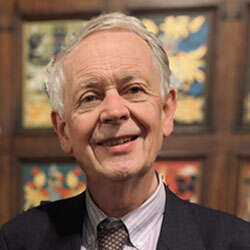 Dr. James Binney
If you’ve taken a course in galaxy formation and evolution, you’ve probably read one of James Binney’s textbooks. Dr. Binney works on equilibrium models of our Milky Way – how the gas and stars are distributed and their motion. He was awarded the Royal Astronomical Society’s Gold Medal for Astronomy in 2025 for his work on the structure and evolution of galaxies.
Dr. Binney has worked on a variety of problems in galactic dynamics across his career. He started out working on models of elliptical galaxies before moving on to the cooling flow problem in the centers of galaxy clusters, and ending up in the field of orbital mechanics of galaxies. His work now focuses on developing models of individual galaxies and their structures. The Gaia mission took more than three trillion observations of objects, producing the best three-dimensional map of our Milky Way. But we still don’t know precisely how our galaxy’s equilibrium state works, or how it formed. A lot of the field focuses on interesting features, like the Gaia phase spiral, but Binney focuses on the bigger picture. These features come from disequilibria from an underlying system we don’t yet understand–”these are ripples on a pond, and the first thing is to understand the structure of the pond”.
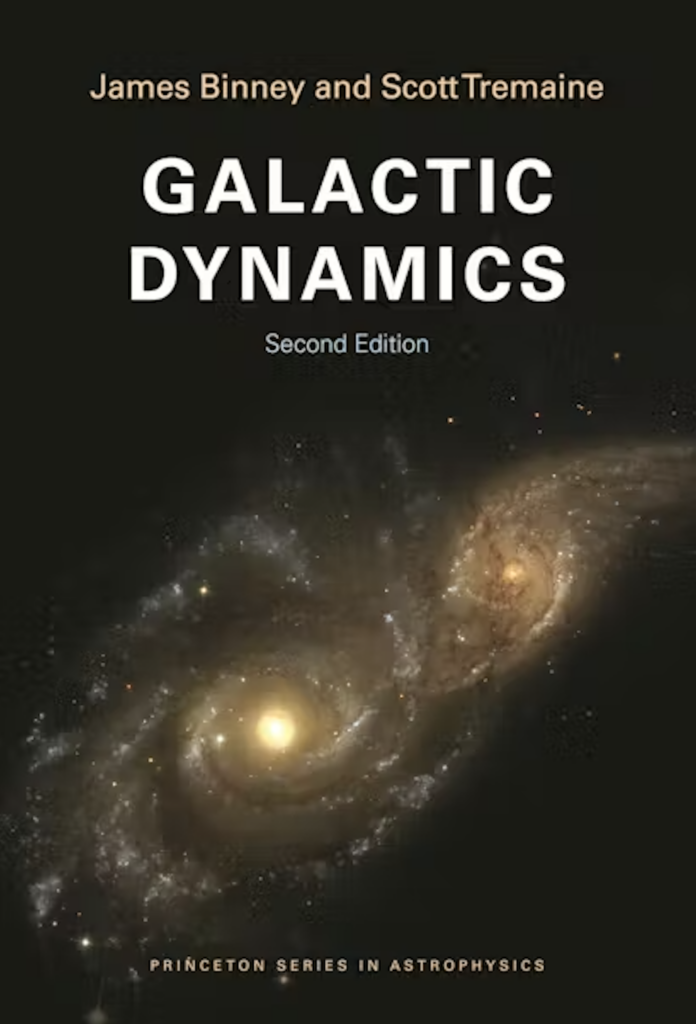 There were gasps of recognition in my office; most of us had read this textbook.
The orbital structure of galaxies is a field with a long history. Early treatments by Ivan King produced a distribution function of the energy in the galaxy, from which he solved for the gravitational potential and evolution. Schwarzschild’s later orbital superposition model assumed a gravitational potential from which he created orbits. Binney’s method creates distribution functions of the stars and matter in the galaxy, and solves for the gravitational potential based on known observables. This method keeps out assumptions about the gravitational potential, and therefore assumptions about the distribution of dark matter. He labels the different orbits of their stars by their action, which is a quantity that relates their potential and kinetic energies.
However, our models of galaxies have a ways to go. Understanding the chemical distribution and history of the galaxy is essential to understanding its structure. There’s also the question of the high-alpha disk, a region where the ratio of iron to hydrogen is very high. In our galaxy, this distribution drops off very steeply, with no explanation, at orbits past our Sun.
His career advice follows his own philosophy towards science: write textbooks and work on what appeals to you. “But teaching is the best way of learning, right? And writing textbooks is a form of teaching…And I think almost everything I know about physics, I’ve pretty much picked up by writing something or other.” Even if it’s not glamorous, writing projects like textbooks are a great way to learn and to give back to the community. Dr. Binney also suggests picking topics that appeal to you, and work on those, even if they’re not trendy in the field. Some people like to chase big new projects, and that’s compelling work for them, but you can also do your own science and make meaningful contributions without being in the thick of competition.
To hear more about equilibrium models of the Milky Way, tune into Dr. Binney’s Plenary Lecture at 11:40 AM MT on Monday, January 5th, 2026, at #AAS247!
Edited by: Sowkhya Shanbhog
Featured Image Credit: AAS
-

Lindsey Gordon is a fifth year Ph.D. candidate at the University of Minnesota. She works on AGN jets, radio relics, MHD simulations, and high performance computing optimization.