In this series of posts, we sit down with a few of the keynote speakers of the 247th AAS meeting to learn more about them and their research. You can see a full schedule of their talks here, and read our other interviews here!
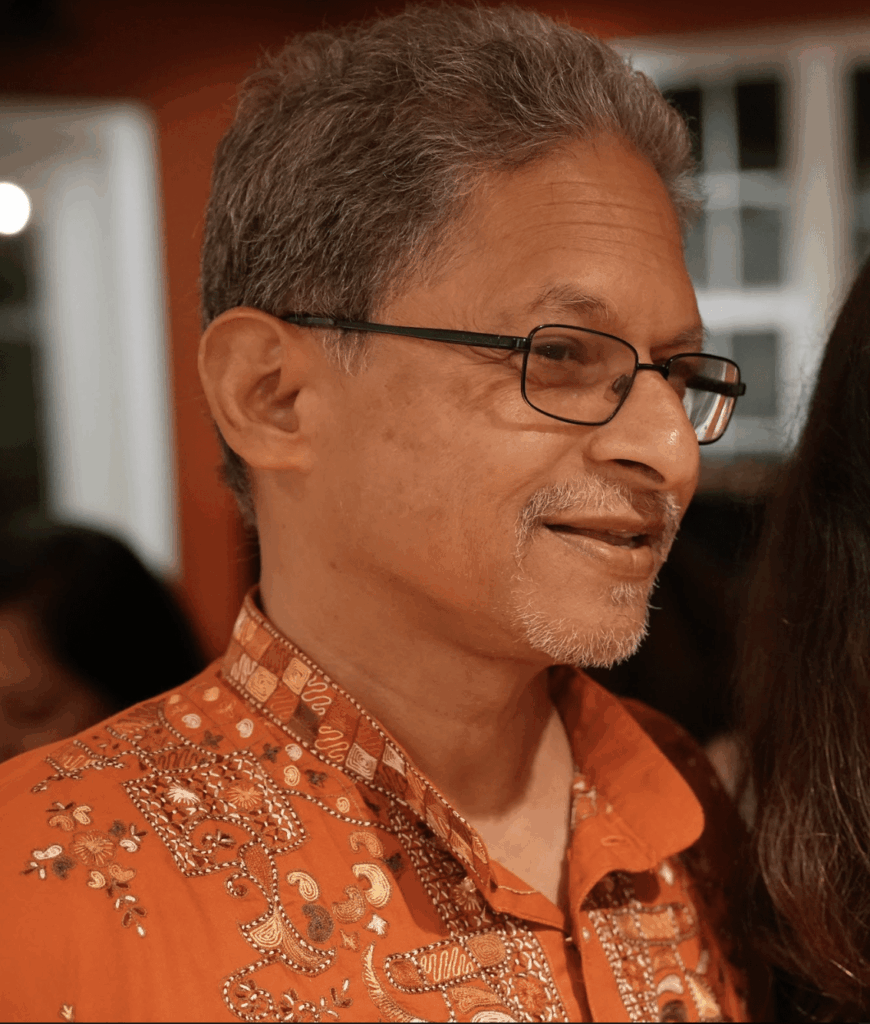 Prof Raja GuhaThakurta
Photo Credit: Vasudev Bhandarkar
Prof Raja GuhaThakurta is a Distinguished Professor of Astronomy and Astrophysics at the University of California, Santa Cruz, and UC Observatories, where he studies the formation and evolution of galaxies. Beyond his research, he is deeply committed to education and equity in science, having founded the Science Internship Program (SIP) for high school students and later the CrEST (Creating Equity in STEAM) initiatives, which include programs that provide real research experiences and computational training to young learners and educators.
For many years, art, not astronomy, was his primary interest. Growing up in India, he aspired to pursue a career in graphic arts and advertising design, envisioning a future built around creativity. Art was everywhere in his family; his mother, sister, and grandmother were artists, and he was naturally drawn to them. Although he loved art deeply, he had no formal training, something he longed for. Still, Prof GuhaThakurta excelled in science in school, and his interests shifted according to his teachers. At different times, he wanted to become a doctor, a research chemist, or a research physicist.
Near the end of high school, he seriously considered applying to the Government College of Art in Kolkata. But it was his grandmother who changed his mind. “If you choose science as a career, you can always keep art as a hobby,” she told him. “But you can’t really do science as a hobby if you choose art professionally.” He followed her advice and went on to study physics, chemistry, and mathematics in college.
Growing up in Kolkata meant living with heavy air pollution and bright city lights, leaving little chance to see the night sky. “I grew up not knowing the night sky at all,” he says. Instead, his earliest experiences with astronomy came from school trips to the planetarium. Located near his elementary school, the planetarium felt like a world of fantasy, a projected sky that bore no resemblance to the one above his home.
That sense of fantasy disappeared years later during a trek in the Himalayas. One night, Prof GuhaThakurta looked up and saw the Milky Way shining clearly across the sky. “It was like a fluorescent lamp stretched across the sky,” he recalls. The planetarium had not been showing a fantasy after all; it had been showing reality. “That was when I realized how much of the real night sky I had missed growing up,” he says.
When Prof GuhaThakurta talks about his research, he describes it as the study of several different histories unfolding at once. The one he feels most closely tied to is dynamical history: understanding why stars move the way they do in galaxies. He is not focused on the motion of a single star, but on the overall patterns seen across large populations of stars. Closely linked to this is structural history. The shape of a galaxy, whether its disk is thin or thick, for example, is strongly tied to how stars move within it. High random motions lead to thicker disks, while more orderly motions produce thinner ones. These histories are further intertwined with chemical enrichment, star formation, and gas dynamics. Together, they describe how galaxies evolve.
Alongside this long-standing focus on galaxy history, a second research interest has been growing: rare phases of stellar evolution. To study galaxy structure, he uses stars as tracers, but in doing so, he began encountering unusual kinds of stars. “In one case, I use stars to understand galaxies,” he explains. “In the other, I use galaxies to understand stars.” In the latter context, galaxies become useful laboratories: collections of stars at a common distance but with different ages and chemical compositions.
After deciding to study science in college, gaining admission to graduate school in the United States marked the next pivotal turning point in Prof GuhaThakurta’s life. It was not an easy path. He had tried more than once to move to the US for higher studies, including an unsuccessful attempt to transfer as an undergraduate. Arriving in the US, however, quickly made him realize how unprepared he felt. “I was completely lost, on more than one front,” he says. There was cultural adjustment, but the deeper challenges were academic and intellectual.
One major shock was physics itself. Prof GuhaThakurta had received strong training in physics in college and completed a year of master’s-level coursework in India, believing he had a solid foundation. That confidence did not last long. In graduate classes at Princeton, he found himself surrounded by students, including undergraduates, who could solve problems far more quickly and creatively than he could. “That really shook me.”
The second gap was computing. Many of his classmates already knew how to code. Prof GuhaThakurta, by contrast, had never used a computer before arriving in graduate school. Personal computers were rare in India at that time, and terms like “username” and “password” were completely unfamiliar. “I had never heard those words before,” he says. It was not only confusing but also overwhelming.
The deepest challenge, though, was learning how research actually works. In his earlier education, problems always came with a known path to an answer. Research was nothing like that. It lived in what he calls the “gray area”, between what is known and what is not. He had never read a research paper before graduate school, while some of his peers had already written research papers.
At that point, Prof GuhaThakurta admits that quitting might have seemed logical. “I should have left and gone home,” he says. But he didn’t. He had invested too much, not just time, but also his belief in himself and the faith others had placed in him. “I didn’t have it in me to quit.” Instead, he adopted a simple survival strategy. Every night, he made a mental list of everything he had learned that day. “It was always a long list,” he says. That became enough. If he was more knowledgeable than the day before, he could get through the next day, one day at a time.
When asked whether his experience as a graduate student was the driving force behind starting CrEST, Prof GuhaThakurta was quick to say no. “I wish it were that intentional,” he said. “I wish it were that deliberate.” He traces it back to his start as an educator at the age of 15 in Kolkata, when a chemistry teacher suggested that he tutor younger students. Soon after finishing high school, his school invited him back to teach for a couple of one-month stints while a couple of science/math teachers were on medical leave. That brief experience, standing on the other side of the classroom, left a lasting impression. “When you teach something,” he reflected, “you understand it better.”
The turning point that eventually led to CrEST came much later, with a single email from a high school teacher asking whether two of her students could assist a university astronomer with real research. That small experiment evolved into the Science Internship Program (SIP), which has since expanded to nearly 300 students per year from around the world.
But CrEST itself was born in a moment of crisis. Following the murder of George Floyd in May 2020, Prof GuhaThakurta felt a sense of misalignment between his work and the world around him. “I was trained to study the universe,” he said, “but I could see a fire burning in society around me. It didn’t feel right just to keep doing what I was doing.” CrEST officially launched on June 25, 2020, exactly one month later. For him, CrEST was a means of responding using the tools he knew best: education, research, and evidence-based thinking. One motivation was what he describes as a growing “pandemic” of misinformation and disinformation. “We don’t have a vaccine for that,” he said. “CrEST is our closest attempt to create one.”
By exposing young people to research that requires claims to be backed by evidence, he hopes to foster long-term resistance to false narratives. But he is clear that education alone is not enough. “If a child is hungry or unsafe,” he said, “critical thinking won’t fix that.” That’s why CrEST partners with organizations that address immediate needs, while focusing on long-term change through education.
Prof GuhaThakurta often explains the importance of access using cricket (see his May 2024 TEDx talk). He points to India’s 1983 World Cup win as a moment when the sport began to open beyond elite circles. Until then, Indian cricket largely favored English-speaking players with access to top clubs. The captain, Kapil Dev, did not speak polished English – something many saw as a bit embarrassing at the time. “It meant Indian cricket had finally started to open its doors to talent from a broader swath of Indian society.” That shift changed Indian cricket forever. Prof GuhaThakurta observes the same pattern in science and academia: institutions that still fail to reflect the diversity of the societies they serve. “Diversity isn’t something you do only because it’s the right thing to do,” he emphasized. “It’s how you achieve excellence.”
When asked what advice he would give to undergraduate and graduate students today, Prof GuhaThakurta said, “Completely follow your heart.” He explained that passion does not always come instantly. Sometimes, students do not yet know enough about a field to feel excited by it, and that is okay. What matters is giving yourself the chance to discover that passion. “If your heart is in it, it’s easier to work through failure,” he explained. Even failure, he noted, can be valuable, because discovering something for yourself is better than never trying at all.
Prof GuhaThakurta emphasized that passion can also change over time. Early in his career, astronomy appealed because of the big questions and powerful telescopes. “Those are incredible toys,” he said, noting how privileged astrophysicists are to use them. But over the decades, what mattered most began to shift. “What’s more important to me now are the people,” he reflected. The mentors, collaborators, students, and even brief chance encounters have become more meaningful.
Not everyone will support your choices, he added. Some people will say no. “Look for the people who say yes,” Prof GuhaThakurta advised, “and learn how to navigate around the people who say no.”
To hear more about CrEST, tune into Prof GuhaThakurta’s Plenary Lecture on Tuesday, January 6, 2026, at 3:40 PM MT at #AAS247!
Astrobite edited by Amaya Sinha
Featured image credit: AAS
-

I am currently a first-year PhD student at Scuola Normale Superiore in Pisa, Italy, where I am focusing on studying high redshift quasars. Prior to this, I completed a dual BS-MS degree at the Indian Institute of Science Education and Research in Pune, India. Now, I am eager to expand my involvement in science communication and outreach initiatives. I have recently developed an interest in cooking, particularly since moving to a new city. I find solace in listening to music during my leisure time.