In this series of posts, we sit down with a few of the keynote speakers of the 247th AAS meeting to learn more about them and their research. You can see a full schedule of their talks here, and read our other interviews here!
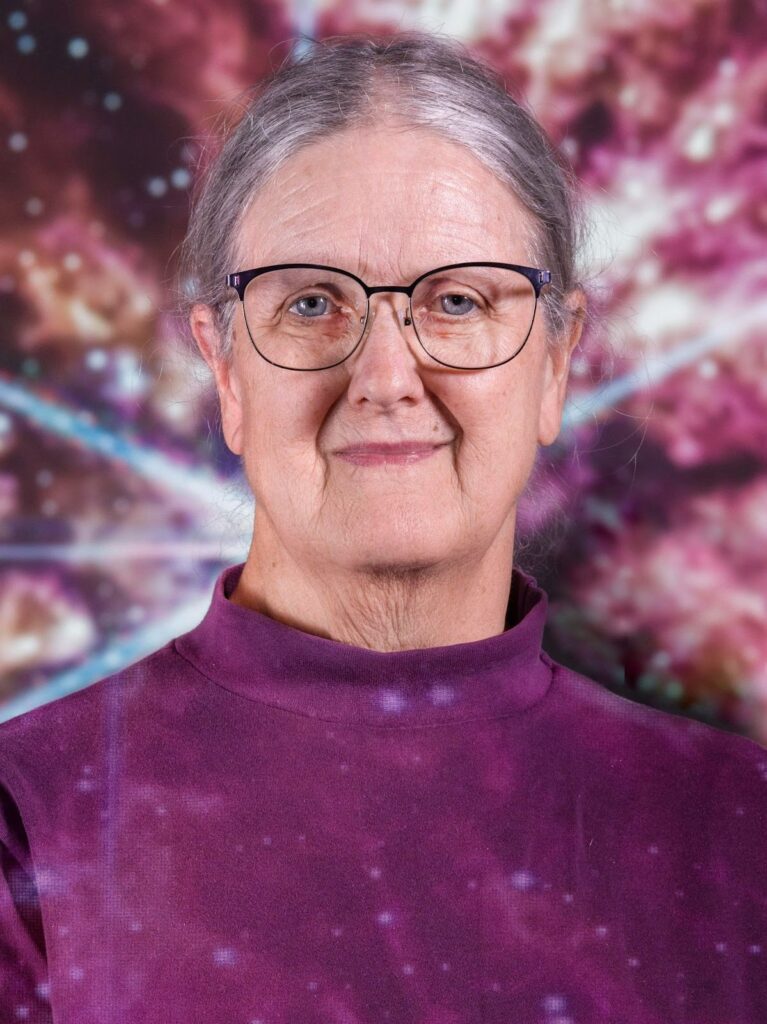 Prof Marcia Rieke.
Photo Credit: Chris Gunn
Marcia J. Rieke is a Regents Professor of Astronomy at the University of Arizona and one of the leading figures in infrared astronomy today. In 2025, she was awarded the Henry Norris Russell Lectureship by the American Astronomical Society (AAS), one of the society’s highest honors recognizing a lifetime of excellence and distinction in astronomical research. Prof Rieke’s work has been central to how we explore the universe in the infrared.
As a kid, she was an avid science fiction reader, a love that pulled her toward space and the idea of other worlds. When she went to college, she planned to be an astronaut and was told that aeronautical engineering would be a good place to start. While on that path during her first year, one class changed everything: A seminar on galaxies, taught by Prof Philip Morrison. “He was just great,” she said, and “I decided, oh!, I want to study galaxies.” From there, she switched to a physics major and eventually found her way into the field of infrared astronomy. She joined the University of Arizona as a postdoctoral researcher to work with Prof George Rieke, “who I ended up marrying,” she added with a smile. In what she describes as a pretty unusual career path, she has stayed at the University of Arizona ever since: “I’ve been there my entire career. I’ve never worked anywhere else.”
One of the most unexpected moments early in her career came with a technological breakthrough rather than a specific scientific result. Researchers working for the U.S. Department of Defense had developed a method for building infrared detector arrays, whereas astronomers were using one-pixel detectors. “We suspected that,” she said, “but actually getting access to one of these arrays turned out to be transformative”. For the first time, we could take truly infrared pictures. The earliest version was modest by today’s standards, but to quote Prof Rieke, “a kilopixel’s a lot more than one!”.
Right now, two research areas excite her the most. The first is our evolving understanding of the very high-redshift galaxies. “It’s very clear that star formation at high redshift is not exactly like we thought it would be,” she explained, pointing out that even galaxies at redshifts as high as z ~ 14 already show surprisingly high levels of heavy elements like carbon, nitrogen, and oxygen. The second area is the study of exoplanets and their atmospheres. By observing worlds beyond our solar system, she hopes to place our own planetary system into a broader cosmic context. In her own words, “someday we’ll find a planet with an atmosphere like Earth’s.”
Perhaps Prof Rieke’s most defining achievement has been her leadership of the Near-Infrared Camera (NIRCam) on the James Webb Space Telescope (JWST). Appointed Principal Investigator (PI) for NIRCam in 2002, she guided the instrument’s development, delivery, and successful commissioning following JWST’s launch in 2021 (read about NIRCam in this astrobite).
One of the most surprising outcomes from JWST has been the ease with which it has been able to find galaxies at extremely high redshifts. When the mission was still being planned and the instrument designs were being debated, the goal was simply to reach galaxies at a redshift of approximately z ~ 10. “Well, we kind of broke that record pretty quickly,” she said. What has followed has been both exciting and puzzling: trying to understand why JWST is seeing so many high-redshift galaxies.
Being the PI on instruments like NIRCam was, as she put it, “challenging sometimes, fun sometimes, [and] frustrating sometimes.” As PI, the responsibility ultimately rested with her, even for things she wasn’t personally building. One brutal moment came during the construction of NIRCam, when a company making the beryllium optical bench made a simple but costly mistake. “The machinist pressed X instead of Y,” she recalled, sending a drill straight through the bench instead of trimming material off. The result was a cracked component and “a million dollars down the drain.” Experiences like that, she explained, are uniquely frustrating because the plan itself is sound; human error is simply unavoidable. That’s why the team never planned to spend every last dollar of their budget, instead setting aside a reserve for accidents and unforeseen problems, though, as she noted, “it’s never fun to have to deal with that kind of stuff.” But those difficult moments made the payoff even sweeter. When JWST finally launched, and she was at the Space Telescope Science Institute (STScI), as the first light reached the NIRCam detectors, the mood changed instantly. Seeing a star appear on the screen was pure joy. “You couldn’t have imagined a happier bunch of people.”
Looking back, her advice to her younger self is to “find what is most interesting to you and pursue it hard”. Academia often sees researchers “jump on a train” and work on the same kinds of problems. Still, she believes the most rewarding work comes from focusing on questions that are truly important and interesting, not just popular.
For undergraduates, her advice is clear. “Physics and more physics and even more physics,” she said. Doing well in physics courses, she explained, is absolutely crucial because astronomy is, at its core, applied physics. A strong foundation in physics gives students the tools they need to understand both the science and the instrumentation behind modern telescopes, making it one of the most important investments they can make early in their careers.
While she acknowledges that the current state of science funding and jobs in the U.S. can be “a bit depressing,” her advice is not to let that discourage you. People should pursue what they truly want to do with their lives, she emphasized, and not let politics get in the way. Things might feel tough for a few years, she said, but there’s reason for optimism: “We can hope that we will change the government and we will change the situation for science funding.” Many people recognize the importance of scientific research, she added, so it’s important not to give up prematurely.
To hear more about distant galaxies discovered by JWST, tune into Prof Rieke’s Henry Norris Russell Lecture on Tuesday, January 6, 2026, at 4:40 PM MT at #AAS247!
Astrobite edited by Amaya Sinha
Featured image credit: AAS
-

I am currently a first-year PhD student at Scuola Normale Superiore in Pisa, Italy, where I am focusing on studying high redshift quasars. Prior to this, I completed a dual BS-MS degree at the Indian Institute of Science Education and Research in Pune, India. Now, I am eager to expand my involvement in science communication and outreach initiatives. I have recently developed an interest in cooking, particularly since moving to a new city. I find solace in listening to music during my leisure time.