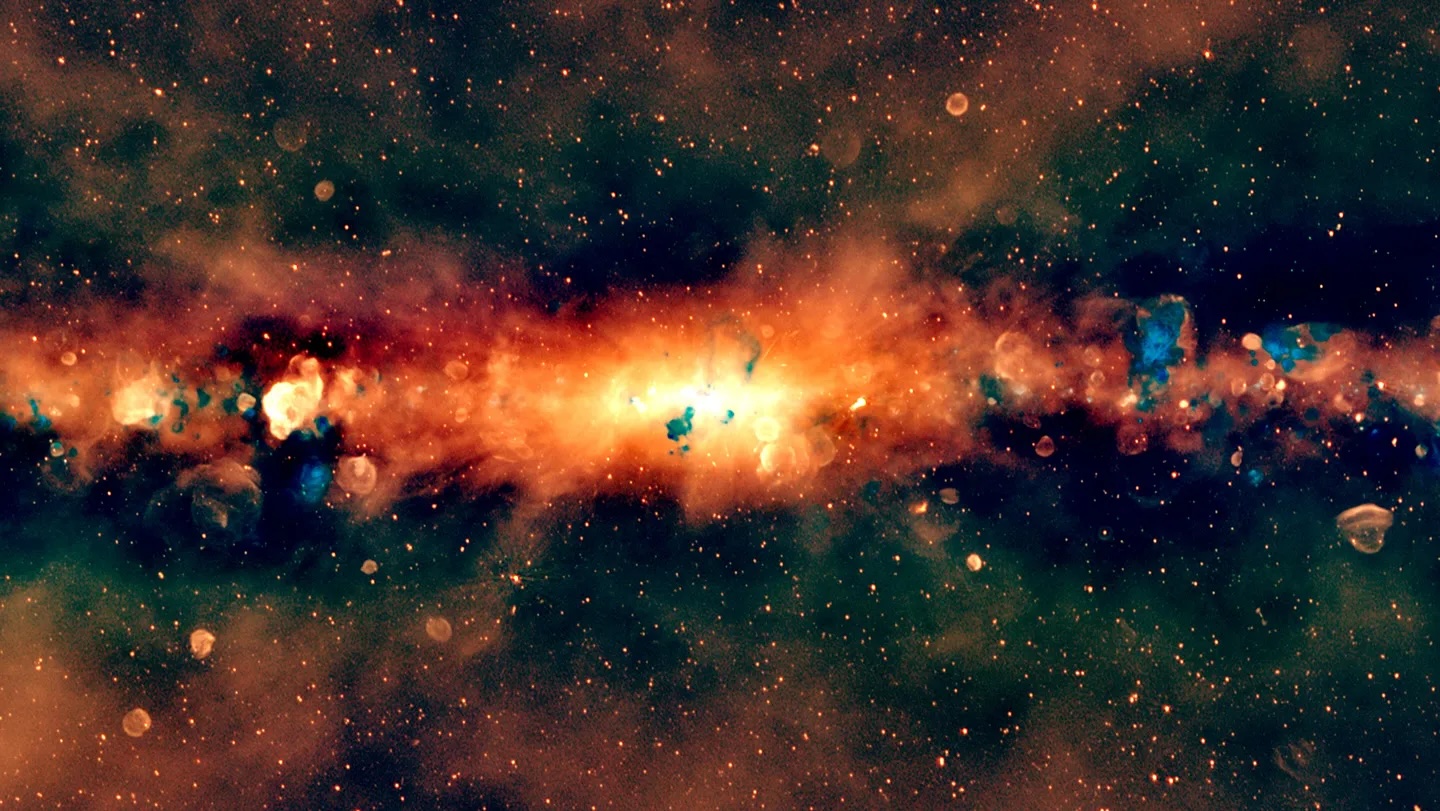
array: A broad and organized group of objects. Sometimes they are instruments placed in a systematic fashion to collect information in a coordinated way. Other times, an array can refer to things that are laid out or displayed in a way that can make a broad range of related things, such as colors, visible at once. The term can even apply to a range of options or choices.
astronomer: A scientist who works in the field of research that deals with celestial objects, space and the physical universe.
galaxy: A group of stars — and usually invisible, mysterious dark matter — all held together by gravity. Giant galaxies, such as the Milky Way, often have more than 100 billion stars. The dimmest galaxies may have just a few thousand. Some galaxies also have gas and dust from which they make new stars.
life cycle: The succession of stages that occur as an organism grows, develops, reproduces — and then eventually ages and dies. Or the sum of all processes involved in creating a product, starting with the extraction of raw materials and ending with the disposal of the product when it’s no longer useful. Indeed, engineers describe this as the cradle-to-grave life of a product.
light-year: The distance light travels in one year, about 9.46 trillion kilometers (almost 6 trillion miles). To get some idea of this length, imagine a rope long enough to wrap around the Earth. It would be a little over 40,000 kilometers (24,900 miles) long. Lay it out straight. Now lay another 236 million more that are the same length, end-to-end, right after the first. The total distance they now span would equal one light-year.
mechanism: The steps or process by which something happens or “works.” It may be the spring that pops something from one hole into another. It could be the squeezing of the heart muscle that pumps blood throughout the body. It could be the friction (with the road and air) that slows down the speed of a coasting car. Researchers often look for the mechanism behind actions and reactions to understand how something functions.
Milky Way: The galaxy in which Earth’s solar system resides.
radiation: (in physics) One of the three major ways that energy is transferred. (The other two are conduction and convection.) In radiation, electromagnetic waves carry energy from one place to another. Unlike conduction and convection, which need material to help transfer the energy, radiation can transfer energy across empty space.
radio waves: Waves in a part of the electromagnetic spectrum. They are a type that people now use for long-distance communication. Longer than the waves of visible light, radio waves are used to transmit radio and television signals. They also are used in radar.
range: The full extent or distribution of something. For instance, a plant or animal’s range is the area over which it naturally exists. (in math or for measurements) The extent to which values can vary (such as the highest to lowest temperatures). Also, the distance within which something can be reached or perceived.
remnant: Something that is leftover — from another piece of something, from another time or even some features from an earlier species.
star: The basic building block from which galaxies are made. Stars develop when gravity compacts clouds of gas. When they become hot enough, stars will emit light and other forms of electromagnetic radiation. The sun is our closest star.
stellar: An adjective that means of or relating to stars.
supernova: (plural: supernovae or supernovas) A star that suddenly increases greatly in brightness because of a catastrophic explosion that ejects most (or sometimes all) of its mass.
supernova remnant: The clouds of gas and debris surrounding a star that exploded long ago. The strong magnetic fields inside these remnants accelerate protons to very high speed, creating cosmic rays.
survey: To view, examine, measure or evaluate something, often land or broad aspects of a landscape.
telescope: Usually a light-collecting instrument that makes distant objects appear nearer through the use of lenses or a combination of curved mirrors and lenses. Some, however, collect radio emissions (energy from a different portion of the electromagnetic spectrum) through a network of antennas.
wave: A disturbance or variation that travels through space and matter in a regular, oscillating fashion.
wavelength: The distance between one peak and the next in a series of waves, or the distance between one trough and the next. It’s also one of the “yardsticks” used to measure radiation. Visible light — which, like all electromagnetic radiation, travels in waves — includes wavelengths between about 380 nanometers (violet) and about 740 nanometers (red). Radiation with wavelengths shorter than visible light includes gamma rays, X-rays and ultraviolet light. Longer-wavelength radiation includes infrared light, microwaves and radio waves.