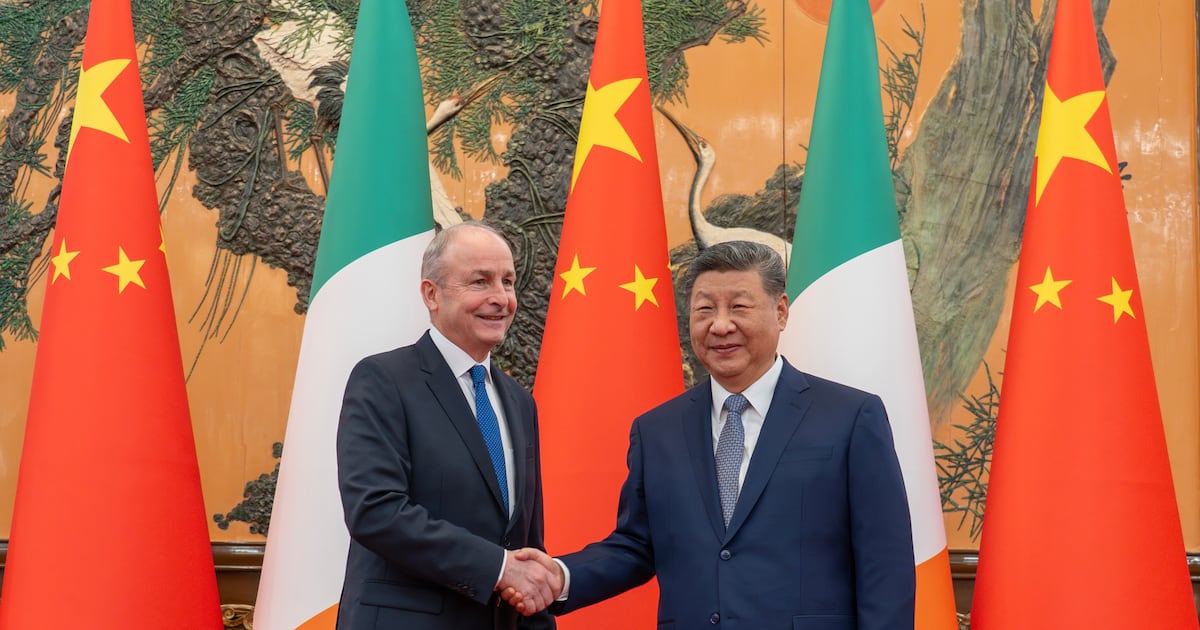
Taoiseach Micheál Martin has declined to criticise the United States for its abduction of Venezuelan president Nicolás Maduro but said he would have preferred a peaceful transition to democracy in the country.
Speaking in Beijing after meeting Chinese president Xi Jinping, Mr Martin said that, in common with other European Union member-states, the Government had not accepted the legitimacy of Mr Maduro’s claim to the presidency.
“He did a lot of damage and was quite tyrannical in his approach and repressive as a leader,” he said.
“That said, we do believe that the future of Venezuela is one that must be decided by the people of Venezuela, and everybody should work to create the right conditions to enable free and fair elections to take place in Venezuela, and that the right conditions would be created because in the last election, we saw what happened when essentially that result was stolen in a repressive manner. We have to ensure that the people get to decide their future in Venezuela and that there’s strong adherence to international rules-based order.”
The Taoiseach and Mr Xi met in the Great Hall of the People on Tiananmen Square, sitting across a broad, long table from one another with each leader flanked by their officials. The Chinese president noted that Mr Martin was the first European leader to visit China in 2026, suggesting that this reflected the value they both attached to the bilateral relationship.
“Both China and Ireland are peace-loving, open-minded, inclusive, self-reliant, and enterprising. The people of both countries won national independence and liberation through struggle, and have relied on generations of continuous efforts to move towards modernisation,” he said.
“China is willing to strengthen strategic communication with Ireland, deepen political mutual trust, expand pragmatic co-operation, seek benefits for the people of both countries, and add impetus to China-EU relations.”
The Taoiseach recalled Mr Xi’s visit to Ireland as China’s vice-president in 2012, which he said laid the foundation for today’s bilateral relationship. He praised China’s role in the United Nations, particularly in peacekeeping and stressed Ireland’s commitment to an open trading system.
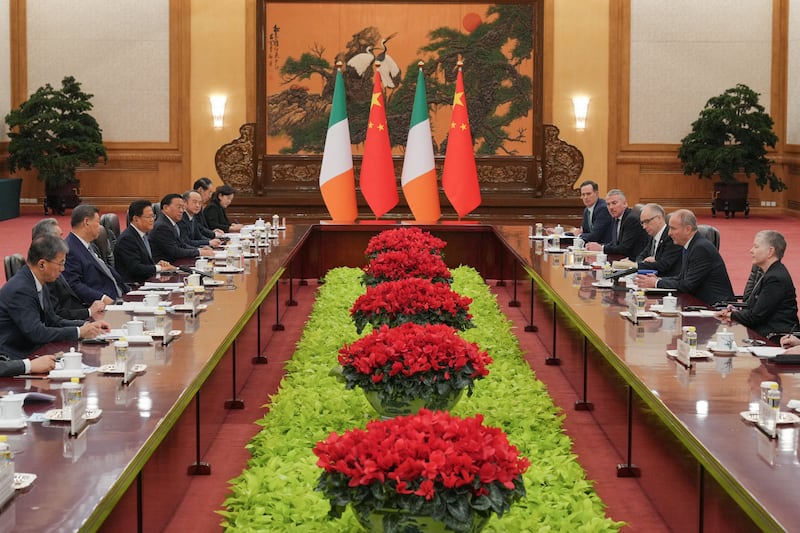 Taoiseach Micheál Martin speaks to China’s president Xi Jinping during a bilateral meeting at the Great Hall of the People in Beijing. Photograph: Andy Wong/AFP via Getty Images
“In the modern world, engagement is still key irrespective of the particular policy decisions or initiatives that are taken from time to time by individual countries. So in other words, Ireland has always been international since our independence,” Mr Martin told reporters later.
“In our discussions this morning, president Xi was very clear on the importance of the UN and the need to reform the UN, the need for the UN to reclaim authority on the global stage. And that’s something that Ireland ascribes to very, very strongly.”
The Taoiseach went from Tiananmen Square to the Forbidden City, home to China’s emperors for 500 years until the fall of the Qing Dynasty in 1911. The museum complex is closed on Mondays so Mr Martin and his delegation had it to themselves as they were led through it on a private tour.
“It is a fascinating place encompassing an extraordinary period of your nation’s history. I pay tribute to the great work and success in conserving and preserving such historically important buildings and artefacts. It has been a most stimulating and fascinating visit which will inspire further study,” Mr Martin wrote in the visitors’ book afterwards.