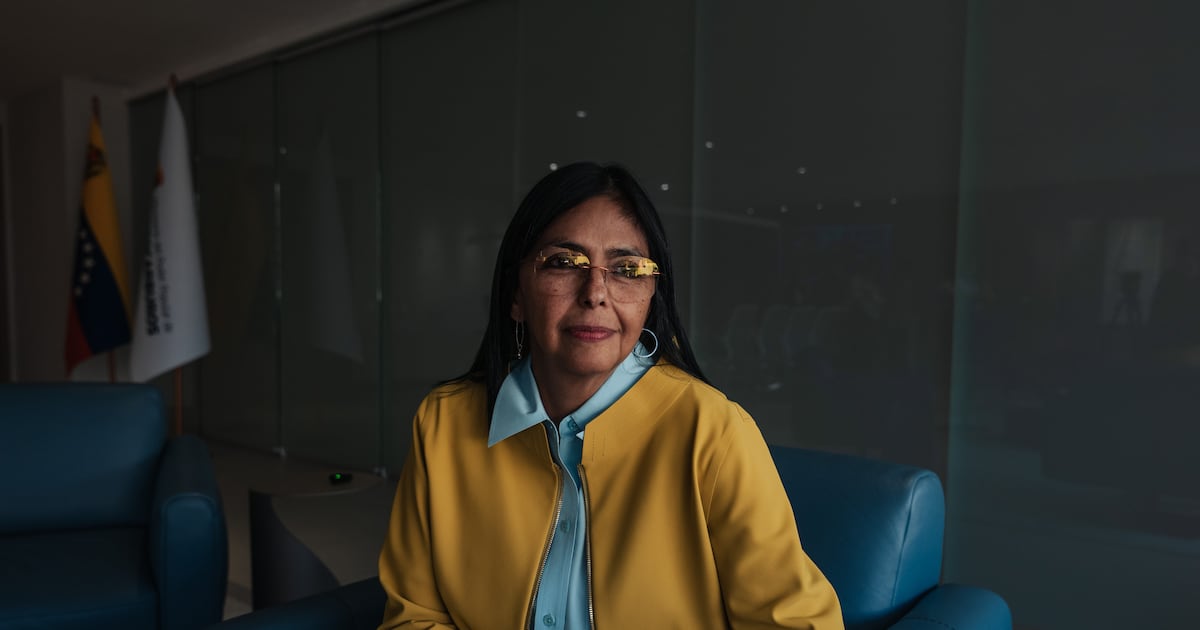
As a vice-president dramatically catapulted into power, Delcy Rodríguez has made a steady start to ensuring Venezuela’s Chavista regime survives the US’s seizure of her boss last Saturday.
Named acting president after the forced absence of Nicolás Maduro, now facing drug trafficking charges in the US, the 56-year old lawyer has exuded authority in her public appearances so far.
More importantly, she has presented to the world the image of a revolutionary movement still united, chairing meetings of its leading political and military figures.
Rodríguez is the daughter of a legendary Marxist guerrilla leader who was tortured to death in the 1970s. Educated in part in France, she rose quickly through the ranks of Maduro’s government.
Rodríguez (56) has earned a reputation for engaging Venezuela’s economic elites, foreign investors and diplomats, and of presenting herself as a technocrat within a male-dominated government.
This signalling of continuity has likely helped ensure that, in the wake of the US raid on Caracas, the capital has not seen any of the often violent antigovernment protests that broke out against the dictatorship in previous moments of crisis.
Ironically, Rodríguez has been aided in her task by US president Donald Trump. His dismissal of the idea that the opposition and its leader María Corina Machado (who was recently awarded the Nobel Peace Prize) will have any immediate role in Venezuela’s post-Maduro politics appears to leave Chavismo – in Washington’s eyes at least – as the only game in town.
But for Rodríguez, Washington’s de facto recognition presents her with an incredibly fraught balancing act. The Trump administration has made a series of demands on Caracas that clash with the core values of the Chavista movement, named after its founder Hugo Chávez.
Among its central tenets are anti-imperialism, typically defined as US imperialism, and resource nationalism.
Now the US, with a military armada assembled off its coast and one raid already conducted on its capital, is demanding that Venezuela open up its oil industry to US companies. US officials up to and including Trump are speaking of Venezuelan oil having been “stolen” from the US.
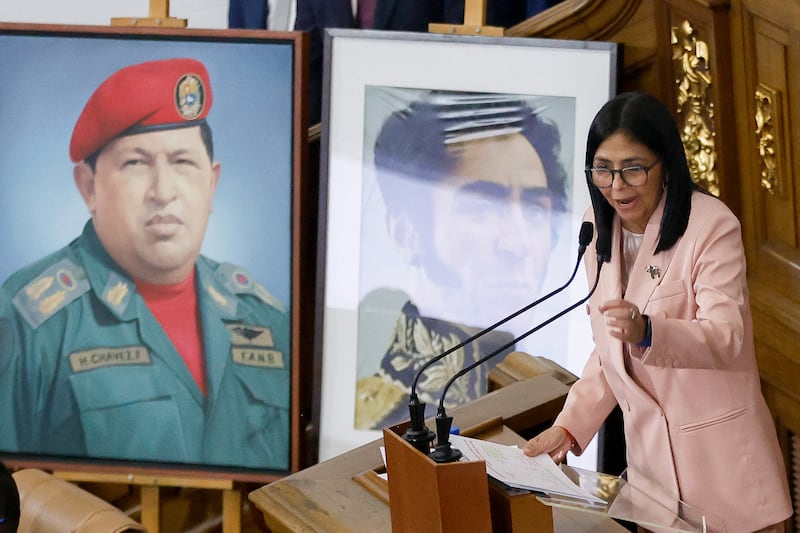 Venezuela’s vice-president Delcy Rodríguez speaks alongside portraits of late Venezuelan president Hugo Chavez and the liberator Simon Bolivar during the presentation of the 2026 fiscal year budget at the National Congress in Caracas on December 4th. Photograph: Pedro Mattey/ AFP via Getty Images
The decay of the Bolivarian revolution launched by Chávez into a corrupt dictatorship overseeing a broken country can obscure the revolutionary currents that still animate Chavismo.
While viewed as a pragmatist within the movement, she has impeccable revolutionary credentials. How far she will be willing personally to cede on core principles in order to ensure the regime’s survival will be a huge decision, especially as concessions tend to feed Mr Trump’s appetite for more.
She will have the support of her brother Jorge, another key figure within Chavismo, who held secret talks with the first Trump administration as far back as 2020. They at least have the advantage of being known quantities in the US, Rodríguez being remembered from her negotiations with US oil companies during her time as economy minister.
But pushed into giving too much ground and some of the more radical elements within Chavismo could become restless. This risk will likely increase if Washington starts demanding some sort of democratic transition. A principal driver for the Bolivarian revolution’s slide into dictatorship is the fear among its leading cadres of a judicial reckoning for their crimes should they lose power.
Another complicating factor for Rodríguez is the presence of thousands of Cuban security personnel in the country. They have been vital in ensuring regime survival for years and their central role was illustrated by the announcement that 32 Cubans were killed in Saturday’s raid. Given US secretary of state Marco Rubio has placed Cuba’s communist government firmly in the Trump administration’s sights, Havana will have little incentive to order its personnel in Venezuela to stand down if its main benefactor comes under US tutelage.