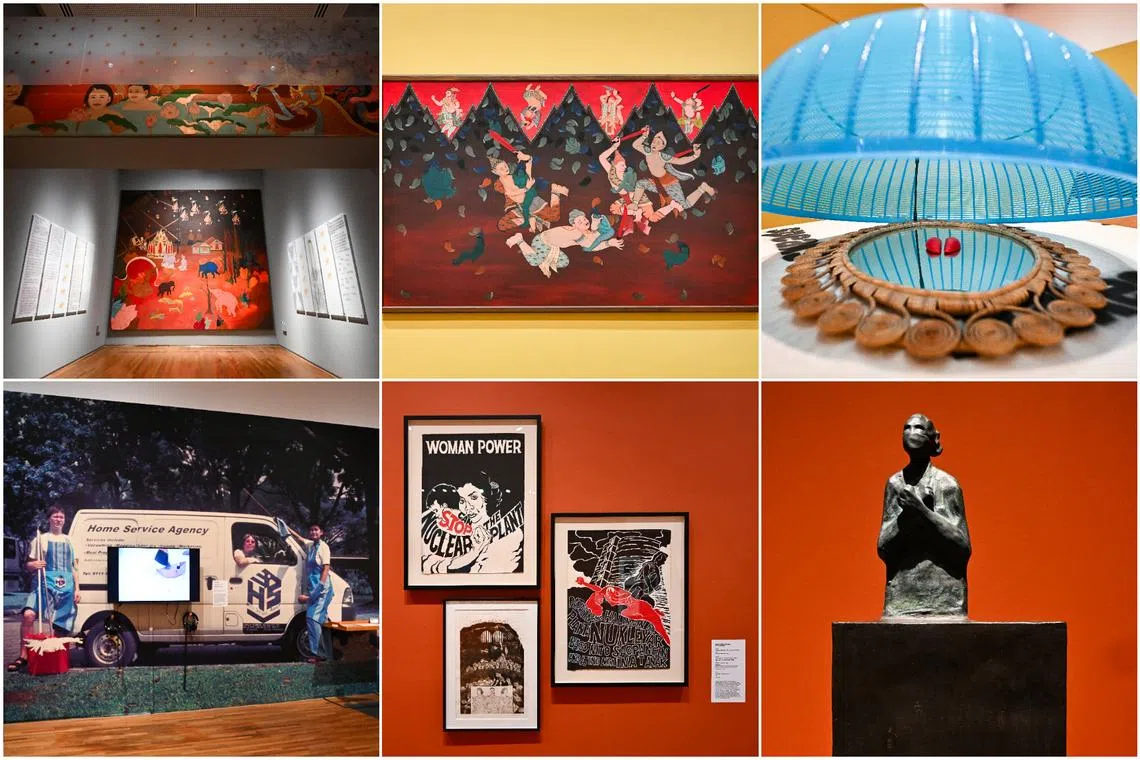
SINGAPORE – National Gallery Singapore’s (NGS) new exhibition Fear No Power: Women Imagining Otherwise gathers together more than 45 works by five pioneer women artists from the region.
They are Singapore’s Amanda Heng, Indonesia’s Dolorosa Sinaga, the Philippines’ Imelda Cajipe Endaya, Malaysia’s Nirmala Dutt and Thailand’s Phaptawan Suwannakudt.
Here are six highlights from the show, which opens on Jan 9 and runs till Nov 15. Admission is free.
Phaptawan Suwannakudt
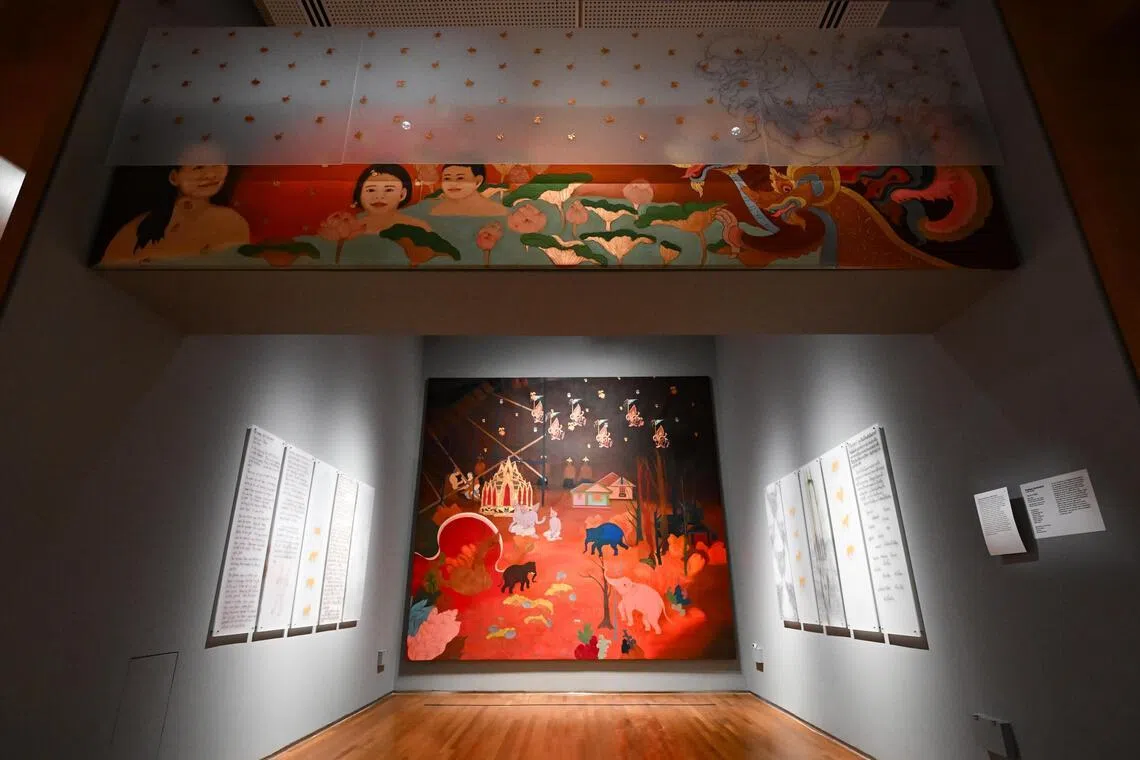
Phaptawan Suwannakudt’s The Sun’s Spell (2026).
ST PHOTO: LIM YAOHUI
This is a new commission by NGS for the show, and the Thai artist has created a piece that draws deeply from her most intimate childhood memories.
The daughter of a mural artist who specialised in Buddhist temple art, Phaptawan grew up immersed in the iconography of religious murals. The Sun’s Spell uses this traditional visual language to depict contemporary, personal stories.
At a media preview on Jan 6, the artist explains that within the alcove where the work sits, she wants to recreate the sensations she experienced as a child wandering into a temple space where her father worked.
The striking mural occupying most of the far wall draws the viewer in with warm reds and golds, as well as a wealth of detail, from flying bodhisattva figures to drifting flowers to elephants. The flowers, she says, were inspired by a poem her father recited to her, while the elephants came from her father’s nickname, bestowed by granduncles who owned a herd.
Phaptawan Suwannakudt
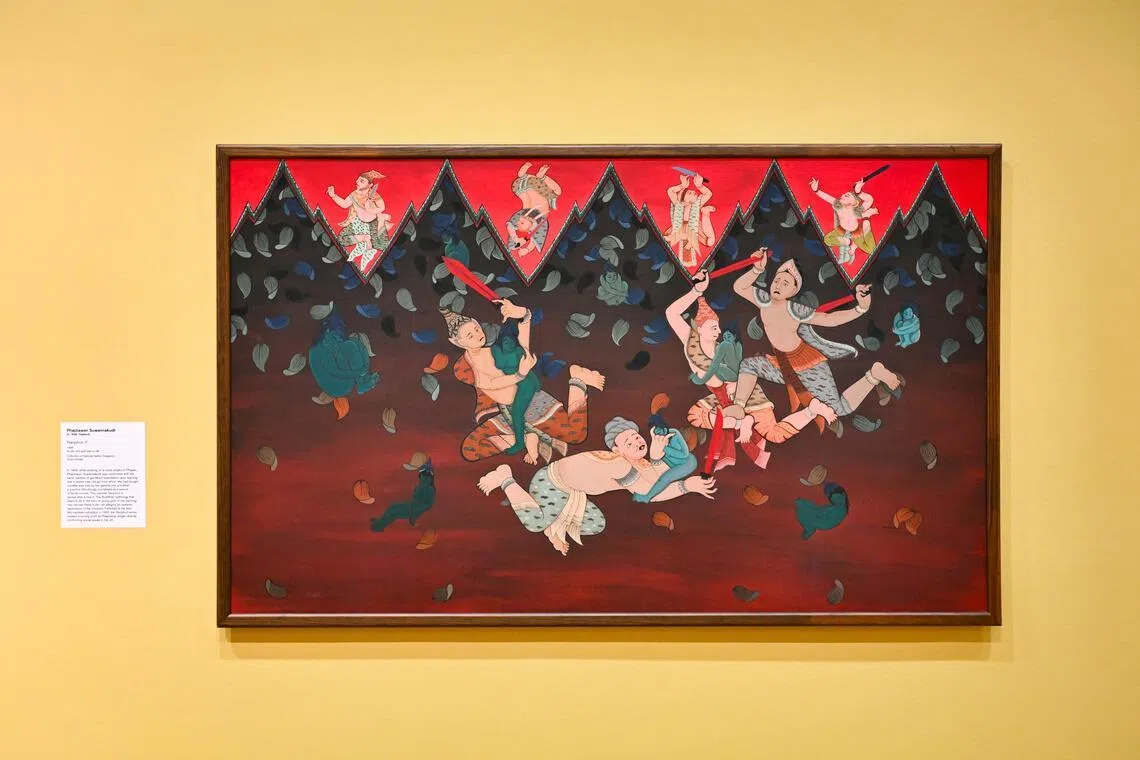
Nariphon II (1996) by Phaptawan Suwannakudt.
ST PHOTO: LIM YAOHUI
This striking work depicting men harvesting girls from a tree draws on a Thai Buddhist myth about a tree that bears fruit in the form of young girls.
This traditional tale is employed by Phaptawan to discuss a much darker story about child exploitation which she encountered when she was working in the northern Thai province of Phayao.
She frequented a beef noodle stall where she was waited upon by a 12-year-old girl, who was sold by her parents to a brothel. Phaptawan made this work in response to the shocking normalisation of this practice, and it marked a turning point in her discipline as she began to deal with more social issues, expressed in the visual language she learnt as a child.
Amanda Heng
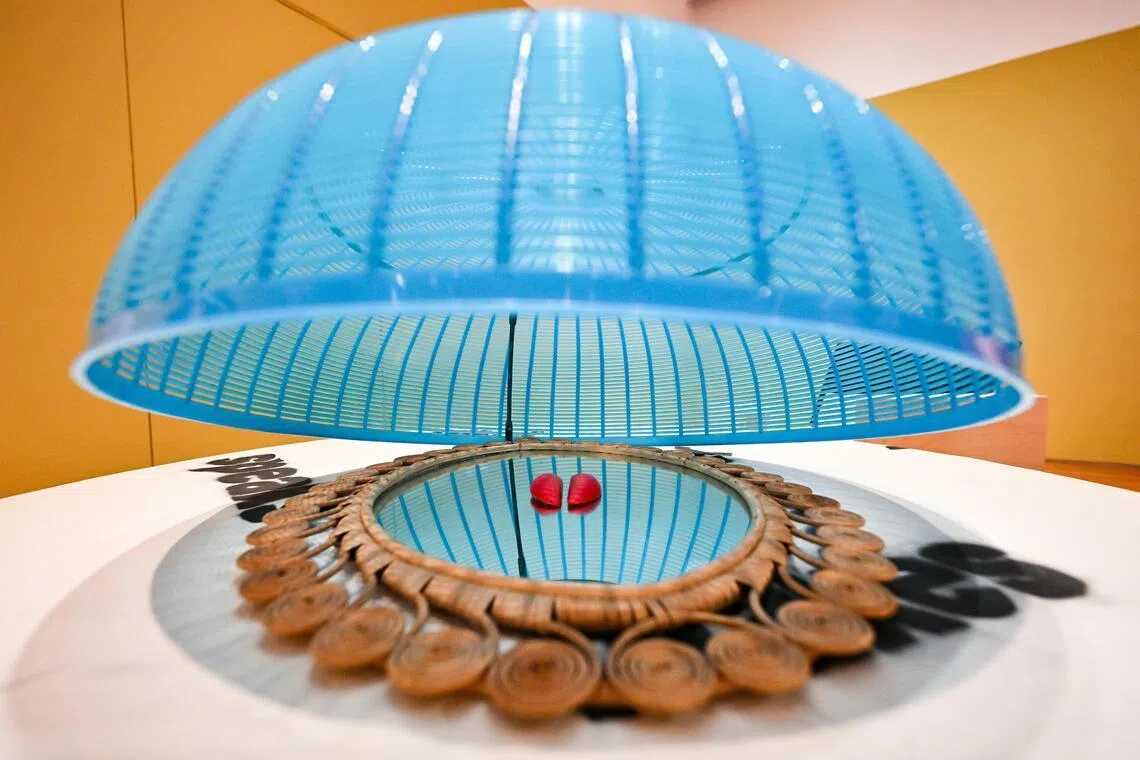
Detail of She And Her Dishcover (1991) by Amanda Heng.
ST PHOTO: LIM YAOHUI
What looks like a regular dinner table at home is subverted by Singapore artist Amanda Heng, who highlights the invisible labour of women in homes and kitchens in this piece. The tablecloth is emblazoned with words such as “desires” and “fear”, hinting at women’s unacknowledged emotional landscapes.
Under the dishcover is a mirror with two moon blocks, used in Chinese divination practice, which resemble lips. In its first iteration at the Singapore Art Museum, visitors were encouraged to interact with the work, lifting the cover to discover themselves in the mirror.
Dolorosa Sinaga
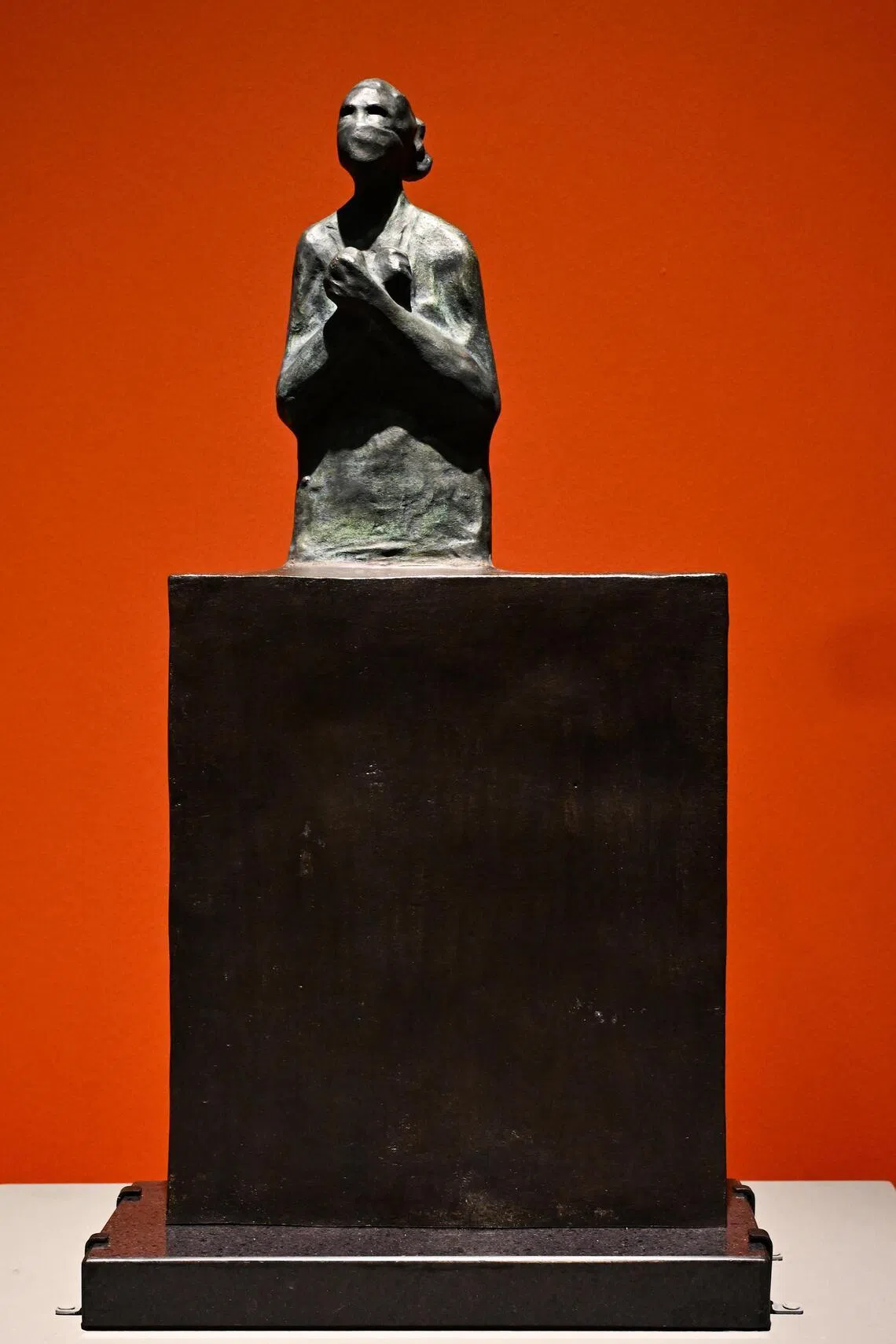
Dolorosa Sinaga’s Fear No Power (2003).
ST PHOTO: LIM YAOHUI
This petite sculpture carries a lot of weight. Created by Indonesian sculptor Dolorosa Sinaga, it is representative of how her practice gave voice to the silenced. It was made to honour the women political prisoners who were detained without trial for their alleged affiliations with Gerakan Wanita Indonesia (Indonesian Women’s Movement), an organisation known for its radical championing of women’s rights. The influential movement was suppressed by then Indonesian President Suharto’s New Order regime.
While the figure is bound and gagged, the slight upward tilt of her head hints at resilience, and the title can be read as an exhortation to hold on to courage.
Imelda Cajipe Endaya
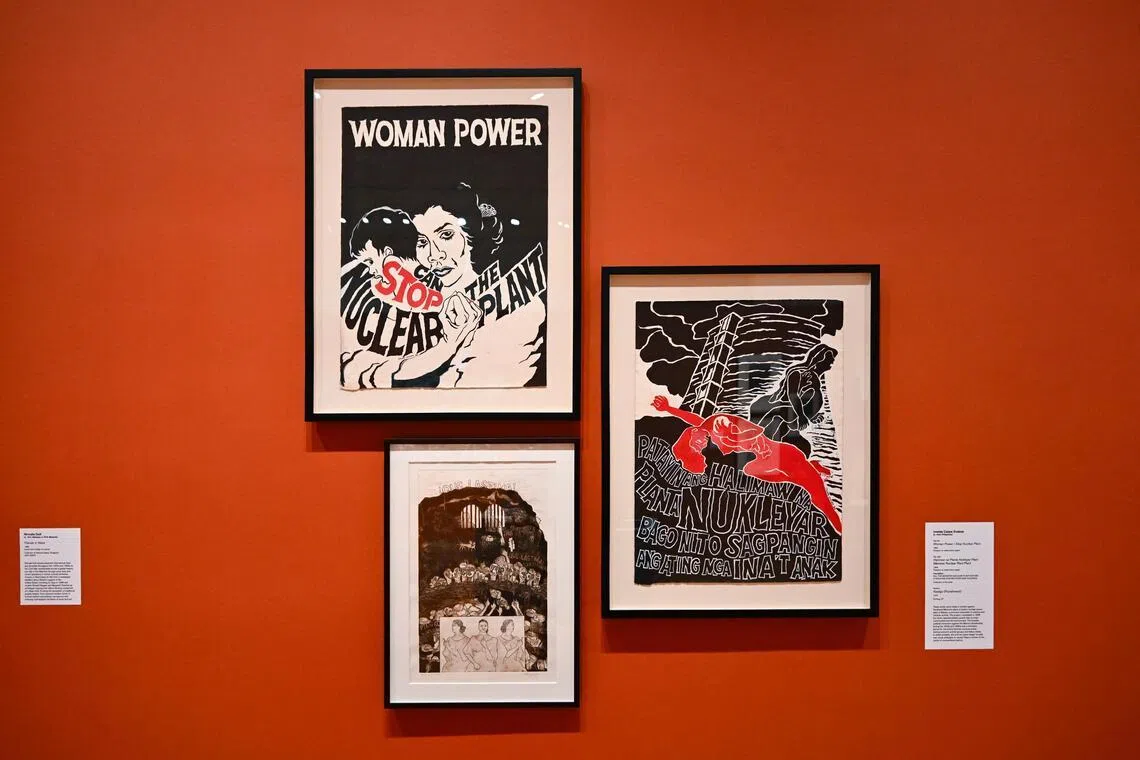
A trio of works by Imelda Cajipe Endaya protesting the construction of a nuclear power plant in Bataan in the 1970s and 1980s, a province vulnerable to seismic and volcanic activity.
ST PHOTO: LIM YAOHUI
This eye-catching trio of posters was created to protest the plans by the late dictator Ferdinand Marcos to build a nuclear plant on the Philippines’ Bataan Peninsula in the 1970s and 1980s.
The plant’s location near a geological fault line and the volcanic Mount Pinatubo, which eventually erupted in 1991, prompted protests. Endaya took part in street protests, and her work shows women actively participating in the sociopolitical movements.
Compare her boldly graphic style with Malaysian artist Nirmala Dutt’s more abstract Anti-Nuclear Piece (Commemoration Of Hiroshima Day) hanging nearby. Dutt draws from the visual language of wayang kulit to express her engagement with global politics.
Amanda Heng
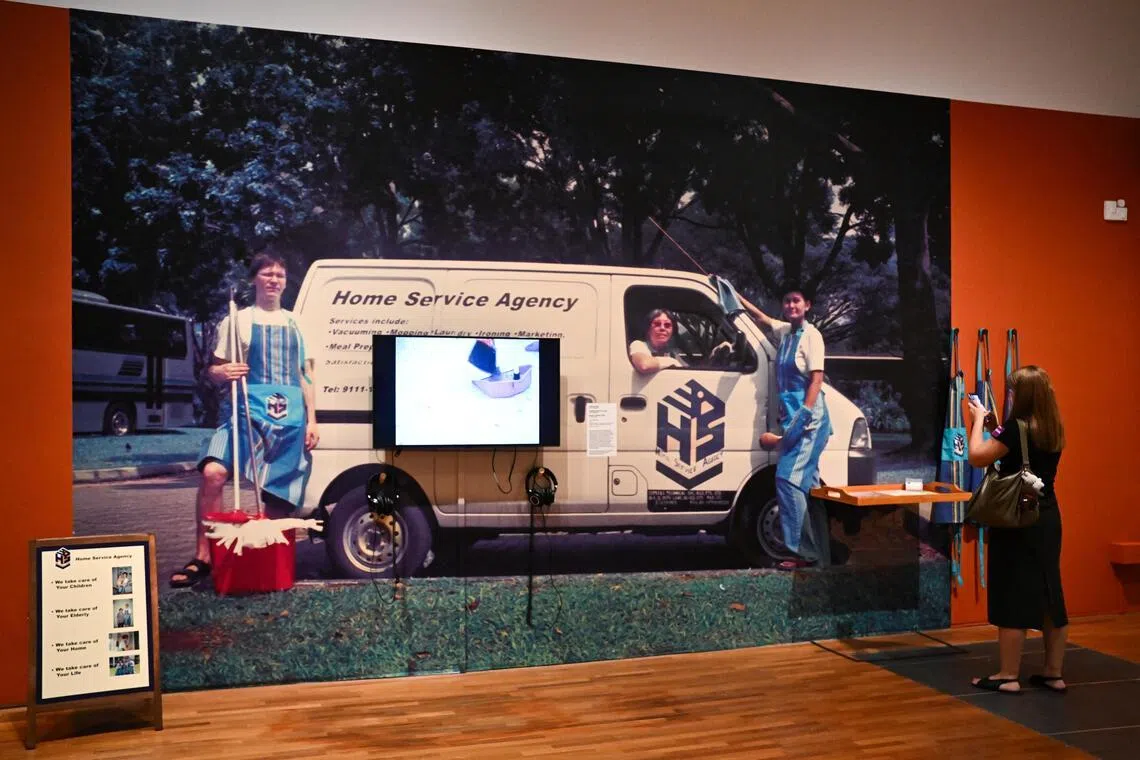
Home Service (2003), a project Amanda Heng collaborated on with fellow artists Twardzik Ching Chor Leng and Vincent Twardzik Ching.
ST PHOTO: LIM YAOHUI
In this project which spanned four months, Heng collaborated with fellow artists Twardzik Ching Chor Leng and Vincent Twardzik Ching to offer domestic services to 20 clients in exchange for a conversation about domestic labour. The resulting conversations are documented in a video, along with an advertisement made by the artists.
What is also intriguing is the detailed paraphernalia on display, with coloured sheets mimicking cheap cyclostyled fliers and brochures advertising Home Service in the familiar lingo employed by domestic maid services.
The work is part of Heng’s shift from object-based installations of her earlier works to performance pieces such as her famed Let’s Walk (1999), which also addressed notions of female beauty and economic stereotypes.
Visual artsNational Gallery SingaporeExhibitions