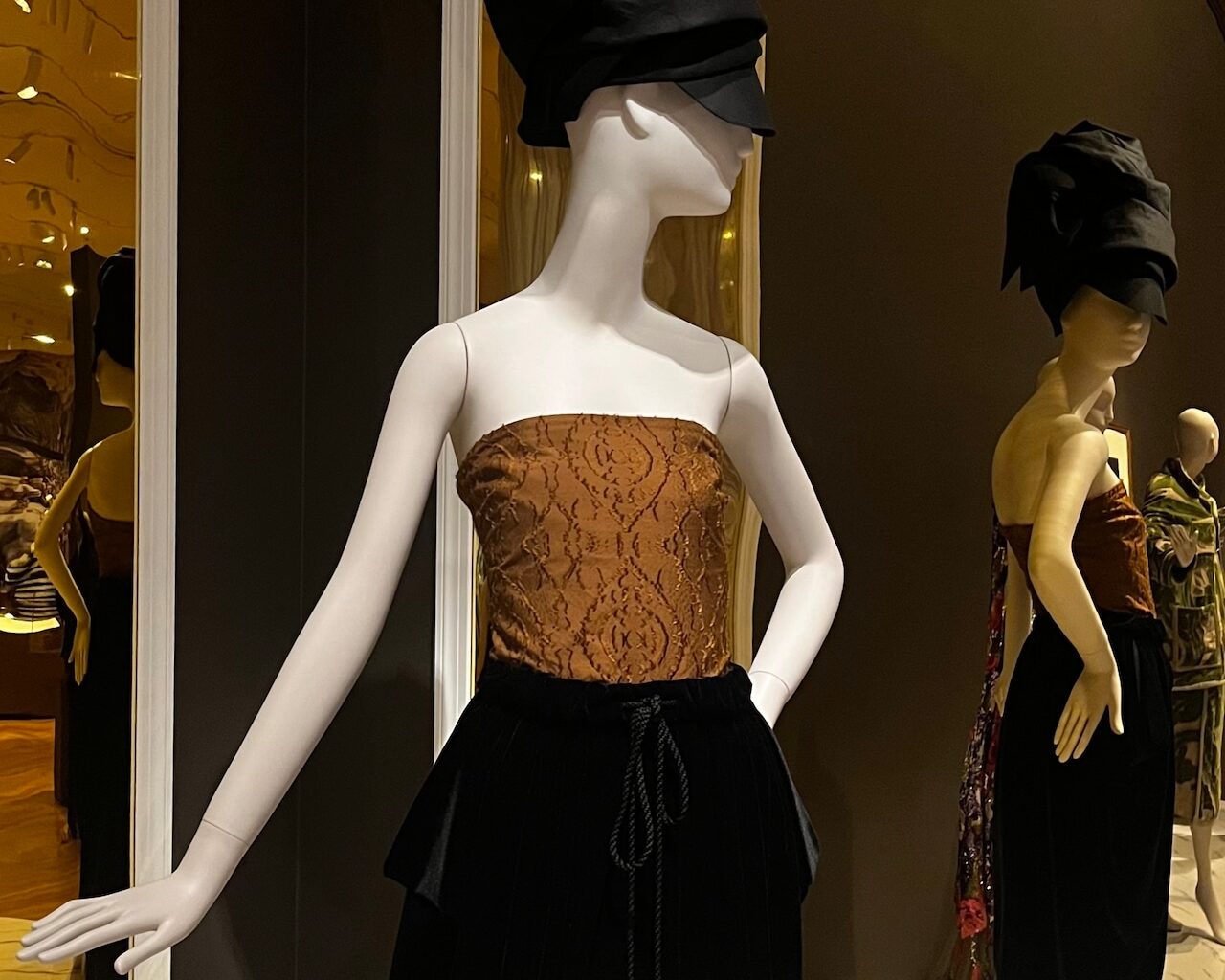
CLEVELAND, Ohio — When the Cleveland Museum of Art opened its “Renaissance to Runway: The Enduring Italian Houses” exhibition with an AI-assisted video at the entrance, museum officials knew it might raise eyebrows.
The decision to use the technology, however, was a practical one. The garments showcased in the exhibition, designed by the likes of Gucci, Versace and Moncler, are too delicate to be worn. The video brings the pieces to life without putting them at risk.
It also helps establish the contemporary, cutting-edge vibe curator Darnell-Jamal Lisby envisioned for the show, the museum’s largest fashion exhibition to date.
“We don’t use technology for technology’s sake,” said Jane Alexander, CMA’s chief digital information officer. “We use it when it solves a problem and makes art more relatable to more people.”
She said the museum views AI as a tool used to support artists, not as a replacement for human creativity. That choice — to use AI in a limited, clearly defined way — comes at a time when generative AI has become more ingrained in everyday life. Debate about its place in creative spaces has centered on how work is made, who owns it and whether jobs could be affected. The museum has received some criticism, including on Reddit, where commenters questioned AI’s role in the exhibition.
“There’s always going to be a handful of complaints if you’re lucky for any exhibition,” said Todd Mesek, CMA’s chief marketing officer. “But the response to the exhibition and the video has been overwhelmingly positive.”
The numbers back that up. Mesek said attendance has tracked about 15 percent above projections, attracting both longtime members and a newer, younger audience.
Museum officials said it was important not only to disclose the presence of AI, but to explain how and why it was used. A placard next to the video does that, identifying Francesco Carrozzini and Henry Hargreaves as the artists behind it.
“My role was to make sure we did this in the best possible way,” Alexander said. “That everything was transparent and that we had ethical and environmental considerations in place.”
This wasn’t someone typing a prompt into ChatGPT and projecting the output on a 20-foot-wall at the exhibition’s entrance. The museum paid the artists for their work and collaborated with them over the course of a year. Alexander also ensured that the images used were properly licensed and that the project relied on minimal energy.
“Renaissance to Runway,” on view through Feb. 1, isn’t the first — and won’t be the last — time the museum has used artificial intelligence. The institution was an early adopter of the technology, viewing it as a way to draw people deeper into its collection. AI-generated descriptions help make artworks more accessible on the museum’s website, and AI-assisted features have been part of its interactive ArtLens gallery since 2012. More are planned for later this summer.
But does that mean the museum would ever present an exhibition focused on AI itself, like a recent show at the Toledo Museum of Art that explored how artists use algorithms, code and generative processes?
“I thought that was interesting,” Mesek said. “But the focus (on AI) here is making sure that this amazing collection is accessible and received by the broadest possible audience.”
Alexander added the museum’s approach to using AI is not fixed.
“It’s an evolving tool, and things are always changing,” she said. “I am always listening, seeing what’s going on and where do we need to change the way we’re thinking, because it is moving fast.”
“Renaissance to Runway: The Enduring Italian Houses” runs through Feb. 1 at the Cleveland Museum of Art, 11150 East Blvd., Cleveland. Advance tickets are required and available for $8-$17 at clevelandart.org.