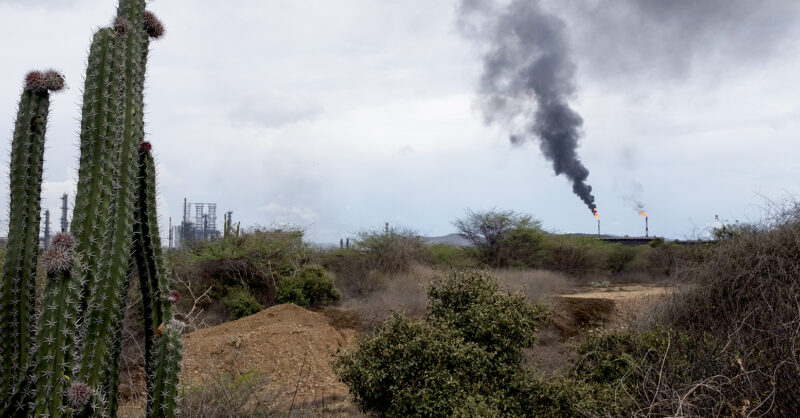
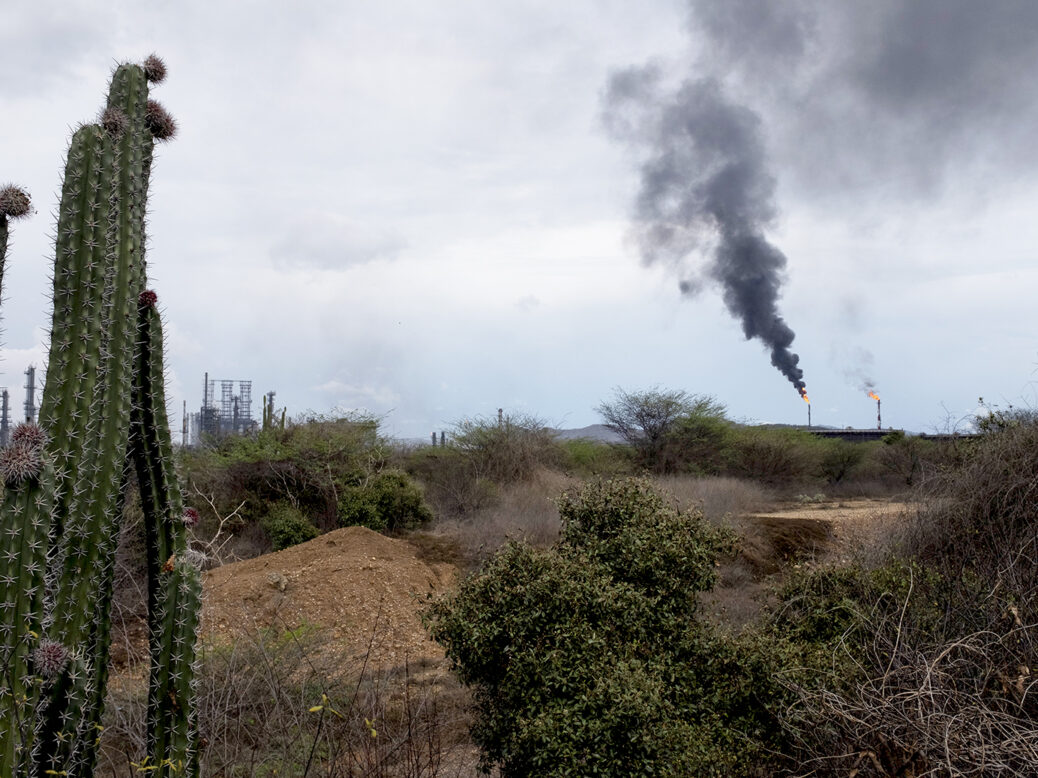
Gas flares at the Jose Antonio Anzotegui Petrochemical Complex in Barcelona, Anzoategui state, Venezuela. Photo by Carolina Cabral/Bloomberg via Getty Images
Remember those loony conspiracy theorists who saw oil behind every invasion and every war? Follow the pipeline, as they liked to say. Well, now we have conspiracy theorists who insist on seeing democracy as the secret motive for the US operation to capture the Venezuelan president Nicolás Maduro on 3 January. Even as Donald Trump explained in a press conference hours later that it was all about oil and that he intended to extract prodigious amounts of it from Venezuelan soil in order to “take care of America”, European leaders took to social media to salute a new age of democracy – a regime change that, strangely, leaves the regime in place. On 4 January, Trump warned there would be a big price to pay if Venezuela’s oil was not returned to the US – it was stolen, he claimed – but no other commitments to the country were promised.
At the risk of disappointing all the democracy conspiracists out there, this is indeed about the oil. Venezuela boasts the largest oil reserves in the world and that is the only thing that drove Maduro’s removal. But there is a larger context.
Venezuela, Iran, Canada, Greenland, even Nigeria – there is a pattern to Trump’s chaos. Oil and natural gas are suddenly at the centre of US foreign policy in a way they have not been for half a century. The shale revolution of recent decades allowed America to shake off its dependency on foreign oil and natural gas and become a major energy exporter. Oil prices remain low, even after major geopolitical shocks such as the wars in Ukraine and the Middle East. In fact, it was arguably competition from the shale boom that diminished Venezuela’s oil production, so what could be the reason to bring it back under American control? Experts predicted energy independence would help the US retreat from the Middle East and focus on its own internal problems. Perhaps this could have happened with a different president – and, more importantly, with a different time line, one in which large language models had never arrived and the promise of artificial intelligence had not reoriented the entire US economy.
Today, the US faces a future not of energy abundance but of energy scarcity, even energy collapse. AI power demand is exploding, with data centres expected to account for up to 12 per cent of total electricity use in the US by 2030 – although the current pace suggests these projections may fall short. This dramatic surge is already being felt by Americans. Last summer, monthly household electric bills increased. In Trenton, New Jersey, the bill for a typical home rose by $26; in Columbus, Ohio, $27. The reason? AI.

New year, new read. Save 40% off an annual subscription this January.
Little surprise then, that alarm bells are ringing. Without some kind of miracle solution, the future looks bleak: growing social conflict between the demands of large AI companies and regular households; political turmoil and, perhaps more painful, the prospect of losing the AI race to China, which has inferior chips and models but now boasts unmatched capacity for generating electricity. Equivalent forecasts see data centres in China consuming around 4 per cent of total electricity use by 2030 – a much more sustainable fraction.
The reason China finds itself on a much better trajectory is, of course, renewables: a source of cheap and quickly scalable energy production, now mobilised across Xinjiang and Tibet in solar and wind farms as large as cities. The US made a bet on the old fossil fuel economy. It was never a great bet to begin with, but now AI makes it look like a desperate one. Where to find a curve of electricity generation as exponential as the needs and pace of AI growth? And without fast AI growth, both the stock market and the wider economy will deflate as quickly as a burst balloon.
Look at Meta’s board of directors and you’ll find a legendary natural gas trader and a close friend of Trump’s among its members. This is the future in a nutshell: Trump’s energy imperialism, announced to the world on 3 January, brings everything together. But for this to happen, new supplies of oil and natural gas must be procured for electricity generation. The most tempting project? Nord Stream 3, linking trillions of cubic feet of natural gas in fields such as Chayvo, Odoptu and Arkutun-Dagi in Russia to Alaska just across the Bering Sea. But Venezuela and Guyana are almost as promising.
What this project might do to the climate is alarming, but there is a more immediate problem. China’s rapid electrification and rising solar and wind power are starting to drive down its fossil fuel use – I visited in December and was stunned by the electrical silence on the Shanghai streets – but this is happening very slowly and from a high plateau. Renewables might be able to power the steep growth rates required by AI, but the accumulated stock of energy needs is large.
If the US cannot continue on its current path without taking over much of the world’s largest fossil fuel reserves, and if China still needs access to those same sources of future production, the predictable result is that Trump’s energy adventurism will effectively turn into an energy blockade on China. Such an outcome, even if not fully intended, is reminiscent of the embargo on oil exports to Japan announced by the US in August 1941. As a result, Japan lost access to nearly 90 per cent of imported oil. Pearl Harbor followed later that year. Are we heading for a similar disaster, a clash between an unstoppable force and an immovable object? The AI doomers may turn out to be right, but not as they envision it.
[Further reading: Venezuelans don’t trust Trump]
Content from our partners
This article appears in the 07 Jan 2026 issue of the New Statesman, What Trump wants