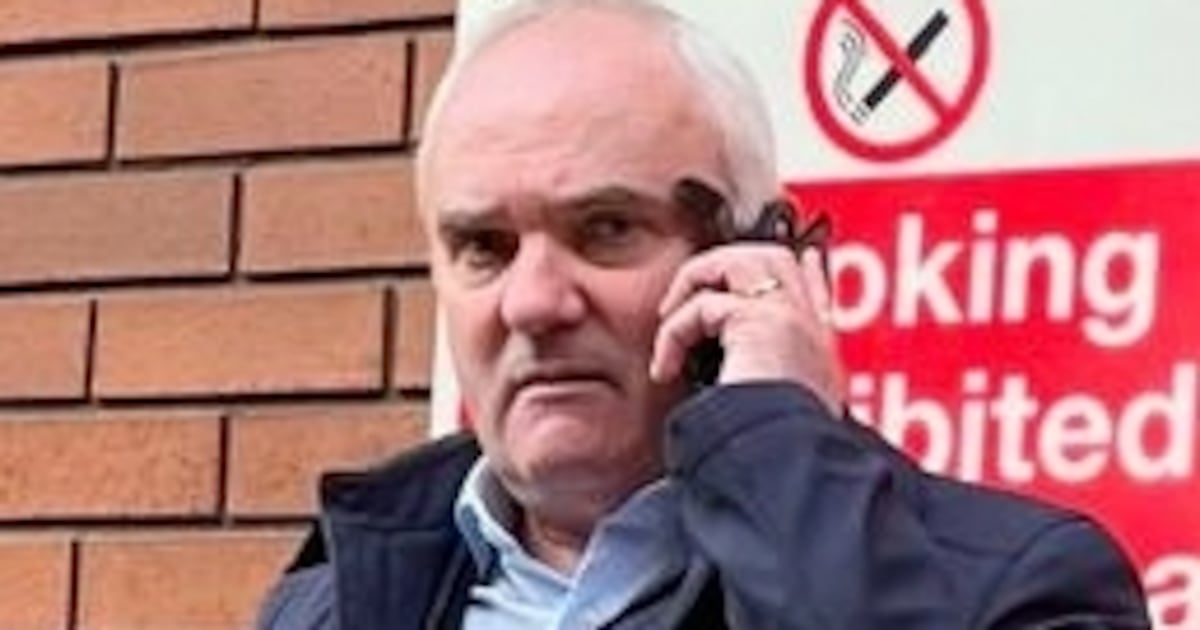
A sentence of more than seven years is being sought for Kevin Phelan, from Omagh, Co Tyrone, who was found guilty by a jury in Leeds last year of conspiring to defraud pension holders.
Phelan (62) is a former land agent who acted for businessman Denis O’Brien and Michael Lowry TD in land deals in England in the 1990s that were later investigated by the Moriarty (Payments to Politicians) tribunal.
He was not in court on Thursday for a sentencing hearing at Leeds Crown Court.
Peter Wright KC told Judge Penelope Belcher that his client, Phelan, was prevented from travelling because of a health issue and said the court should order a medical report to be paid for out of public funds.
Judge Belcher noted that Phelan’s medical position appeared to be unchanged since September when he had been unable to attend because of a heart issue. She said he had not yet received treatment for his condition.
Mr Wright said it was expected Phelan’s condition would be treated with the insertion of a stent.
Ordering a full medical report, the judge said she was “not prepared to accept Mr Phelan’s word. He is a convicted fraudster”.
She described Phelan as one of the “amigos” principally involved in running a fraudulent pension liberation scheme that saw investors defrauded and the UK revenue cheated out of taxes.
Following a trial that lasted seven-and-a-half months last year, a jury found Phelan and two others, Daniel Giles, of Jacob Drive, Coventry, and Mohammed Bashforth, of Wakefield, West Yorkshire, guilty of conspiring to defraud pension holders and cheat the UK Revenue between January 2013 and December 2014.
[ Who is Kevin Phelan?Opens in new window ]
The sentencing hearing in relation to Giles and Bashforth took place on Thursday. The judge reserved her decision and remanded the two men, who had been out on bail, in custody.
Phelan’s sentencing hearing was adjourned to March. He remains on bail.
During Thursday’s hearing, Tim Hannam KC, for the prosecution, said Phelan was one of the principal conspirators throughout the fraud. He said Phelan was involved in the falsification of documents, the production of false accounts, and the concealment and disposal of evidence once the police began to investigate the scheme in late 2014.
The complex nature of the fraud was one of the reasons the case took so long to come to court, he said.
The fraud involved two companies, Cornerstone Friend Society and Cornerstone Direct, receiving money from investors, and the transfer of investors’ money to Sequentia Capital SA and other Sequentia group companies associated with the conspirators, the court has heard.
When the police started to investigate, properties acquired by Phelan “for a pittance years earlier” were transferred at dishonestly inflated prices to cover for money transfers that were part of the pension fraud, Mr Hannam said.
[ DAA chief Kenny Jacobs begins High Court action seeking his return to workOpens in new window ]
Backdated documents were also drafted, he said, falsely showing the alleged purchase of loan notes associated with the ownership of the Doncaster Rovers football club, again to explain the transfer of funds.
There had in fact, he said, been three attempts to buy the football team “but they had all failed”.
The “conspirators” had plans to develop the pension fraud on a larger scale and Phelan was involved in leasing premises associated with the growth of the business and the establishment of a call centre, Mr Hannam said.
“The intention throughout was to steal investors’ money,” counsel said. The judge was entitled to consider the conspirators’ future plans to develop the fraud when deciding on sentence.
There were 74 victims of the pension liberation fraud, involving more than £1.9 million, which made it a “category one” case where the “starting point” for sentencing was seven years.
Mr Hannam suggested the judge adopt a higher starting point as the conspirators intended a level of harm that was “much greater” but had been stopped by the intervention of the police.
Phelan featured in the Moriarty tribunal because he acted in property deals in England involving Mr Lowry and Mr O’Brien.
The deals included one where Mr O’Brien bought the lease to the Doncaster Rovers Football Club stadium so it could be redeveloped, as well as the purchase by Mr Lowry of investment properties in Mansfield and Cheadle.
The tribunal decided the deals were linked to Mr O’Brien seeking to confer financial benefits on Mr Lowry and were in turn associated with the former communication minister’s interference in the 1995 mobile phone licence competition to the benefit of Mr O’Brien’s Esat consortium.
Both men strongly disputed the tribunal’s findings. Phelan did not give evidence to the tribunal.