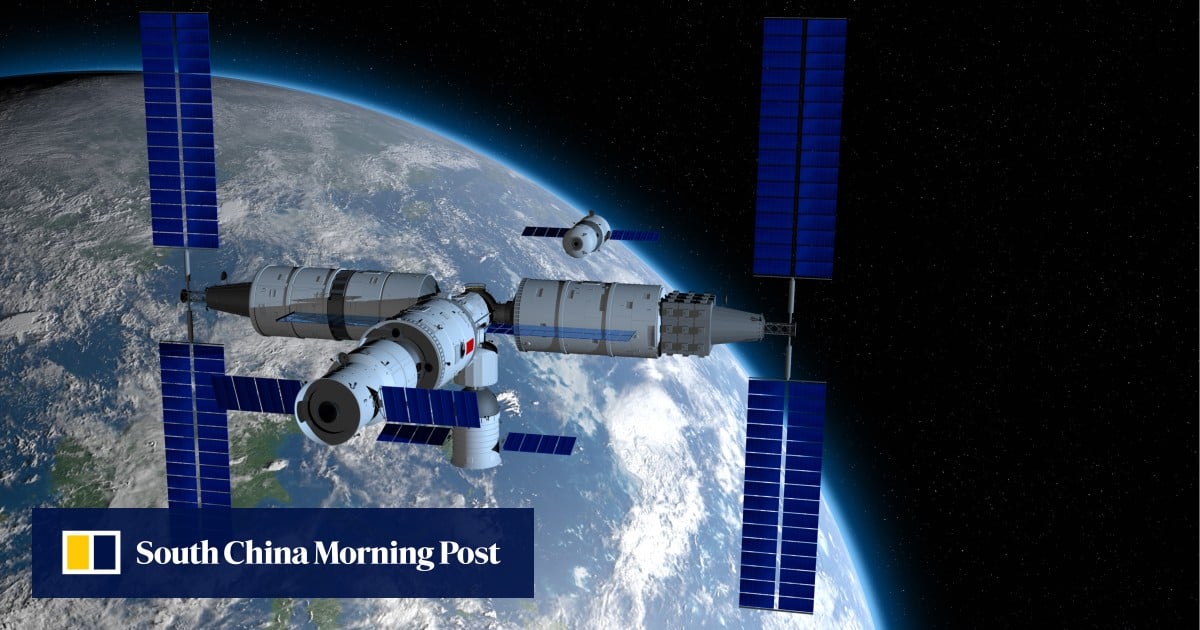
Led by only the second civilian the country has sent into space, China had started a series of experiments on board its Tiangong space station that could lead to the development of safer and more powerful space batteries, state media reported on Wednesday.
The tests on lithium-ion batteries run by Zhang Hongzhang, a professor at the Dalian Institute of Chemical Physics, could help scientists better understand how gravity affects the workings of the batteries.
The country’s first civilian astronaut was an aerospace engineer and professor at Beihang University, Gui Haichao, who went to the space station in 2023.
Zhang’s research covers a variety of advanced batteries, including lithium-ion batteries, which are a key power source for space exploration thanks to their high energy density, light weight and reliability.
In an interview published a day before the launch in late October, Zhang told the official China Youth Daily that he applied at once after seeing a 2018 astronaut recruitment notice, which for the first time was aimed at flight engineers and specialist scientists as well as military pilots.
His main task is to conduct experiments on the space station and communicate with ground researchers to maximise results.