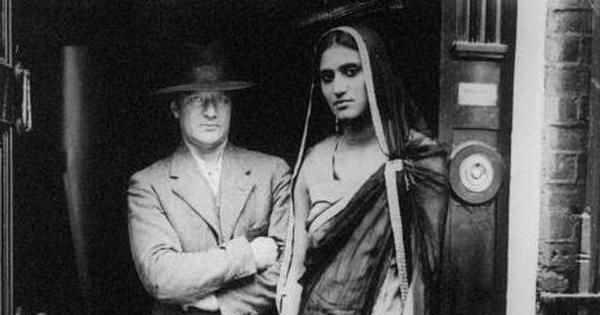
In 1925, British newspapers announced that the eminent sculptor Jacob Epstein had found a new muse. She was neither English nor European. The Daily Record described her as beautiful “in a way that perhaps only women of the east can be beautiful”, praising the inscrutability of her expression, the “symmetry of [her] form and dignity of mien”. Her name was Sunita Devi and she had arrived from India with a small child, an older sister and a past that has now blurred into legend.
Sunita posed for many of Epstein’s ambitious works. She became the face of his celebrated Madonna and Child as well as Lucifer, and the subject of several of his drawings and sculptures. Other women competed for Epstein’s attention too, but, if British newspapers are to be believed, it was Sunita who was the most intriguing and enigmatic of them all. By the time she disappeared from London six years later, she had left behind a trail of rumours and sculptures that bear her features.
Almost everything known about Sunita before her arrival in England comes second-hand from Epstein’s biographers and from newspapers eager for sensation.
She was born in 1897, according to some accounts, and was said to be a Kashmiri Muslim. Her original name was Amina or Armina. She lived in Bombay with her husband Ahmed Peerbhoy, heir to one of the city’s most influential business families. Adamjee Peerbhoy, the family patriarch, had risen from poverty to build cotton mills and tanneries and serve as sheriff of Bombay and president of the Muslim League.
She left behind the comforts of her life in Bombay to move to England.
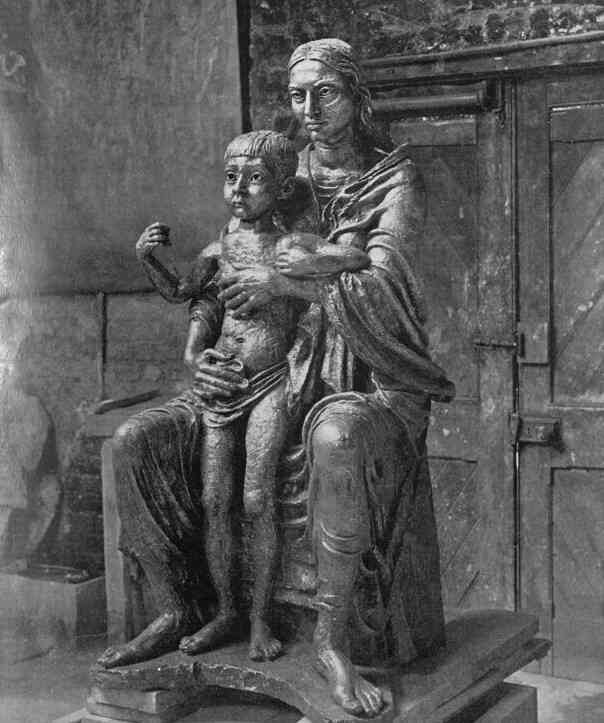 Madonna and Child. Credit: The Sphere/Newspapers.com.London acts
Sunita arrived in London with her young son Enver or Anvar, no more than four years old, and her older sister, Miriam Patel. One newspaper claimed that both women had “abandoned” their husbands in India, unwilling to submit to the lives prescribed for them. Miriam shed her name and became Anita Devi. Amina was now Sunita Devi.
Another version of events suggests the sisters were entranced by Anna Pavlova when the celebrated dancer visited India in 1922. Though Pavlova claimed to be disappointed by Indian dance forms, which she felt required “urgent revival”, she was deeply impressed by the Ajanta frescoes. In 1923, Pavlova staged two acclaimed collaborations with Uday Shankar in London: Krishna Radha and Oriental Impressions.
Whether the sisters performed in these productions is difficult to establish, but they did join Pavlova’s company in 1925. In one account, provided by Sunita to a newspaper, the sisters were spotted in a London restaurant by someone, perhaps a talent scout from Anna Pavlova’s company. Around this time, the sisters ran a stall at the British Empire Exhibition at Wembley Park, where they sold “Oriental” artefacts, including ivory objects, Benares brassware, trinkets, jewellery and even items described as erotica.
While Anita continued as a dancer, performing small acts in productions such as Alf’s Button and Slaves of a Caravan, Sunita’s career took a very different turn. Soon, glowing reports appeared of “Princess Sunita’s” occult abilities and her supposed gifts as a psychic. Advertising her programme with the slogan “You ask—I tell”, Sunita reportedly evoked laughter and admiration in equal measure with her uncanny responses to audience questions.
Sunita also appeared in the Maskelyne brothers’ magic act. One of her feats involved lying submerged in a water tank on stage for over five minutes, apparently breathing through a transparent, nearly invisible hose.
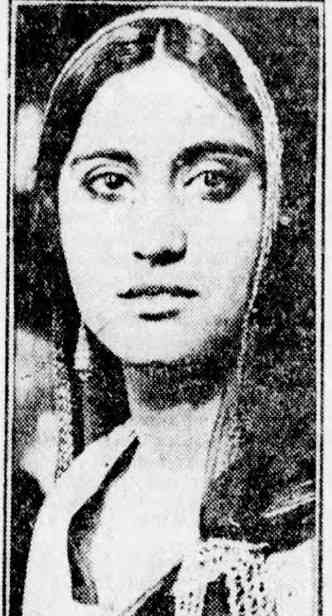 Sunita Devi. Credit: Kansas City Journal/Newspapers.com.
The sisters entered Jacob Epstein’s orbit in 1925, shortly after the British Empire Exhibition. One account suggests the painter Matthew Smith (1879-1959) first encountered Sunita and made her his muse. One of his best-known paintings of her is A Red Sari: Sunita Reclining. A few months later, she began modelling for Epstein, as did her son and, on occasion, her sister. Epstein described her as one of those “divinely discontented models”, possessing an “exotic, undefinable quality”.
Predatory figure
Sunita, Anita and Enver even became members of Epstein’s household, sharing his Bloomsbury home with his sculptor wife Margaret. This arrangement was initiated by Margaret herself, largely, as Epstein’s biographers suggest, to counter the influence of his younger mistress and model, Kathleen Garman. In one lurid episode, Margaret even shot Garman – and it was only Epstein’s intervention that prevented the matter from being taken to the police.
Epstein was already renowned as a radical, unconventional and controversial figure. Born in New York in 1880 to Jewish parents from eastern Europe, he trained as an artist in Paris before settling in London. He drew profound inspiration from the immense Egyptian and Assyrian sculptures in the British Museum.
His career was marked early by scandal. In 1908, his monument to Oscar Wilde at Père Lachaise Cemetery in Paris provoked outrage, and his later sculptures for the British Medical Association building on the Strand attracted both admiration and condemnation for their uncompromising depictions of the human body. Similar reactions greeted Rima, his memorial to the American naturalist and writer WH Hudson in Hyde Park, though in this case, Epstein found unexpected defenders in his own models.
In his choice of sitters, Epstein gravitated toward the “daringly different” and the “flagrantly bohemian”. In ways that would today be described as predatory, many of his models also became his mistresses, though this cannot be established in Sunita’s case. Margaret, by most accounts, actively encouraged such arrangements in order to keep Garman at bay.
Sunita appears in several of Epstein’s best-known works. Between 1925 and 1931, he sculpted four figures based on her, one of Enver and one of Anita. Sunita and Enver posed together for the first version of Madonna and Child (1926-27). Epstein also produced numerous drawings of Sunita in pencil, charcoal and watercolour, as well as studies of mother and son and of the sisters together.

Jacob Epstein with a bust of Sunita Devi, c. 1926. Credit: Wikimedia Commons [Public Domain].
He was fascinated by what he perceived as the brooding, tragic quality of Sunita’s beauty, seeing in her what he called an “eternal Oriental type”, ideal for his conception of the Madonna. Epstein’s biographer Richard Buckle described her less romantically: “Sunita was a tall woman with a huge head, and far from Madonna-like. She could find no food or drink fierce enough in taste, and used to put pepper in her whisky.” Even so, Buckle conceded that she became “perhaps the most famous of all Epstein’s models”.
Epstein made only one bust of Anita, whom he found less striking than her sister. Yet it was Anita, along with another model, Dolores, who famously stormed a London theatre to disrupt a play that mocked abstract art, including Epstein’s Rima. The women hurled tomatoes and eggs at the director, Frank Worthington, before the police intervened.
Return to India
By 1931, the trio no longer lived with Epstein, though Sunita remained a regular visitor to his studio. That year, he sculpted her half life-size in the nude, titling the work Reclining Goddess.
In 1931, Sunita became inexplicably entangled in contemporary political currents. The first Round Table Conference (November 1930-January 1931) convened in London to discuss the Simon Commission’s recommendations, with delegates from princely states, minority groups and the British government. The Congress, whose key leaders were imprisoned during the Mahatma Gandhi-led Civil Disobedience Movement, boycotted the conference. Sunita was speculated to be a Congress spy.
Soon afterward, Buckle writes, Sunita “disappeared” with the secretary of a maharajah into the interior of India. Nothing further was heard of her until news arrived of her sudden and mysterious death in 1932, widely attributed to “intestinal inflammation”. Newspapers reported that Sunita had foretold her own end, telling friends in London: “I am going to my death. I know it is so.” Those who attended her funeral struggled to reconcile the name Amina Peerbhoy with the woman known to the world as Sunita Devi.
Anita returned to India upon hearing of Sunita’s death, but went back to London. Enver remained in the UK, working as a manager for a company. As for Epstein, he went on to earn the admiration of a new generation of artists. On the centenary of his birth, Henry Moore paid tribute: “He bore the brunt of public criticism, in fact he took the brick bats and made the way easier for sculptors like me coming after him.”
Epstein’s Madonna and Child, first shown at the Museum of Modern Art in New York, is now installed at Riverside Church. His study busts of Sunita and Enver are held at the New Art Gallery Walsall, England. Lucifer, an 11-foot sculpture inspired by Milton’s Paradise Lost, is housed in the Birmingham Museum.
Sunita clearly relished the attention she received as Epstein’s muse. In 1930, she remarked of him: “He is a wonderful man. He is kind to everybody and would not hurt a fly. Whatever people think of his art they are always impressed by the wonderful sense of life one gets from his work.”