Back to Article List
This famous asterism at the heart of the Strongman is visible in the early-morning sky this month before sunrise.
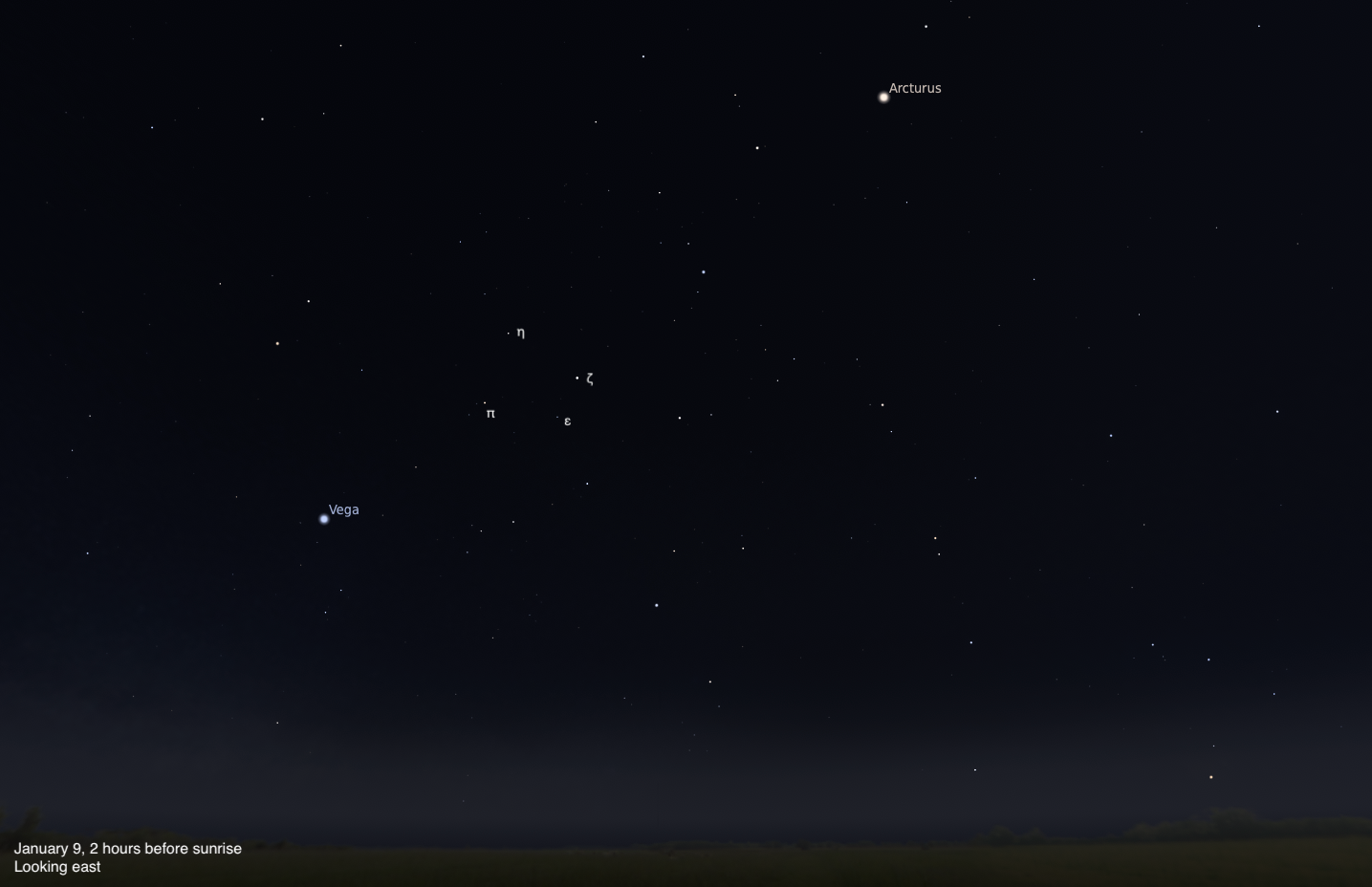
The Keystone of Hercules is visible to the naked eye rising in the east a few hours before sunrise. Credit: Stellarium
- The article details observations for January 8, 2026, including instructions for locating the Keystone of Hercules in the eastern sky before sunrise by identifying specific stars (Vega, Arcturus, Zeta, Eta, Pi, and Epsilon Herculis), and provides guidance for telescope users to find the 6th-magnitude Hercules Cluster (M13).
- Specific local times for sunrise (7:22 A.M.), sunset (4:53 P.M.), and moonset (10:51 A.M.) are provided for January 8, alongside the Moon’s phase as waning gibbous at 55% illumination, all relative to 40° N 90° W.
- Jupiter reaches opposition on January 10, 2026, at 4 A.M. EST, a celestial alignment where Earth is positioned directly between the Sun and Jupiter, making it highly visible in the southern sky.
- During this opposition, Callisto will transit Jupiter’s disk from approximately 2 A.M. EST to 6 A.M. EST on January 10, with its shadow directly overlapping the moon’s southern edge, potentially discernible as a subtle darkening or distension.
Looking for a sky event this week? Check out our full Sky This Week column.
January 8: Zoom in on the Perseus Cluster
If you’re up early today, try finding the famous Keystone of Hercules in the eastern sky, about 40° high two hours before sunrise. Looking east, you’ll see a bright star (magnitude 0.0) some 20° high at that time — that’s Vega, the alpha star of Lyra the Lyre.
From here, glance to the upper right for a rough square of four stars located about ⅓ of the way from Vega to the bright star Arcturus (magnitude –0.1) in Boötes the Herdsman. That’s the Keystone. Its brightest star is magnitude 2.8 Zeta (ζ) Herculis, which anchors the southwestern corner (the star farthest right as the constellation rises, at the upper righthand corner of the Keystone). To its upper right in the sky this morning is Eta (η) Her (magnitude 3.5), about 7° to Zeta’s north and forming the upper lefthand corner of the Keystone in this configuration. Then drop 6.5° southeast (to the lower left) to Pi (π) Her (magnitude 3.2), and finally slide another 6.5° southwest (to the lower right) to find magnitude 3.9 Epsilon (ε) Her at the lower right corner of the box.
If you have a telescope, take a moment to glance about ⅓ of the way along a line from Eta to Zeta Her — there you’ll find the famous Hercules Cluster (M13), a magnificent globular cluster glowing at 6th magnitude.
Sunrise: 7:22 A.M.
Sunset: 4:53 P.M.
Moonrise: —
Moonset: 10:51 A.M.
Moon Phase: Waning gibbous (55%)
*Times for sunrise, sunset, moonrise, and moonset are given in local time from 40° N 90° W. The Moon’s illumination is given at 10 P.M. local time from the same location.
Jupiter reaches opposition the morning of January 10 at 4 A.M. EST. As the clock ticks over from midnight on the 9th to the early hours of the 10th, the gas giant is high in the southern sky, some 70° above the horizon and located to the lower right of Pollux in Gemini. Turn a telescope on the planet and you’ll see that by 12:30 A.M. CST (early on the 10th for the eastern half of the U.S.; still late on the 9th for the Mountain and Pacific time zones), Callisto is closing in on Jupiter’s southeastern limb. Europa is farther east, while Io (closer) and Ganymede lie to the gas giant’s west.
Callisto reaches the limb and begins to transit just minutes before 2 A.M. EST on the 10th (11 p.m. PST on the 9th in this time zone only). Within 10 minutes, it’s passed fully in front of the planet, moving from east to west. Two hours later, around 4 A.M. EST, Callisto is roughly central on the disk.
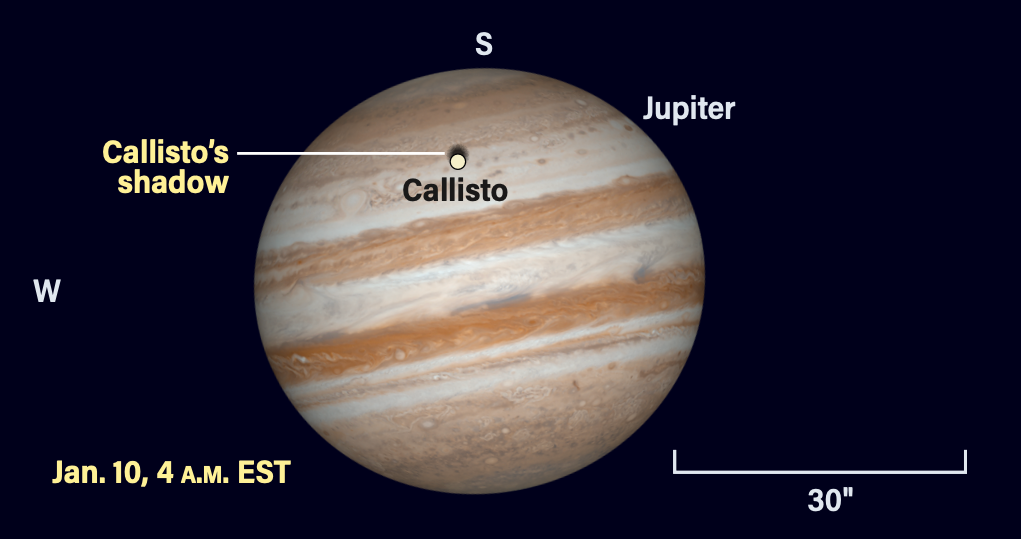
The day Jupiter reaches opposition, Callisto nearly blends with its shadow as they transit. Can you spot the shadow, just peeking out from Callisto’s southern edge? Credit: Astronomy: Roen Kelly
At opposition, the Sun appears directly behind us as we look at Jupiter and from a viewpoint above the solar system, Earth stands directly between the Sun and the gas giant. That means as moons cross Jupiter on this date only, they directly overlap their shadows. With Callisto central on the disk, look closely at the moon’s southern edge. Does this limb appear slightly darker or distended? This may be all the evidence of its shadow, also crossing the cloud tops at the same time, that you may see. You’ve got plenty of time to hunt for (or even try to photograph) it — Callisto’s transit ends shortly after 6 A.M. EST on January 10, roughly an hour before sunrise on the East Coast.