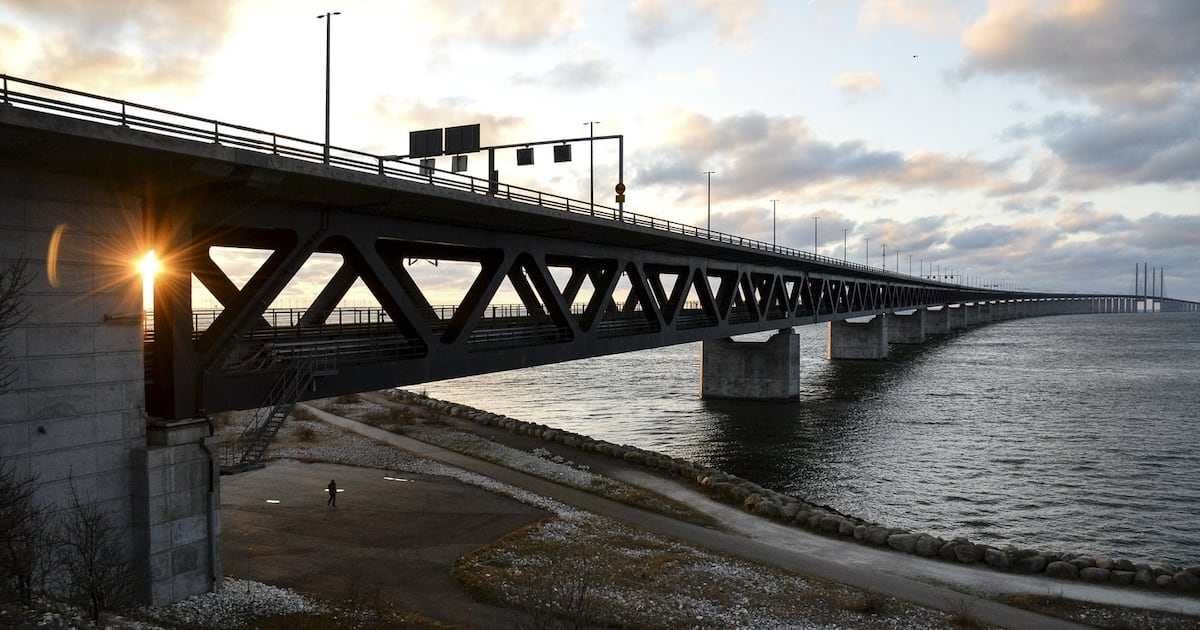
Newry could become Ireland’s Malmo and follow the lead of the southern Swedish city, which is home for thousands of people working in the nearby Danish capital, Copenhagen, a report has suggested.
The 64-page report, Newry Next, has set out a plan that would address Dublin’s housing needs by making the Co Down town into a cross-Border commuter hub by facilitating the construction of 6,000 new houses over the next decade.
Written by businessman Paschal Taggart and Ger Perdisatt, a strategy adviser on artificial intelligence (AI), it has argued that Newry could leverage its cross-Border location – and its proximity to both Dublin and Belfast – to provide large homes to commuters for €150,000 less that they would pay in commuter towns such as Mullingar, Portlaoise and Carlow.
The initiative, supported by former senator Martin McAleese, has suggested the Newry and Bambridge areas of Co Down could use the same “economic corridor” model as other cross-Border commuter towns and cities throughout Europe.
Under this model, workers live in one country where the cost of housing and living is cheaper, but work in another country where they pay their income taxes.
Prime examples in Europe are the corridors connecting Malmo and Copenhagen; between Annemasse, France, and Geneva in Switzerland; and between Bratislava in Slovakia and Vienna, Austria.
The authors said there were 14,000 cross-Border commutes daily on the railway and motorways that linked Dublin and Belfast and that commuting time was 45 minutes to Belfast and 75 minutes to Dublin.
But they have identified deficits in water infrastructure as the main impediment to growth in the area.
In his foreword to the report, Dr McAleese said the lack of wastewater capacity had already stalled the delivery of more than 1,300 homes and almost 30 commercial projects in the area.
“That simply cannot continue to be a brake on progress and development,” the report said.
A central recommendation is an investment of more than £107 million (€123 million) for wastewater treatment expansion and network reinforcement.
It also recommended upgrades to railway and roads infrastructure, as well as the establishment of an anchor development zone, similar to the Shannon Free Zone, which offers favourable tax arrangements to attract investment.
A second phase of investment would allow more infrastructural upgrades.
The report said that from the £107 million the direct and economic benefits to the region could be as much as £1.5 billion over the next decade.
Most of the upgrades could be paid from existing funding schemes, it said.
The wastewater upgrade would act as “enabling infrastructure”, allowing private capital “to fund housing commercial development without ongoing public subsidy for construction”.
“The resulting activity expands the local tax base, supports employment and strengthens long-term regional economic resilience,” it said.
Mr Taggart told The Irish Times how a house that would cost €400,000 in commuter towns in the Republic would cost €150,000 less in Newry.
“The reason for that is threefold. There is no VAT on housing in the UK. It’s 13.5 per cent in the Republic, which is €65,000. Secondly, the sites are cheaper. Thirdly, construction materials are cheaper.”
Mr Taggart said the construction of 6,000 houses would increase the population of the region by 15,000.
The benefit for Dublin is that cross-Border commuters would pay Irish income taxes, but would then spend money locally in the Newry and Bambridge areas, he said. There would also be knock-on benefits, with more retail businesses and other economic activity. .
“The simplicity of this thing is that these types of scenarios are common all over the world. You take Geneva, which has 120,000 people living in France. And 100,000 people who live in Bratislava are working in Vienna,” Mr Taggart said.
He said the report has been distributed to political parties in Northern Ireland and said the initial feedback from them had been very positive.