The Venezuelan capital hit the headlines this week after U.S President Donald Trump ordered the seizure of its leader there.
Nicolás Maduro, President of the South American country, was in a heavily-guarded military compound in Caracas when U.S troops swooped and brought him home to face trial.
A 20-minute drive from that compound is the National Pantheon monument, which contains the grave of one Daniel Florence O’Leary… and therein lies a fascinating story.
You see, Trump may be keen to portray himself as the liberator of Venezuela after this week’s dramatic events, but Cork man O’Leary got there first – and will never be displaced in the heroic story of how Venezuela was born.
******
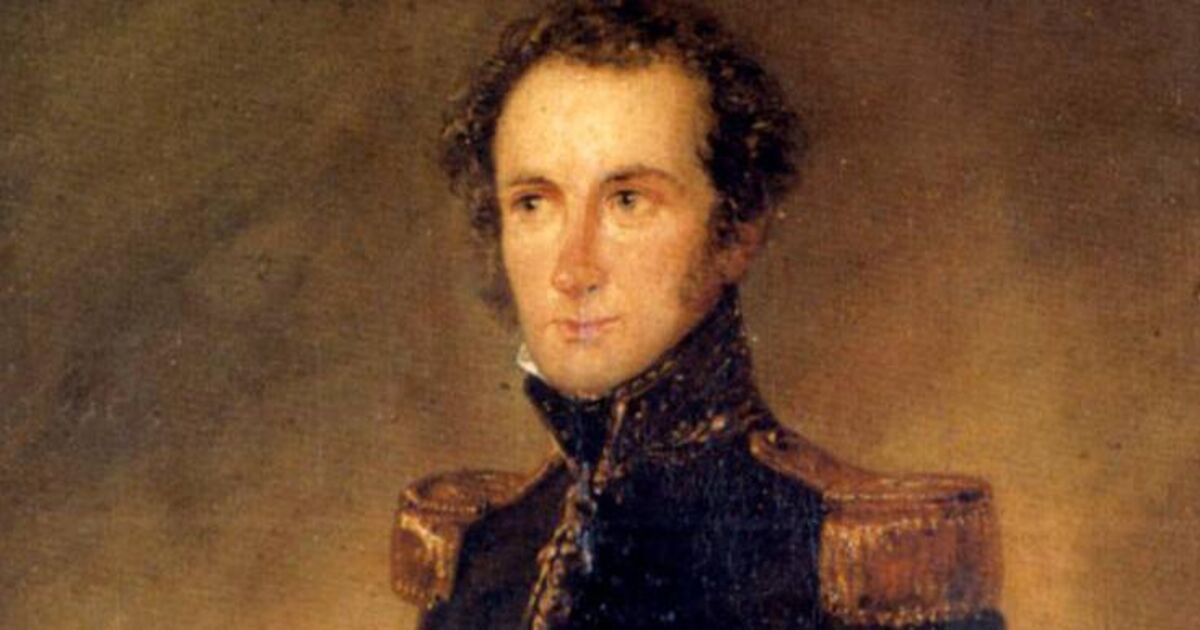
Daniel O’Leary was born in 1801 in Barrack Street, Cork city, into a wealthy family of butter merchants, who had a store at the junction of Barrack Street and Bandon Road. In 1812, the family moved to the more fashionable, upmarket Mary Street.
He grew up in revolutionary times. The French Revolution had created a new breed of men of privilege who were idealistic about nationhood and the power of the people.
If O’Leary was looking for a spark to ignite his idealism, he found one in a contemporary, Simón Bolívar, born 4,300 miles away in Caracas.
He would become the father of five South American nations – Venezuela, Columbia, Peru, Ecuador and Bolivia, which is named after him – but first he had to overthrow the Spanish imperialists who ran them.
Bolívar ran a recruitment drive for troops to help him, one appeared in the Cork Merchant Chronicle on March 16, 1820. It stated:
“Simon Bolivar President of State, Captain General etc. etc. to the brave soldiers of the Irish Legion.
“Irishmen, having left your own country in order to follow the generous sentiments which you have always distinguished yourselves among the illustrious of Europe, I have the glory now to number you among the adopted children of Venezuela and to esteem you as defenders of the Liberty of Columbia.
“Irishmen, your sacrifices exceed all praise and scarcely has Venezuela sufficient means to reward you according to your merits, but whatever Venezuela possesses and can dispose of shall with pleasure be consecrated to the use of distinguished foreigners, who came to offer themselves and services as a tribute to our infant Republic. Be assured that we will first prefer the privation of all our property, then divest you of any of your most sacred rights”.
It was a rallying cry answered by Daniel O’Leary. Just 16, he turned his back on a life of business and joined his fellow Irishmen in enlisting in the Red Huzzards of Venezuela.
Daniel was born for the military life, and was appointed a Second Lieutenant at 17, and a year later was promoted to the rank of Captain.
The Cork man took part in many of the great battles of the Americas alongside Bolívar, and was wounded in the battle which freed New Granada from Spanish rule in 1820.
The pair grew close, and in 1822, O’Leary was promoted to Lt Colonel and Principal aide-de-camp to Bolívar, accompanying him on his victorious marches through Peru, Ecuador, Columbia, and Bolivia.
During this time, O’Leary became a folk hero in Venezuela in particular, as it gained its independence from Spain and won nationhood. He represented the country in talks in London, Paris, and Madrid, and managed to visit Cork for a final time.
O’Leary never forgot his native city, and presented to the Old Queen’s College a collection of woods, minerals and birds for its museum.
In 1828, he married Bolívar’s niece and two years later, when the great leader died, he retired to Jamaica.
After a remarkable life, devoted to the struggle for smaller nations to shrug off their imperial past, similar to the one which Ireland fought against Britain a few decades after his death, O’Leary died in 1854.
He was interred at Bogota in Colombia and South America was plunged into mourning.
However, 28 years later, the Cork man’s mortal remains were taken by a grateful Venezuelan nation from Bogota to Caracas and laid to rest in the beautiful National Pantheon of Venezuela, next to his Commander-in-Chief Bolívar. The tomb is protected by a 24-hour guard.
It is not the only part of Caracas where O’Leary is remembered. There are statues of him and streets are named after him, including O’Leary Plaza. A Battalion in the Venezuelan army is named Battalion O’Leary.
Arguably, his greatest epitaph is Las Memorias, his 32-volume account of the Wars of Independence in South America.
******
Nor has O’Leary’s native city forgotten its illustrious son.
In 2019, his memory was honoured in Cork with the unveiling of a plaque at Barrack Street, to mark the site of his birth. President Michael D. Higgins applauded those who had organised the plaque “in memory of a great Corkman who had such a huge impact on Latin America”.
At another ceremony in Cork in 2004, some of General O’Leary’s personal possessions were presented to army staff at the city’s Collins Barracks, with the intention that they go on public display in the military museum.
A piece of electrical box street art also pays tribute to O’Leary in Barrack Street, and there is a bust of the great man in Fitzgerald’s Park.
On recent trips to South America, Micheál Martin and former lord mayor of Cork John Sheehan have paid official visits to memorials to O’Leary.
******
It’s fair to say that most South American nations have endured chequered and tumultuous histories since gaining their independence – and Venezuela is no different.
However, one element that has always united all that nation’s leaders, including the recently-deposed Maduro, has been their willingness to invoke O’Leary as a symbol of national pride and shared history, along with Bolívar.
The next leader of Venezuela – and hopefully that will be a democratically-elected native of that country, and not Donald Trump – can only hope they earn as much enduring popularity as the Cork man.