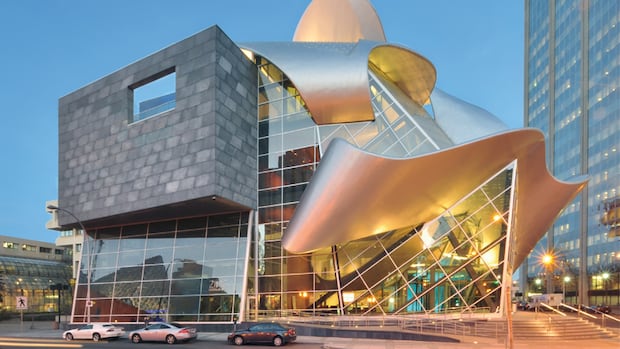
The Art Gallery of Alberta is channeling its creative energy to boost membership numbers that have failed to come back since the COVID-19 pandemic.
Membership bottomed out to roughly 2,800 individuals during the pandemic, which started in 2020 and wasn’t declared over until 2023, according to Catherine Crowston, the AGA’s executive director and chief curator.
That is a major drop from the 10,000-member peak seen when the renovated gallery reopened in 2010.
Although memberships have increased since then — there are currently about 6,500 members — Crowston told Edmonton AM that her organization is still trying to navigate the lingering impacts of the pandemic.
“There’s a lot of change in the way that people … interact with cultural organizations,” Crowston said on Thursday. “I think that people are making plans for their lives in different ways, and so I think that membership is one thing where we see maybe a hesitancy to commit to something over a longer period of time.”
LISTEN | The AGA is trying to boost membership numbers:
Edmonton AM7:20Reviving declining membership numbers at the AGA
The Art Gallery of Alberta has seen a decline in memberships. Now there’s a push to improve those membership numbers. Catherine Crowston is the executive director and chief curator of the AGA.
Now, Crowston said, the organization is working to foster that longer-term commitment by demonstrating that membership isn’t just about securing free admission.
Membership is “also about being part of a larger kind of community [while] contributing to arts organizations in the city and across the province,” she said.
Part of that effort was last year’s establishment of the Women for the Art Gallery of Alberta committee (WAGA), a group of 10 women with a goal to reach 10,000 memberships.
“It’s an ambitious goal, but … there’s so many activities that we’re working together on to engage people with the gallery in different ways,” Crowston said.
Teresa Melton, co-chair of WAGA, said she was driven to get involved with the committee by her passion for sustaining Edmonton’s vital arts and cultural institutions.
“I think in order for Edmonton to be a thriving city, we really need to support and use the incredible assets that we have,” Melton said.
Melton said WAGA has been collaborating with the gallery on programs and members-only events to boost patronage, while working with the organization to promote engagement “via the root of membership.”
“Membership is just one easy entry point to the art gallery. So not only is it important for the success of the art gallery itself as an asset to the city, but it’s important for supporting artists, art education, and exposure to the world of art,” Melton said.
According to the gallery’s website, membership plans are available for adults, seniors and couples, with a one-year adult pass costing about $58.
The Art Gallery of Alberta’s 2024 annual report shows that of its nearly $6.4 million in total revenue, membership fees accounted for about $116,000, while general admission brought in almost $200,000.
Construction woes
In addition to the impact of the pandemic, Crowston said that ongoing construction around the downtown building has also been a major hindrance for visitors.
“Downtown Edmonton, from our perspective, has been under construction for about 10 years,” she said.
According to Crowston, these projects have limited parking availability and made it difficult for people to navigate downtown to reach the gallery.
But the gallery isn’t the only organization in Edmonton’s Arts District noticing issues from construction.
The Winspear Centre has “heard clearly from patrons and subscribers” that construction and a lack of parking have made it harder to attend performances, according to Hanna Choi, vice-president of marketing and business development for the Winspear Centre and Edmonton Symphony Orchestra.
In an emailed statement sent through a spokesperson, Choi said the organization recently received survey feedback that suggested 65 per cent of respondents have found it difficult accessing the concert hall.
Additionally, 70 per cent of all respondents specifically cited road construction and changes to parking payment, due to the removal of EPark machines, as factors hindering accessibility for the venue.
In an emailed statement to CBC News, the City of Edmonton said it “recognizes that ongoing construction can be disruptive and appreciates the public’s patience as we work to rehabilitate, new and build new infrastructure, improving access for all.”
Melton said the gallery is beginning to see re-engagement because of the committee and the organizations’ combined efforts.
“When we tell people that we’re engaged in this opportunity to revitalize and elevate the art gallery … the majority of people are like, ‘oh, such a great idea. So glad that you guys are doing this.’” said Melton. “So we’re really seeing a lot of positive traction with that.”