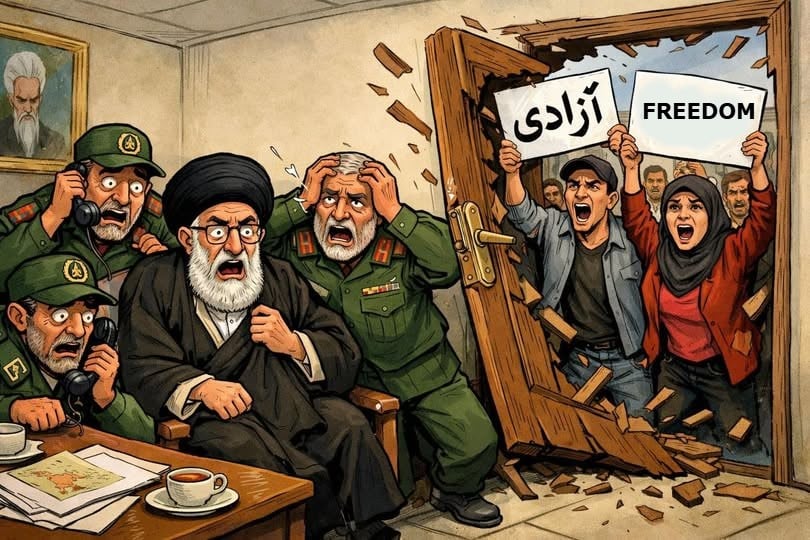
What could be the consequences of such event on the region in general and on Israel in particular
The fall of the Islamic regime in Iran, if and when it occurs, would be one of the most dramatic geopolitical events of the early twenty first century. This would not be a routine regional change of government, but a profound shock to an ideological, military, and strategic axis that has shaped the Middle East, and beyond, for decades.
Under clerical rule, Iran today constitutes the backbone of what is known as the “Axis of Resistance”: Hezbollah in Lebanon, Shiite militias in Iraq, the Houthis in Yemen, and Hamas and Palestinian Islamic Jihad in Gaza. The collapse of the regime in Tehran could sever the arteries of funding, guidance, and ideological legitimacy that sustain this axis. In the short term, chaos is possible: internal power struggles, the unraveling of governing institutions, and even attempts by extremist elements to seize strategic assets. Yet over the medium and long term, the region could enter a new phase, less ideological and more pragmatic.
For Israel, the implications are twofold. On the one hand, the supreme strategic threat of an openly hostile, nuclear, capable Iran orchestrating a multi front confrontation, could be significantly weakened or even disappear. A blow to the core of the Iranian system would directly affect Hezbollah and Iran’s other proxies, reducing their capacity to wage a prolonged war of attrition. On the other hand, a transitional period in Iran could be dangerous. Regimes in decline tend toward irrational behavior, and the temptation to “burn down the club” through regional escalation cannot be dismissed.
At the regional level, Sunni Arab states, led by Saudi Arabia, the United Arab Emirates, and Egypt, would be compelled to redefine their security doctrines. The fading of the Iranian threat in its current form could accelerate normalization processes, deepen economic cooperation, and potentially lead to the emergence of a new regional security architecture in which Israel is a legitimate and central player provided that a suitable solution to the Palestinian conflict would be found, one that could be acceptable to those states.
Globally, the fall of the Iranian regime would reverberate through energy markets, alter the balance of power among the United States, China, and Russia, and reshape the future of sanctions regimes. A post clerical Iran could gradually reintegrate into the international system, shaking established interests and creating new opportunities alongside intense competition for influence.
And what of the likelihood of such a collapse? Recent developments, recurring protests, a severe economic crisis, fractures within the ruling elites, and the erosion of public legitimacy, point to a regime weaker than it once was. At the same time, the instruments of repression remain intact, and the Islamic Revolutionary Guard Corps continues to demonstrate a considerable degree of loyalty. An immediate collapse, therefore, is far from certain. However, a scenario of prolonged erosion leading to a breaking point remains entirely plausible.
The question is not whether change will come, but how, when, and with what intensity. For Israel and for the world, preparing for the day after may be no less important than closely monitoring the events unfolding today.
Former news editor in the IBA radio in Arabic and chief editor for the digital platforms in Arabic on both IBA and IPBC. He has written many articles in Arabic, English and Hebrew on various topics. He has academic degrees in Middle Eastern history, Member of the presidency of the Israeli Press Council, Member of the board of directors of the Journalists Association Jerusalem, Member of the board of directors of the Israeli Translators Association.