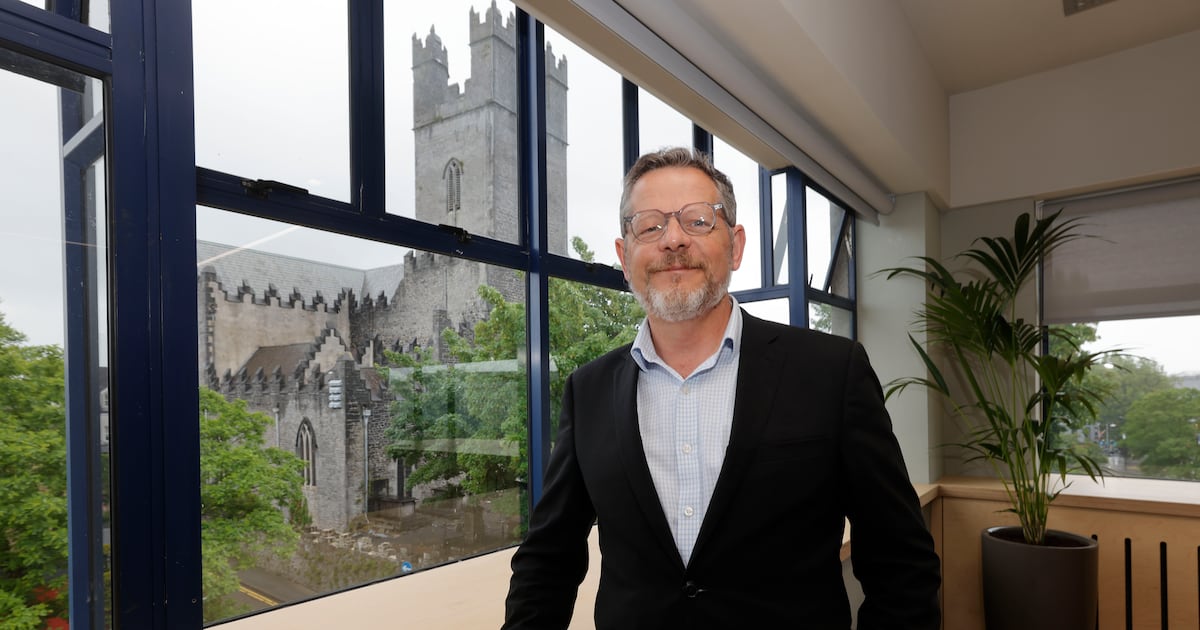
The cancellation of a planned Christmas market exposed significant tensions at the top of Limerick City and County Council.
Issues relating to staffing are at the heart of disputes that have arisen during the experiment in local democracy that sees Limerick as the only place in Ireland with a directly elected mayor.
Correspondence between Mayor John Moran and the Limerick council’s director general Pat Daly, released under the Freedom of Information Act, shows disagreement between the pair and “serious concerns” expressed by a trade union.
Moran, a former Department of Finance secretary general turned independent politician, was elected in 2024 as the first holder of the new office.
Proposing the council’s budget each year is the key power of the mayor. He has a wide-ranging mayoral programme on issues from housing to amenities.
While the mayor’s office has a small complement of four staff and a special adviser, he needs to harness the wider local authority staff resources to deliver on various policy ambitions. However, Limerick council’s website lists “human resources (HR) and local authority staffing matters” in an overview of the director general’s functions. Differing interpretations of the role of the mayor in this area has led to tension.
Last March Moran included a Christmas market among plans for his annual mayoral fund. He sought an integrated plan for various Christmas events from council officials.
Moran cancelled the market last autumn, telling the Limerick Leader the proposals “were developed late” and he “wasn’t happy it was going to be a success”. “It’s public money, so we decided we would push it off until next year,” he said.
In a controversial Live 95 radio interview on October 22nd, Moran suggested 2024 Christmas events in Limerick were “not up to the standard” of places like Waterford and Galway.
[ Limerick mayor faces setback in hopes for railway link to Shannon AirportOpens in new window ]
More broadly Moran said: “We have to do better”, that staff “have been delivering at full speed”, but “there’s no strategic HR” and “no transformational team” in the local authority.
He said the Limerick council was “going through one of the most fundamental transformations in local government”. “But I can’t make that happen, because that is ultimately going to be the choice of the director general as to what resources and how he allocates resources,” he said.
A council statement last week said it “has long had a strong, strategic approach to HR and organisational development”.
It cited the complex 2014 amalgamation of the previously separate city and county councils as an example of how it is “no stranger to transformational change”. The workforce and management is “more than capable of navigating major change”, it said.
In October Daly took exception to Moran’s radio comments. He emailed all council staff on October 23rd, saying: “I fully understand and share the sense of disappointment that some of the remarks have caused.” He advised staff to focus “on what we do best, that is serving our community with professionalism”.
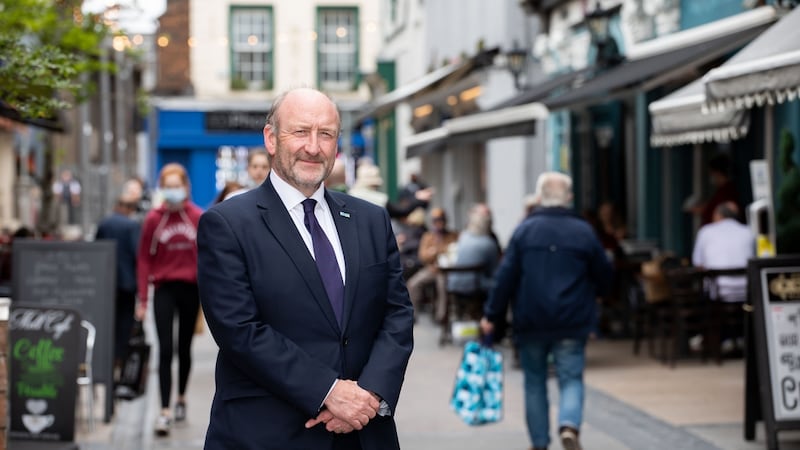 Pat Daly, chief executive of Limerick City and County Council, took exception to comments the mayor made on local radio
Moran later emailed all staff saying he was “disappointed” by Daly’s email. He wrote that “there are two sides to every debate” and “what is not in debate is that I hold the staff and management of the council in the highest regard”.
He thanked the “many” staff who welcomed his comments and understood his message, saying his main point was that “the people of Limerick deserve even more from us when it comes to delivering results”.
Moran said his view is that the council “has still not transformed itself into an organisation capable of maximising the opportunity” of having Ireland’s first directly elected mayor.
“This is not an effort to ascribe blame,” he said. “With new help we would work out the answers to some key questions. Starting with: who is responsible for what?”
He said the recent addition of a project management team from consultancy firm Grant Thornton would help improve delivery of the mayoral programme.
Councillors passed a motion of confidence in Daly on October 28th during a stormy meeting when Moran defended his position while sustaining criticism from elected representatives.
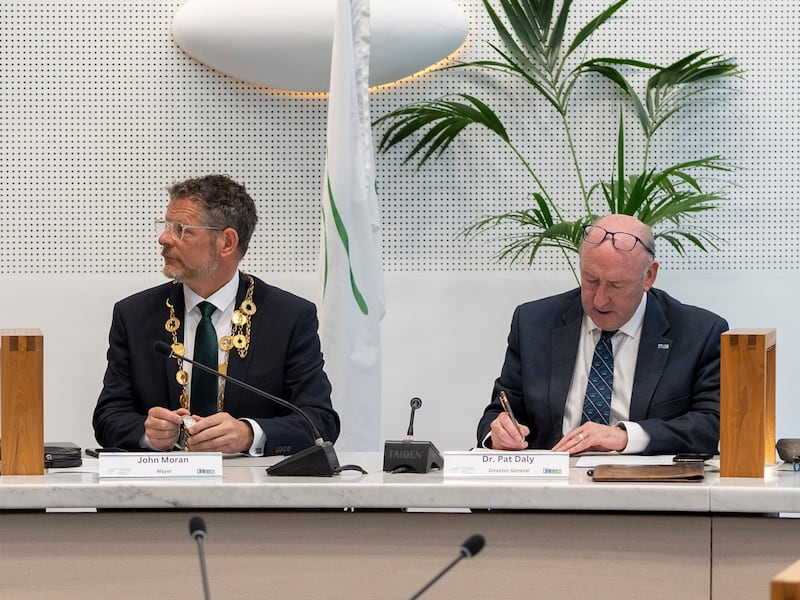 Mayor of Limerick John Moran and director general of Limerick City and County Council Dr Pat Daly at a local authority meeting.
Photograph: Don Moloney
On October 31st the Fórsa union, which represents 500 Limerick City and County Council workers, wrote to Daly saying the content of Moran’s email to staff raised “serious concerns”.
These include a claim that the mayor, in expressing disappointment at an internal management communication, “risks undermining the authority of the council’s executive and creating confusion around lines of accountability”.
Another Fórsa concern was commentary in Moran’s email that it viewed as concerning “operational matters”, including “staffing structures” that fall “within the remit of the director general”.
Fórsa said “any encroachment by consultants into the core work of our members, any attempt to give direction to [council] staff, or any involvement in operational decision-making will be regarded as a serious industrial relations matter”.
[ ‘Fight for us in the communities’: Views on ‘rocky’ first year of Limerick mayorOpens in new window ]
A statement from Moran last month said there were “very clear” arrangements under which the consultants were hired. They were to aid him in his mayoral programme delivery and “not give directions or make operational decisions”.
Daly sent Fórsa’s letter to Moran on November 3rd, flagging it for discussion with him at a meeting the following day.
Earlier on November 3rd, Moran sent another email to staff on the council budget process, mentioning a possible deficit of €8.8 million. The council later passed a balanced budget with the help of measures including a commercial rates increase.
Moran said the only way to make difficult decisions was “together and with as much of the right information as possible”.
He was spending time with council directors to understand “the value you all contribute to Limerick and what is the ‘cost’ of that in terms of full-time staff numbers”. Moran said he would make sure the directors “have all the time they need to explain the value of their own team’s contribution” and “identify any savings that could be made”.
Fórsa wrote to Daly on November 3rd saying the mayor’s message was “generating anxiety among staff, who interpret these remarks as an indication of potential workforce reductions” and requested a meeting “with HR and relevant senior management”.
[ Post-Connolly alliance seeks long-term change to left-wing politicsOpens in new window ]
Fórsa confirmed it met Daly on November 11th and said last week “there is no industrial action under way” in the council, “nor is there any planned”.
Moran provided a statement to The Irish Times last month. On Fórsa’s suggestion that he had risked creating confusion around council lines of accountability, the mayor’s statement said any confusion “may arise from confusion in some quarters” about the “correct interpretation” of amendments to the Local Government Act 2001.
These amendments from 2024 relate to the office of the directly elected mayor.
Moran’s statement referred to sections in the legislation suggesting the mayor shall be responsible for “the efficient and effective operation” of the local authority and “for that purpose carry on and manage and control generally the administration and business of the authority”.
His statement characterised Daly’s view as being that “only the [director general] has responsibility for all operational issues”.
The statement added: “Do Fórsa recognise that the mayor by virtue of these provisions is very much part of what they term the ‘council’s management team’?”
[ ‘Big disappointment’: EC officials criticise Irish opposition to Mercosur dealOpens in new window ]
A Fórsa statement said its “concerns related specifically to staffing matters. These were raised through the appropriate channels”.
In relation to the council’s website listing staffing matters among Daly’s functions, Moran’s statement said: “It is important to read the actual detailed statutory framework under which all functions are transferred to the mayor unless retained by the [director general] …
“To analyse this accurately, it cannot be sufficient to rely on summaries of complex rules when deciding the division of functionality.”
The statement added that this had been “much discussed” between the mayor and the director general. It said the mayor had requested legal advice to confirm whose interpretations were accurate.
On Fórsa’s suggestion that Moran’s November 3rd email to staff caused “anxiety” among employees, his statement said: “It is the function of the mayor alone to propose a balanced budget.” In doing this, the mayor “must take account of the demands on the organisation for service delivery and the setting of priorities” in a way that aligns with the priorities of Limerick people and be acceptable to the full council, whose members must approve it.
Moran’s view is that this requires a “full interrogation of matters in considerable detail especially in an environment of constrained financial resources”.
The statement said Moran is of the view, and has said publicly, that the council needs further financial and human resources to fulfil its mandate.
It also said: “A change as fundamental as that which Limerick is going through is most certainly going to need considerable change in past practices and often change can be hard for some.
“This is especially so where, as appears abundantly clear, the legislation did not itself give … clear guidance as to how it was to be interpreted.”
Moran added: “One thing is clear, the people of Limerick voted for change and the introduction of the model is already providing great visible results.”
Limerick City and County Council’s statement agreed on this last point, praising council teams “out every day making those actions happen”. It also said: “Change can indeed be challenging, but [the council’s] staff have a proven history of adapting, innovating, and raising standards”.