The chair of the Oireachtas Foreign Affairs Committee has said he regrets there wasn’t more “political leadership” on the Mercosur trade deal.
Fianna Fáil TD for Dublin South West John Lahart said he felt the case was not made for the trade deal before the Government ultimately decided to vote against it at EU level.
“Mercosur is exactly the kind of international trade pivot Ireland has to make,” he said, adding that there was a “tantalising prospect” of a market of hundreds of millions of people available to Irish exporters.
A briefing by EU trade representatives organised by Mr Lahart for the Foreign Affairs and Trade and Agriculture committees was told that additional beef imports into the EU would amount to 150 grams of extra beef per EU citizen per year, which Mr Lahart said amounted to “less than a burger per person per year”.
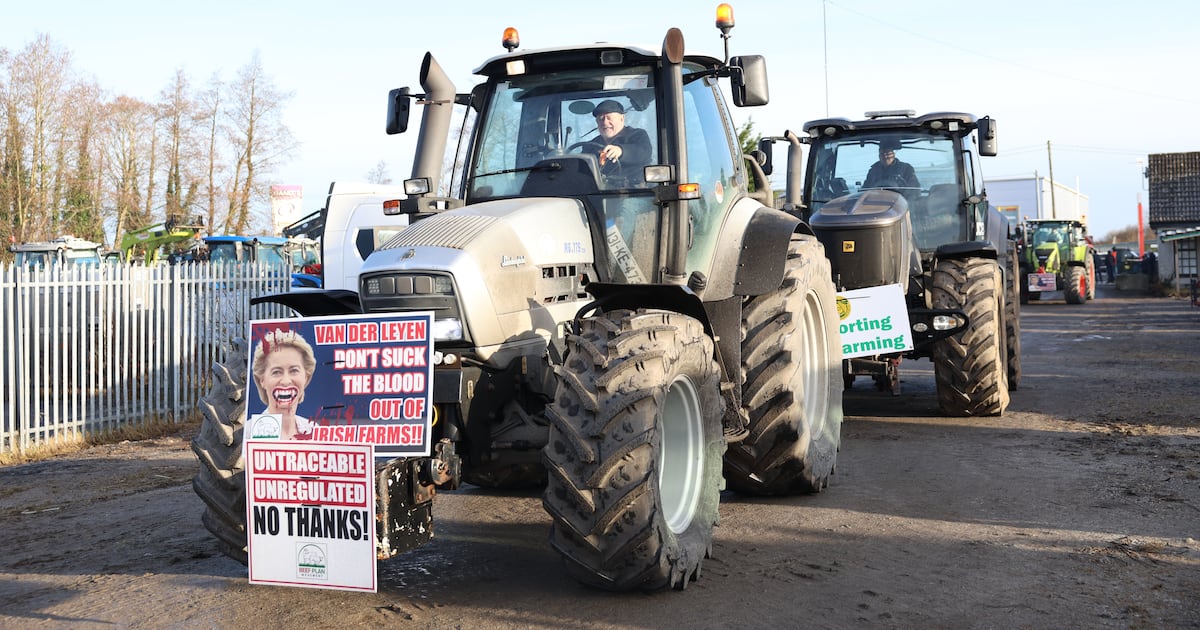
The agriculture lobby and the Government had both said the deal could not be supported because of risks to beef farming in particular.
“I regret that there wasn’t more political leadership and leadership generally on this matter,” Mr Lahart said. “The case never got made for it.”
The Dublin South West TD sparked speculation of a heave against Taoiseach Micheál Martin last October in the wake of Fianna Fáil’s presidential election fiasco when he said there needed to be a conversation about the leadership, which had been brought forward by the presidential election.
“Right through autumn I anticipated a full debate on [Mercosur] at the very least at parliamentary party level. I was looking forward to it. And then it suddenly landed on us almost unexpectedly soon,” he said.
Mr Lahart also said the international community is on “tenterhooks” against the backdrop of shifting global power dynamics that have undermined political trust.
He told The Irish Times that as part of his role as chair of the committee, he interacts with representatives of a host of countries, “a good few of whom find themselves in the eye of the changed international situation”.
The changing geopolitical picture, he said, has resulted in “different perspectives on international trade, on different directions of international trade, on rapidly evolving interpretations of relationships that had previously been taken for granted as being solid and secure”.
Mr Lahart was speaking after US special forces seized Venezuelan leader Nicolás Maduro in a raid at the start of January, after which US president Donald Trump increased his rhetoric on wanting to acquire Greenland for strategic reasons.
The Taoiseach was in China, where he was received by Xi Jinping on a diplomatic and trade mission.
Meanwhile, in Brussels, Ireland voted against the Mercosur trade deal between the European Union and a group of South American countries over concerns about its impact on the agricultural sector. That decision prompted disappointment in Brussels, which had wanted Ireland to vote for the deal in line with its wishes and with Dublin’s stated outlook as a pro-trade government.
“Many countries and trading blocs find themselves in the eye of these storms,” Mr Lahart said. “Relationships previously regarded as solid, stable, predictable, based on traditional alliances – much as we would like to think the world order will be returned, it seems to be clear that’s not going to happen.”
He said this was “because trust has broken down in some cases and there’s a tremendous sense of betrayal”.
Mr Lahart, referring to the United States, said there is a “diplomatic dance going on because you have a major power acting in a particular way”.
Mr Lahart said he personally supported the positions on the Venezuelan affair outlined by the Government and by EU foreign policy chief Kaja Kallas.
“The international community is on tenterhooks … it’s a fraught time for governments – they’re walking tightropes and their language reflects that.”