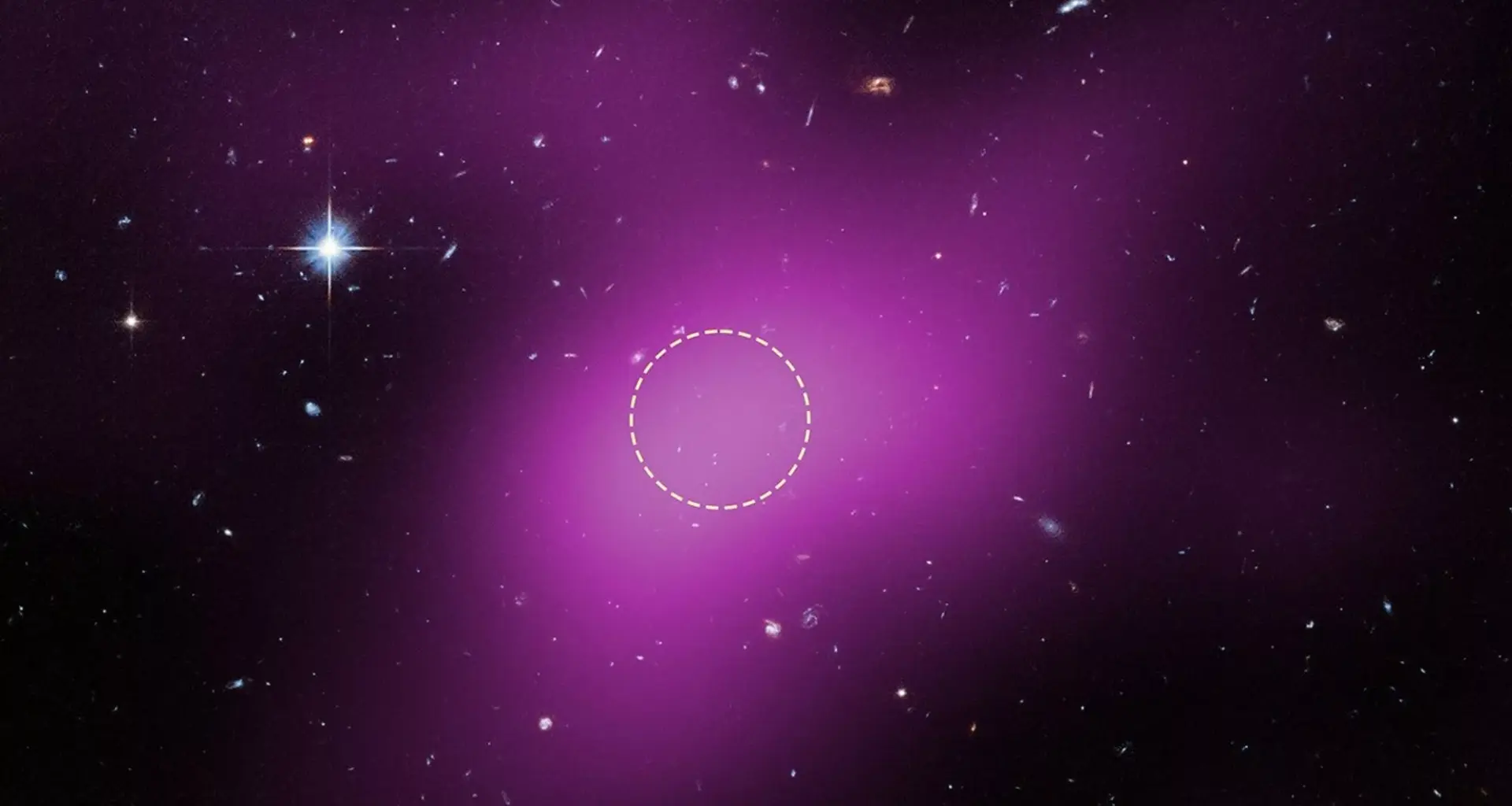
Astronomers with Hubble have spotted “Cloud‑9”, a ghostly, starless cloud of dark matter and hydrogen, a fossil relic from the dawn of galaxies. Found near the spiral galaxy M94, this rare “RELHIC” is the first confirmed glimpse of such a primordial leftover, offering fresh clues to how galaxies, and the universe itself, took shape.
Cloud‑9 floats through space beside the galaxy M94, about 14 million light‑years away. It’s small, around 4,500 light‑years wide, quiet, and doesn’t spin. Yet it’s heavy, packed with as much hydrogen as a million Suns.
“This is a tale of a failed galaxy,” said the program’s principal investigator, Alejandro Benitez-Llambay of the Milano-Bicocca University in Milan, Italy. “In science, we usually learn more from the failures than from the successes. In this case, the absence of stars proves the theory right. It tells us that we have found in the local universe a primordial building block of a galaxy that hasn’t formed.”
Team member Andrew Fox of the Association of Universities for Research in Astronomy/Space Telescope Science Institute (AURA/STScI) for the European Space Agency. “We know from theory that most of the mass in the universe is expected to be dark matter, but it’s difficult to detect this dark material because it doesn’t emit light. Cloud-9 gives us a rare look at a dark-matter-dominated cloud.”
Astronomers discover a galaxy-wide wobbling black hole jet
Lead author Gagandeep Anand of STScI said, “Before we used Hubble, you could argue that this is a faint dwarf galaxy that we could not see with ground-based telescopes. They didn’t go deep enough to detect stars. But with Hubble’s Advanced Camera for Surveys, we’re able to nail down that there’s nothing there.”
Astronomers see RELHICs as dark‑matter clouds that failed to spark stars, windows into the universe’s first galaxies. Cloud‑9 hints at countless other “failed galaxies,” hidden in the dark. Unlike the sprawling, messy hydrogen clouds near the Milky Way, Cloud‑9 is tiny, compact, and perfectly round.
At its heart lies a sphere of neutral hydrogen, stretching 4,900 light‑years across. Cloud‑9 may look empty, but it’s mighty. It holds as much gas as a million Suns, yet stays starless because an enormous amount of invisible dark matter, about five billion Suns’ worth, keeps it stable. That makes Cloud‑9 a giant “shadow galaxy” that never switched on its lights.
It’s a reminder that the universe isn’t just about stars. Cloud‑9 shows the hidden side of the universe. Cloud‑9 is a starless cloud of gas, a “failed galaxy” that never turned on its lights. It’s hard to see because brighter galaxies outshine it, and drifting through space can strip away its gas. Finding one is like catching a rare glimpse of the hidden framework that holds the universe together.
Gravitational waves may reveal the nature of dark matter
First spotted by China’s giant FAST radio telescope and later checked by U.S. facilities, Cloud‑9 was finally revealed by Hubble to be truly starless, a failed galaxy adrift in the dark.
Too small, and it would vanish; too big, and it would shine like any other galaxy. But Cloud‑9 sits in a rare “sweet spot”, a starless relic that lets astronomers peer directly into the hidden physics of dark matter. Its rarity makes each discovery precious, hinting at more failed galaxies waiting in the shadows to reveal secrets of the early universe.
The discovery of this relic cloud was a surprise. “Among our galactic neighbors, there might be a few abandoned houses out there,” said STScI’s Rachael Beaton, who is also on the research team.
Journal Reference:
- Anand, Gagandeep S, Benítez-Llambay, Alejandro, Beaton, Rachael et al. The First RELHIC? Cloud-9 is a Starless Gas Cloud. The Astrophysical Journal Letters. DOI: 10.3847/2041-8213/ae1584