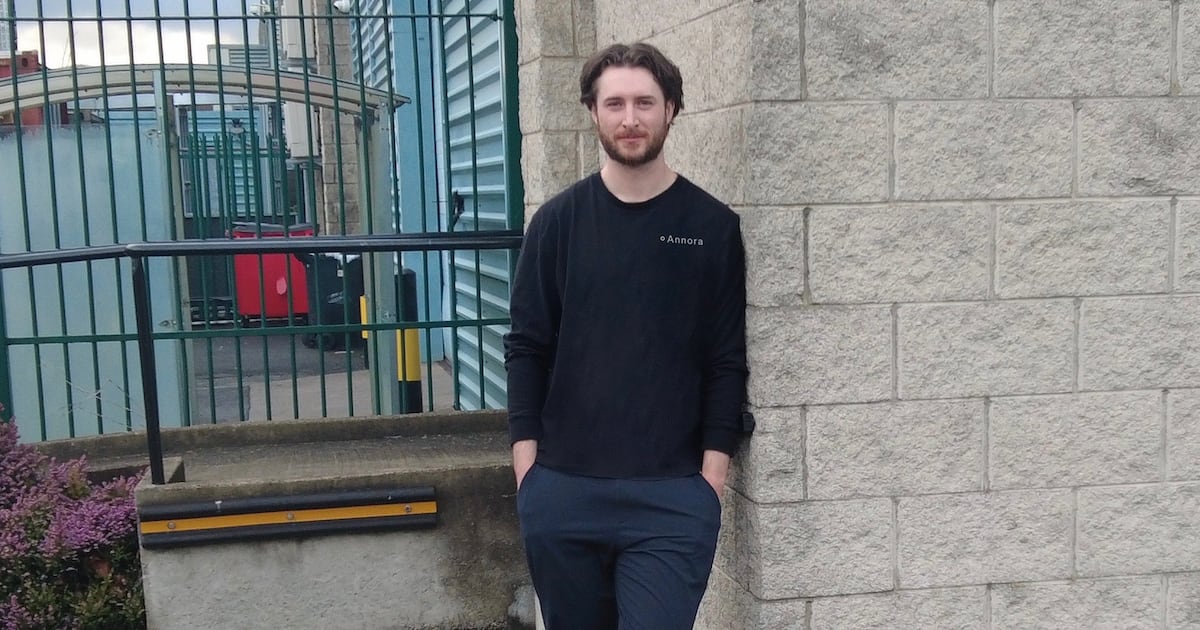
Patrick Byrne is a mechanical and manufacturing engineer with a particular competency in data science/analysis. After graduating, he joined Intel, working in a role that used data to reduce costs.
It was there that he was introduced to the automation and machine learning that’s now at the heart of Annora, the company he cofounded in 2024 with artificial intelligence expert Dr Wes Teskey to build AI agents and software for infrastructure critical manufacturing.
“The two biggest challenges for manufacturing companies in the West are competition from countries with lower labour costs and a retiring workforce that isn’t being replaced. Both of these challenges only have one solution: automation,” Byrne says.
“That said, the software currently used by manufacturing companies makes automation almost impossible because data is spread across many different silos that don’t talk to each other,” he adds.
“People have to enter information into multiple systems that are clunky, slow and difficult to use. It’s hard to switch off these systems too because they are ingrained. It can take years to change over and there’s always a risk. Transitions gone wrong can cripple companies.”
The commercial drawback of these legacy systems is stark. They create production bottlenecks and slow down the quotation process, resulting in low win rates for new work. Annora’s solution is to combine the silos into a single system that is capable of tracking every action and order across the business.
“Because every action is tracked, simple and repetitive tasks can be automated and the system gets smarter and improves over time,” Byrne says.
“It takes time to build a solution so we do so iteratively, focusing first on revenue generation to fill the company’s existing capacity. This focus on revenue means customers start seeing returns within a few months of working with us compared with three to five years for a regular ERP [enterprise resource planning] transition.”
The business began as a consultancy 18 months ago with its product gradually taking shape since then. Informing its development has been the fact that Byrne spent hours crunching data in client companies trying to fix problems caused by the lack of joined-up systems.
“It turned out that things were worse than we’d imagined,” he says. “We had initially built an AI search system, like ChatGPT, for a particular company but then we discovered that the underlying data was often outdated, incorrect or conflicted with other sources. Multiple systems that don’t talk to each other create errors, missing data and massive inefficiency.”
As Annora won more consultancy assignments, Byrne studied workflows reviewing transcripts, running calculations and interviewing directors, executives and workflow owners, only to see the same problems arising again and again.
“The breakthrough came when we realised that problems in manufacturing, engineering and purchasing often didn’t originate in these departments, but were coming from upstream,” he says.
“Sales didn’t have clear boundaries around what they could sell, so they’d commit to products that had never been built, or couldn’t be built at all. This cascaded downstream into chaos. That’s when we understood that starting from the top of the funnel, the enquiry and quoting process, didn’t just deliver fast ROI it also solved problems across the entire company.”
To go with their novel product the founders decided to change how companies were charged for QPR (configure, price, quote) systems. Traditionally, they paid up front and essentially took all the risk whereas Annora charges a small percentage on business won using its system.
The company’s target market is growth-oriented manufacturers employing between 50 and 1,000 employees. Its competition comes from large and long-established players in the sector but Byrne is undaunted.
“They were developing their systems when it was really expensive to build software so they’ve just continue to stack more software on top of systems often not designed for manufacturing in the first place,” he says.
“Others before us have tried to replace these legacy software companies but they’ve been replacing like-with-like. We’re doing something entirely different.
“Instead of building another monolithic platform, we’re building flexible modules that can be implemented on their own or as part of a whole system replacement. We’re enabling companies to replace their ERP over time rather than forcing a big switch all at once. This means our customers can get a return on their investment and use that return to fund the replacement of their existing systems.
“Our flexible modules are like templates that can be redesigned to fit the customer perfectly by using generative AI to rewrite the code. The customer gets something that feels entirely bespoke but delivered faster than traditional software can be configured.”
Annora got going on a shoestring budget of about €25,000 and Byrne has been full time in the business for the last 18 months without drawing a salary. The company received a small feasibility study grant from the Dublin city local enterprise office and Byrne took part in both the New Frontiers programme at Dundalk Institute of Technology and the National Digital Research Centre‘s pre-accelerator.
Annora is opening a funding round in the new year with the aim of raising around €3.5 million. “I’d like a combination of money and expertise – people with manufacturing experience and connections who could help us expand our product into niche industries we’re less familiar with,” Byrne says.
“The hardest part of setting up the business has been operating in uncertainty,” he adds. “You work 80 hours a week with no idea if you will be successful. I’ve been lucky to watch my mother run her business since I was 12 so I was under no illusion about how difficult it is. The main thing I’ve learned is that all you can do is keep going and stay focused on what you can control.”