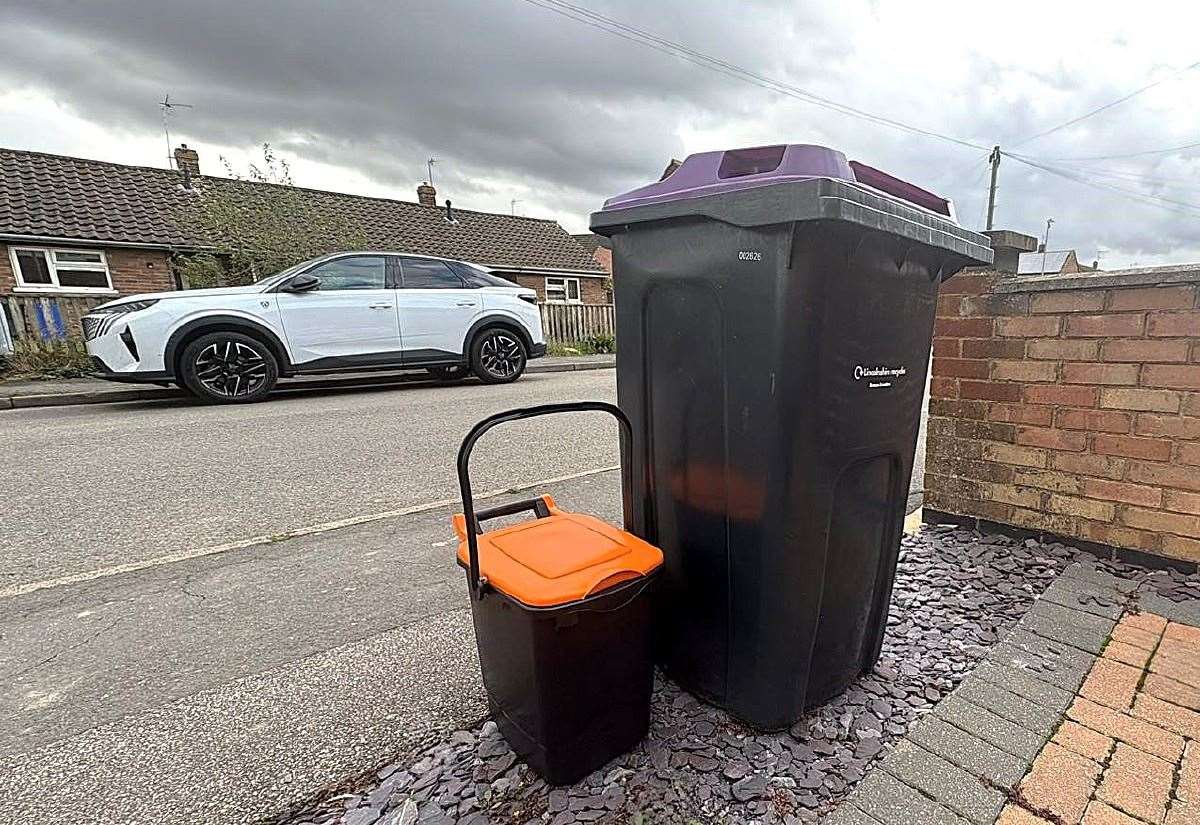
Plans to introduce a new food waste recycling service across South Kesteven have prompted a mixed response from residents, with many raising concerns about space, cost and potential hygiene issues.
Households will receive two new caddy containers next month ahead of the scheme’s official start on Monday, April 13.
A small five-litre indoor caddy will be supplied for daily use, alongside a larger 23-litre outdoor caddy for weekly collection.
 New food waste caddy pictured next to a standard black household bin. Photo: SKDC
South Kesteven District Council says the scheme aims to cut the amount of waste sent to landfill and convert food scraps into fertiliser and biogas.
Reactions from readers have ranged from cautious support to outright opposition.
A majority of commenters expressed frustration at the practicalities of managing an extra bin, particularly in smaller kitchens, terraced homes and limited gardens.
Alana Simpson, on the Grantham Journal Facebook page, wrote: “I imagine the people who come up with these ‘bin for all occasions’ decisions live in a house with a massive garden and can store them. They don’t think of 50% of the town.”
Jo Smithers, commenting on LincsOnline, said: “We already have four bins indoors. Where are we supposed to put these additional bins?”
“The problem is not the bins but where to put them on the street,” said Julie Robson.
Food waste being collected as part of the new recycling service. Photo: SKDC
Alongside storage, hygiene and vermin are major concerns.
Despite the council confirming collections will be weekly, replacing the current fortnightly disposal of food waste in the black bin, many residents fear the new caddies will create a nuisance.
Lisa Wells commented on the Rutland & Stamford Mercury’s post: “Well that will smell delightful in the summer and the flies!” while Neil Sawyer in Grantham joked: “Maggot heaven in the summer lol.”
Sheila Rimmington in Grantham added: “I don’t want food left out for animals, eg mice and rats, encouraged to try and get it.”
Some people questioned whether the service represents good value for council tax payers.
Grantham reader Scott Burland wrote: “Just another reason to put up council tax by 4.99 percent. Expensive bin collection,” while Stamford commenter John Baxter added: “How much are the council paying for me to store their equipment on my property without my permission?”
Food waste being treated at a specialist processing plant. Photo: SKDC
Despite concerns, a minority welcomed the scheme for its environmental benefits.
Janice Clough said: “Most areas of the country collect food waste. It’s nice to know that at last we’re now going to have this collection. Most of the black bin waste is related to food. Anything that stops so much going to landfill is good.”
Paul Mason, also on the Grantham page, said the anaerobic digestion facility generating natural forms of energy, such as biogas, would be “an excellent alternative to fossil fuels, and a fertiliser which can be used in local farming.”
“As someone who has to keep my bin bags inside my house for two weeks this will be great,” added Lucy Catherine in the Grantham discussion.
Others pointed out the potential to reduce washing of black bins or to divert food scraps from landfill to energy production.
Several residents also reflected on previous trials in the district, which they said were ineffective or caused inconvenience.
Dawn Senior recalled an earlier scheme, saying: “Did a trial of this years ago on Tennyson Avenue [Grantham]. Didn’t really work then.”
Emma Woollard-Grose wrote in Stamford: “I was part of the trial. They were awful.”
Councillor Rhys Baker (Ind), cabinet member for environment and waste, said previously that the new scheme would be “a simple change with a powerful impact” and encouraged households to participate, stressing that food waste collection will follow the same schedule as existing bins.
“Many residents are already enthusiastic recyclers and I am sure they will embrace this new system to see where it can take us,” he said.
“This is a simple change with a powerful impact. Together, we can reduce waste, generate clean energy and make Lincolnshire greener for generations to come.”
The council advises residents to remove food from packaging and avoid liquids in the caddies.
Items collected will be sent to a Lincolnshire anaerobic digestion facility to produce renewable electricity and nutrient-rich fertiliser.
For further guidance and tips on reducing household food waste, residents can visit www.southkesteven.gov.uk/foodwaste or the Love Food Hate Waste website.
What do you think? Share your views in the comments below.