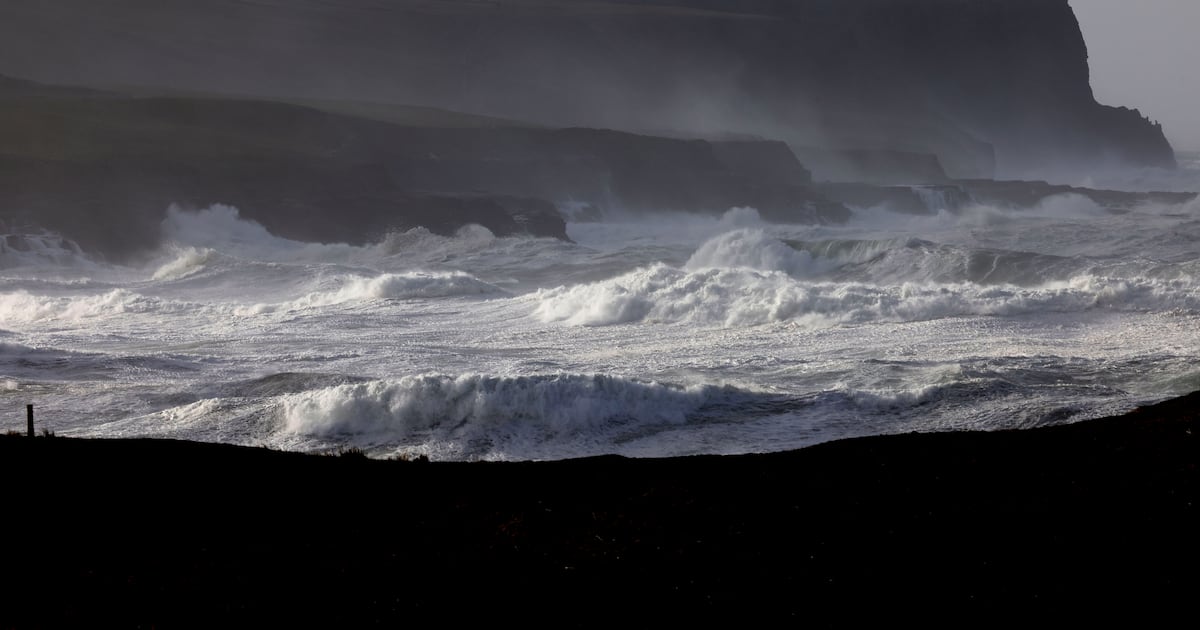
Ireland’s exposure to extreme weather is set to increase as latest research by Europe’s climate analysts shows underlying conditions worsening.
The Global Climate Highlights report by the EU’s Copernicus climate change monitoring service shows how 2025 was Earth’s third hottest year on record, marking an 11-year streak of temperatures above normal.
All indications are this run will continue, with rising average temperatures reaching a perilous threshold by 2030 that scientists had not expected would happen until around 2040.
“The last three years that we have experienced – when we look back in five years’ time – will be cooler than average, rather than continue to be exceptional,” said Dr Samantha Burgess, deputy director of Copernicus Climate Change, the EU body charged with providing information on past, present and future climate patterns.
She said the result would be “significant ecosystem disruption” as well as the “intensification and increased frequency of extreme events”.
[ We need everything to solve the climate crisis Opens in new window ]
Ireland’s experience closely follows the global trend, with 2025 the country’s second-warmest year on record and the last four years the warmest documented. Last year was also marked by pronounced weather-related difficulties for many.
Storm Éowyn brought the most destructive winds on record almost a year ago, prolonged regional droughts prompted Uisce Éireann to impose the earliest-ever water restrictions and severe localised flooding inflicted heavy damage on parts of the south, southeast and northeast.
Ireland also had its warmest summer despite no official heatwave. Instead, unusual conditions kept daytime heat from dissipating, leading to uncomfortably warm nights that kept overall temperatures high.
The Copernicus data indicates the years immediately ahead will bring similar or more severe challenges.
Average temperature increase worldwide over the past three years exceeded the 1.5-degree threshold – a marker for how far the planet has warmed above pre-industrial levels, before the burning of fossil fuels accelerated.
That excess increase is now forecast to become standard by 2030 – a decade earlier than predicted when the world’s countries signed the Paris Agreement in 2015, pledging to work together to prevent that 1.5 degrees being breached.
“Those are stark findings,” Paul Moore, climatologist with Met Éireann, said. “It shows that we have already reached a new spike [in temperatures] and we’re on course for another one.
“And as we know, as temperatures warm, the extreme weather events get more extreme and more frequent.”
The Global Climate Highlights report shows how 91 per cent of the world had above-average temperatures in 2025 and half had more than their usual number of heat-stress days, those when heat and humidity reached levels that put public health at risk.
January was the warmest recorded and February saw the lowest volume of sea ice since satellite-aided measurements began almost 60 years ago.
Dr Burgess, of Copernicus, said there was no getting away from the problem’s underlying cause.
“The primary reason for these record temperatures is the accumulation of greenhouse gas in the atmosphere, dominated by the burning of fossil fuels,” she said.
“As greenhouse gases continue to accumulate in the atmosphere, temperatures continue to rise, including in the ocean. Sea levels continue to rise, and glaciers, sea ice and ice sheets continue to melt.”
Marie Donnelly, chair of Ireland’s Climate Change Advisory Council, the body that advises government, said the implications of the data must be made real for the public and policymakers.
“Climate change is going to lead to more ferocious storms and the consequences that follow,” she said. “It’s going to lead to more floods, to more sea-level rise and more coastal erosion.
“These are things that really impact on people’s homes and property and how they live.
“The age-old message we keep repeating needs to be said again: climate change is coming from fossil fuels. We have got to get out of fossil fuels.”