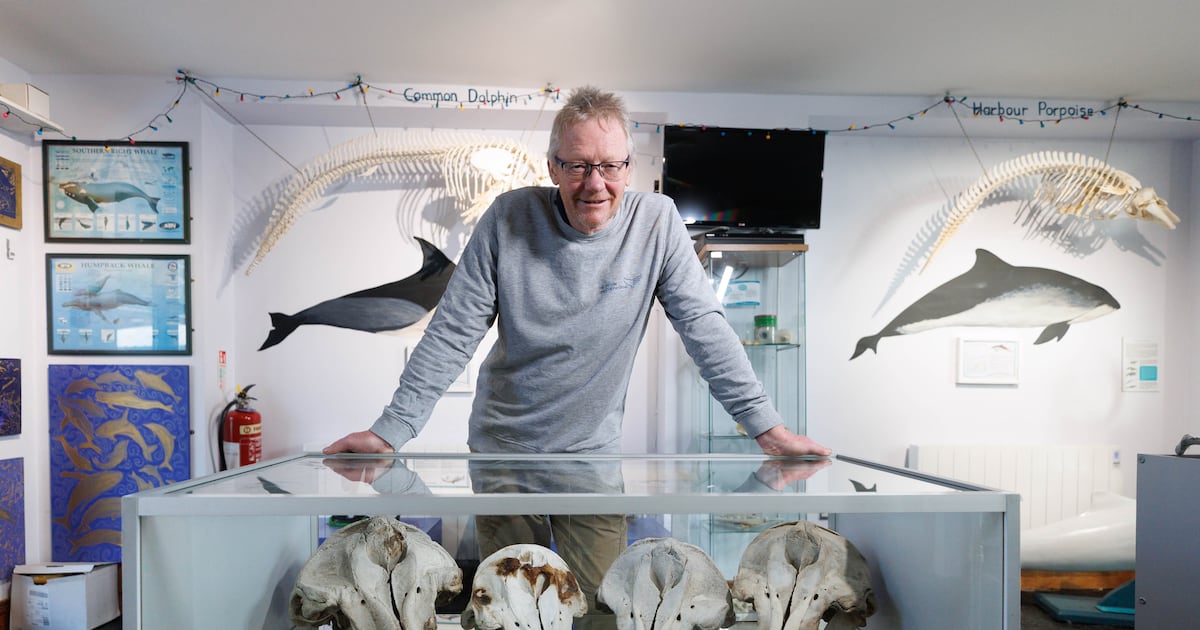
When dead whales wash up on beaches, many headaches follow.
Weekend plans get disrupted, favours have to be begged from experts and helpers and, if you are Simon Berrow, you might end up with a narwhal skeleton in your back garden.
“I’m trying to secure it from foxes,” he says of the rare find from the Donegal coast in November that he has been preserving in sealed containers outside his home.
The ad-hoc response to strandings of the ocean’s largest creatures in Ireland has worked to date because of the dedication of people from amateur enthusiasts to State vets and academics.
But with strandings becoming more frequent and the need to understand the reasons behind them increasingly pressing, pressure is growing to develop a more structured approach.
[ Dead dolphin found on Carlow river bank believed to have been pursuing fish ]
A meeting at Dublin Zoo to discuss the issue was attended by representatives of the Irish Whale and Dolphin Group (IWDG), the National Parks and Wildlife Service (NPWS), the veterinary profession, local authorities and experts from Ireland and overseas.
The consensus was that a formalised and consistently funded system is needed for postmortems, tissue collection, carcass preservation, database compilation and analysis.
“The IWDG arrange regular postmortems on behalf of the Marine Institute but only on specific species for specific purposes,” Berrow says.
“For example, we examined dolphins and porpoises over a period as part of a project looking at by-catch fatalities – the unintentional killing of cetaceans by fishing nets.
“But outside of those kinds of projects, our work is almost entirely voluntary. We get a small amount of funding to help but not enough to do anything comprehensively.”
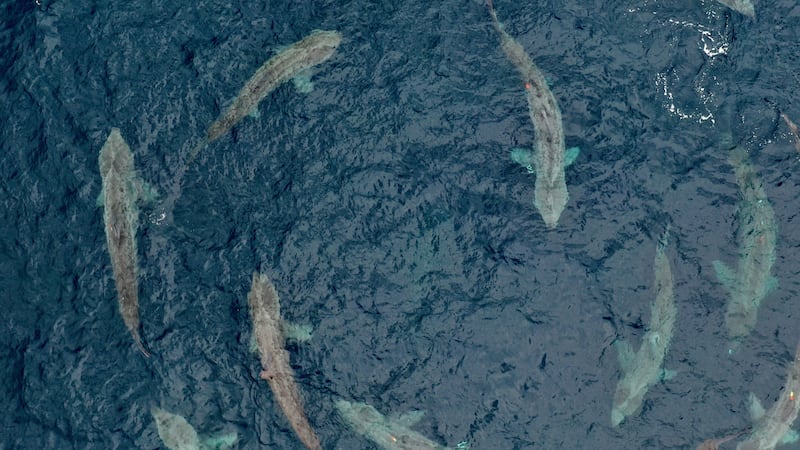 Circling basking sharks photographed from a drone off Co Clare. Photograph: Simon Berrow
The Department of Agriculture-funded Regional Veterinary Laboratory in Cork has been a significant support, providing facilities and manpower for postmortems, but an animal may have to be transported from the other end of the country, and that often relies on favours.
“Typically whales are found washed up at weekends because that’s when people are out walking and then you have to ring around whoever you know locally has a truck and ruin their plans asking them to bring a lump of whale down the country,” Berrow says.
Once a whale, or part of the mammal, has been secured for postmortem there can be a delay before detailed investigations take place.
At the IWDG’s offices in Kilrush, Co Kildare, a collection of stomachs sits in the freezer awaiting a researcher.
“It has the makings of a good research project, so hopefully someone will get funding to look at them,” Berrow says.
The narwhal could make a research project itself.
The small Arctic whale that often has a distinctive tusk protruding like a fencing sword from its rounded head has not been found in Ireland before.
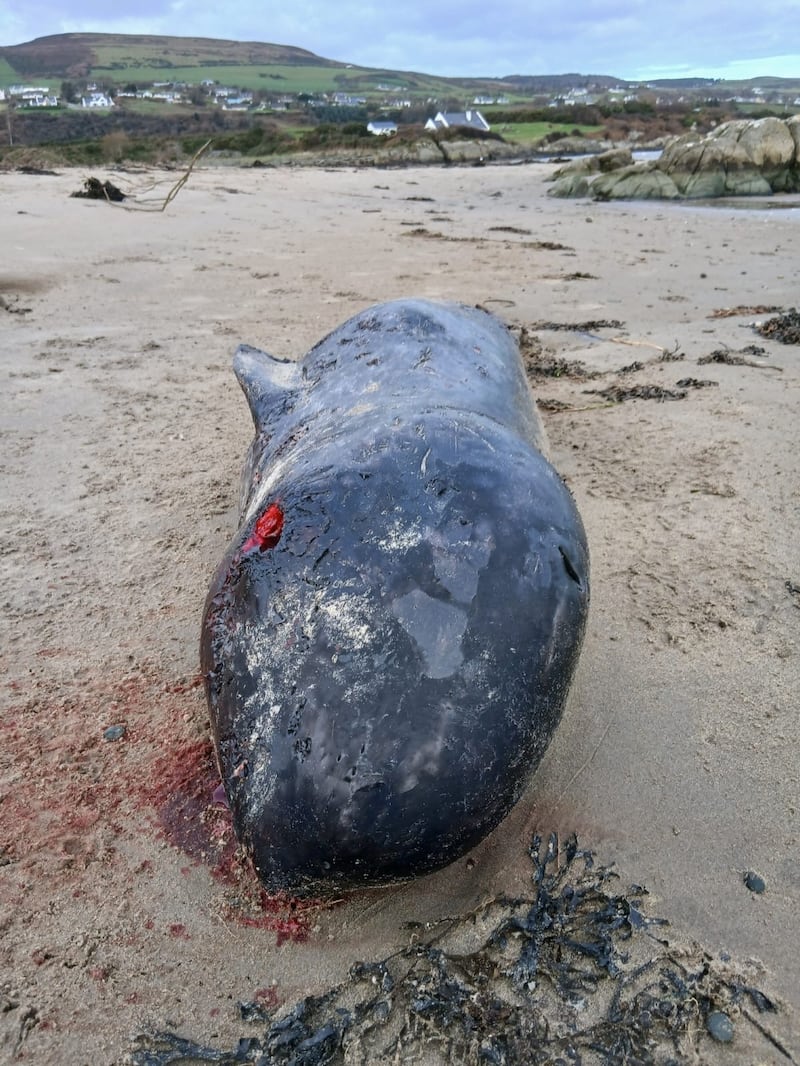 This female narwhal washed up on a beach in Donegal was first recording of the species in Irish waters. Photograph: NPWS
The Donegal narwhal was female and had no tusk as these are mainly found on males, but its corpse provided no obvious clues as to why it died or why it strayed into Irish waters in the first place.
One of its five stomach chambers was full of parasites, so that will need further investigation. Other test results are awaited.
Climate change can cause species to appear in regions they do not normally inhabit, and it is possible this played a role in this case.
“Narwhals live among the sea ice and the ice is disappearing,” Berrow says.
“The seas are getting too warm for ice and too warm for the food the whales feed on. You might think, well why didn’t it move further north where it’s colder then?”
Berrow says it is possible the animal was attracted further south by food sources, but moved north because the seas they normally inhabit were too warm for them also.
“Or it just might have been so upset by the changes in its normal habitat that it got completely confused and didn’t know where it was,” he says.
Last year, there were 300 strandings by mid-December, mostly of dolphins and porpoises and mostly dead, but there were also pilot, sperm, minke, fin and beaked whales, as well as unidentified remains.
As a follow-up to the meeting in Dublin Zoo, a formal proposal is to be made to the Government for a structured Statewide response, with all regional veterinary offices supported to accept postmortem specimens found in areas closest to them and a more systematic approach to data collection and analysis.
“If we selected 50 important specimens in a year and spread the work evenly, nobody would be asked to do too much and it would provide a good sample base for analysis,” Berrow says.
The relevant Government departments have signalled their interest.
The Department of Agriculture says it is “aware” of ongoing informal inter-agency discussions on the response to marine mammal strandings in Ireland and “will consider any discussion paper or formal proposal which emerges from those talks”.
The Department of Housing, which is responsible for the NPWS, says NPWS representatives attended the meeting.
The service is “open to reviewing the current systems and procedures and putting these procedures on a more structured long-term footing”, it says.