The last telemetry from MAVEN was received on December 4, and contact was officially lost two days later. The event occurred during a planned occultation, when Mars temporarily blocks the line of sight between the spacecraft and Earth. According to NASA, such outages are brief and expected, with signals typically resuming within minutes. In this case, the spacecraft did not reconnect once it passed out from behind the planet.
NASA classified the situation as a spacecraft emergency and began recovery efforts through the Deep Space Network (DSN). The network includes 230-foot antennas based in California, Spain, and Australia that work continuously to maintain communication with missions across the solar system.
Tracking Data Reveals Signs of Unexpected Rotation
NASA teams recovered a fragment of tracking data during radio science operations, which pointed to an anomaly. The signal fragment suggested the spacecraft may have started rotating unexpectedly. This motion could have shifted MAVEN’s high-gain antenna away from Earth, cutting off the narrow communication beam used for long-distance data transmission.
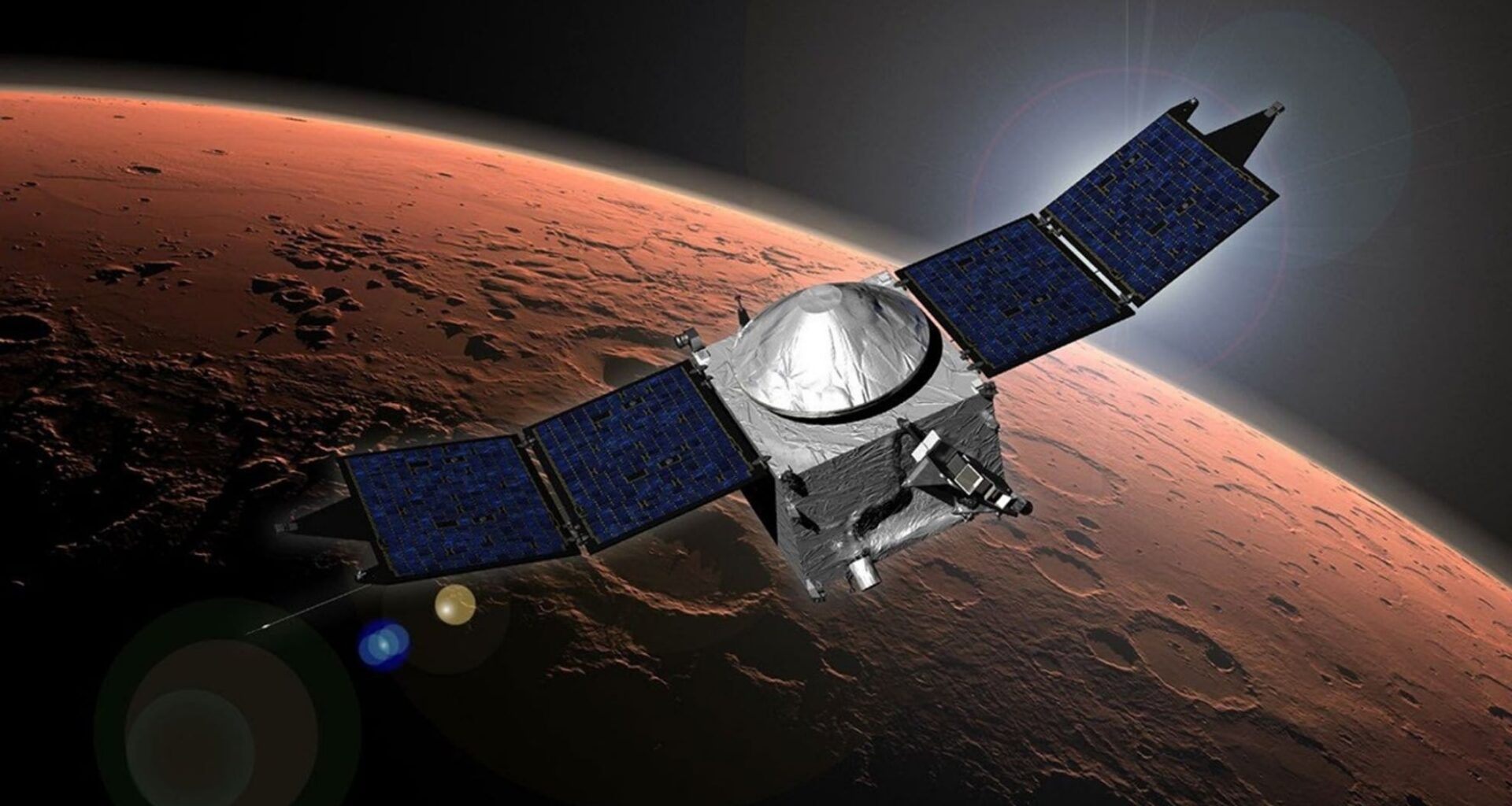
 This artist’s concept depicts NASA’s Mars Atmosphere and Volatile EvolutioN (MAVEN) spacecraft near Mars – © NASA
According to Earth.com, this change in orientation may explain the failure to regain contact. During normal operations, attitude control systems keep the spacecraft aligned so its antenna stays locked on Earth. A deviation of just a few degrees can cause communication links to fail. NASA engineers are reviewing recent command histories to determine what may have triggered the event.
DSN engineers have expanded their search range and are using Doppler effect measurements, small frequency changes that indicate motion, to identify possible orbital shifts. These frequency variations support the idea that MAVEN’s path or orientation has changed since the last confirmed signal.
Possible Entry Into Safe Mode Affects Communication
MAVEN may have entered safe mode, a software-controlled state that limits normal activity and protects the spacecraft in case of sensor conflict or power drops. This would disable regular functions and could include reconfiguring antenna direction. Onboard fault protection systems are designed to reset subsystems automatically when a problem is detected, though the exact cause of the silence remains unknown.
NASA is using emergency recovery procedures that include sending blind commands and scanning for signal tones. These methods are standard when telemetry is unavailable. Simulations are being run to test possible scenarios involving pointing, power supply, and thermal conditions. A drained battery could shut off transmitters and halt solar charging, further complicating recovery.
While these procedures can succeed in restoring contact, NASA has acknowledged that recovery could take weeks. Deep-space spacecraft rarely stop transmitting without warning, making this event particularly complex to resolve.
Relay Function and Science Operations Disrupted
In addition to its scientific mission, MAVEN serves as a relay satellite for surface missions. It forwards data from Mars rovers like Perseverance and Curiosity using its Electra relay system. With MAVEN offline, NASA has had to depend on other orbiters to maintain communication with the surface.
This has put pressure on the daily schedule, as fewer orbital passes reduce the time available for transmitting commands and receiving rover data. While the rovers can store data onboard, extended relay outages can limit operations and delay updates.
MAVEN was launched in November 2013 and entered Mars orbit in September 2014. The mission focuses on atmospheric escape, the process by which solar wind and radiation strip gases from the Martian atmosphere. By studying this phenomenon, scientists can better understand how Mars evolved from a planet with potential liquid water to its current state.
The spacecraft marked its ten-year milestone in 2024. Despite its age, it remained operational until the sudden anomaly in December 2025.