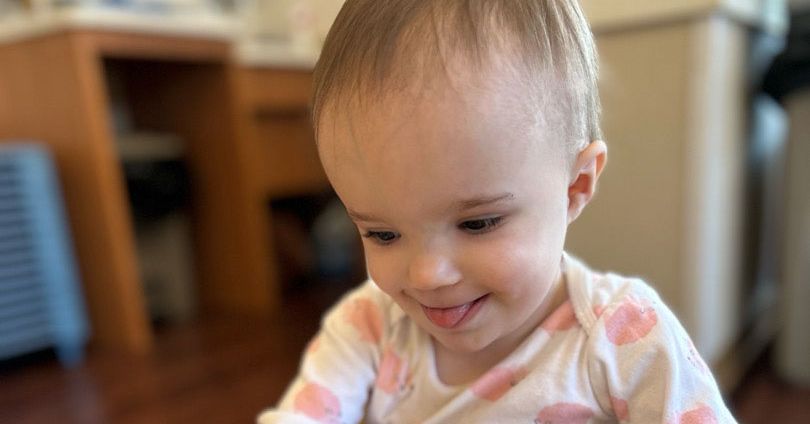
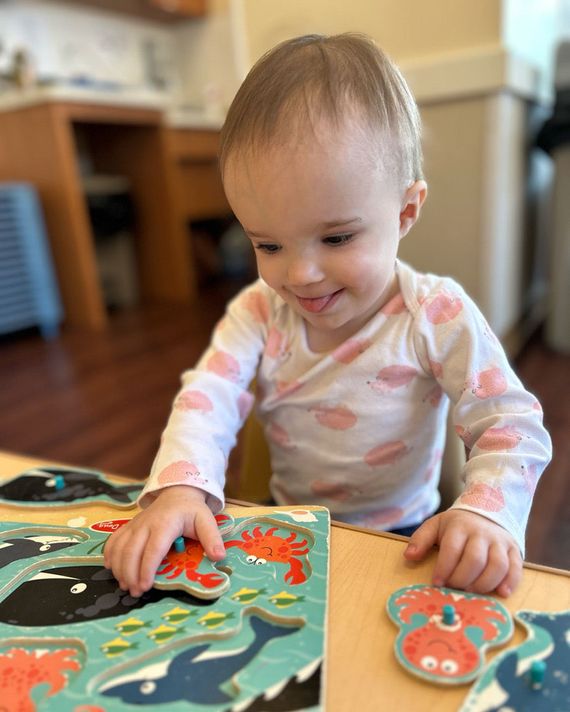
The first nine days of Jorie Kraus’s life followed a pattern: problem, solution. Problem, solution. Problem: Jorie was a preemie, born at 33 weeks by cesarean section. Solution: She’d spend a few weeks in the NICU. Problem: Although her parents, Joanie and Dave Kraus, had known since Joanie’s 20-week scan that Jorie had a heart abnormality, it turned out she actually had five, plus spinal and gastrointestinal abnormalities, too. Solution: She’d need a few surgeries. Each new diagnosis was frightening, but on the day Jorie was born, a surgeon assured Joanie and Dave that to the medical staff, her problems were all routine. We’ll fix it; we’ll move on, Joanie remembers thinking.
But on day ten, the pattern broke. The results of a rapid-genomic-sequencing test showed that Jorie had DeSanto-Shinawi syndrome, an extremely rare, incurable disorder marked by abnormalities in the WAC gene, which is thought to play a crucial role in neurodevelopment. DESSH, as the syndrome is sometimes called, was first described in 2015, just eight years before Jorie’s birth in 2023. Because the affected gene is associated with brain development, those with the syndrome often have motor challenges, intellectual differences, and sometimes behavioral and social ones, too. They also tend to have hypotonia, or muscle weakness, which means they might struggle to walk, sit up straight, eat, or even breathe. (The diagnosis helped explain many of Jorie’s mysterious health issues.) There are few treatment options available, beyond Band-Aids like physical therapy for symptom management. In the doctor’s office, Joanie heard all of this, but she launched into her usual line of questioning anyway — “What now? How do we fix this?” — until Dave spoke up. “Joanie, there’s no fix for this,” he said.
About a month after Jorie’s diagnosis, Dave was holding his daughter in the NICU when her monitoring alarms began to beep. “She went completely limp in my arms,” he told me. Her face started turning blue, and he could feel her tiny body growing colder. “I’m like, Did I — did she die?” The NICU nurses took Jorie and gave her oxygen. Later, Joanie and Dave learned that Jorie’s muscle tone was so low that her laryngeal tissues had become “floppy,” as Joanie describes it, and were obstructing her airway. Over the next two months, the Krauses lost count of how often these oxygen crashes happened. “You thought you watched your kid die,” Joanie said. “And it became the norm.” Each morning, Joanie would call the NICU night nurse and ask not whether it happened but how many times. Eventually, they learned that her hypotonia made breathing that much harder for Jorie; a G-tube and a break from oral feeding helped get the issue under control.
After 73 days in the NICU, Joanie and Dave took their daughter home. They figured out how to work the G-tube until she was strong enough to eat on her own and ramped up her physical therapy. Compared to her time in the NICU, Jorie was doing okay at home. But by the time she was nearly 2 years old, she had yet to babble let alone speak words, and she couldn’t walk on her own. Instead, she could “cruise” using her hands to steady herself on the living-room couch while walking sideways. She barely had enough core strength to power herself around in a sit-in walker. In pictures of Jorie from day care from around that time, she was often sitting apart from the other kids. “She would just sit there and observe and absorb,” Dave said. “But she wasn’t doing anything with it.” Joanie and Dave live in Eden Prairie, Minnesota, and Joanie is a classic case of midwestern nice. She hates to say anything negative about anyone, and especially the pediatrics team at the Mayo Clinic in Rochester, Minnesota, who helped her daughter. But she admitted to me that she was frustrated that their treatment plan for Jorie seemed to be: Give her lots of love and hope for the best. She didn’t realize that Dr. Whitney Thompson, then a first-year fellow in neonatal medicine and clinical genomics at the Mayo Clinic, hadn’t forgotten Dave’s hopelessness when he learned of his daughter’s rare diagnosis — and for the last year had actively been looking for answers.
As a fellow, Thompson had helped manage Jorie’s care, and she had been among those advocating for the genomic-sequencing test that identified Jorie’s condition. (From a clinical perspective, the fact that the Krauses had gotten an answer so quickly was remarkable. It typically takes five years or longer for someone with a suspected rare disease to receive a correct diagnosis, a situation so common it has a name: the diagnostic odyssey.) Shortly after Jorie was born, Thompson had met Laura Lambert, Ph.D., an early-career biomedical scientist at the Mayo Clinic who specializes in studying the role of genetic variants in rare diseases. The two instantly hit it off, and they started brainstorming about how they could combine Lambert’s lab with Thompson’s clinical expertise. “We just had really similar goals — we wanted to see what we could do specifically for the NICU and pediatric populations,” Lambert said. Before she joined the Mayo Clinic, Lambert had spent a few years working with an artificial-intelligence reasoning agent — a program that can infer and draw conclusions — to identify existing drugs that could be repurposed as treatments for conditions that had none, like Jorie’s. An estimated 20 percent of medications are already prescribed off-label — that is, for illnesses that are not their intended target. Patients with PTSD-related nightmares have been helped by prazosin, a hypertension drug; infants with certain heart issues have been treated successfully with sildenafil, better known as Viagra.
In the past, figuring out which drug may work on a rare illness has required time and bandwidth that few researchers, if any, had to spend. But AI introduced the possibility of quickly answering the primary question that intrigued them: What if a fix for Jorie’s condition already existed? They named their custom tool BabyFORce for its focus on NICU patients, though it has since expanded to help pediatric patients of all ages.
It’s easy to be pessimistic about AI, especially considering the slew of increasingly dour headlines about layoffs, psychotic breaks, imaginary boyfriends, suicides, and the encroaching creep of ChatGPT-generated slop. But for the often-overlooked field of rare-disease research, a handful of new AI-powered programs are fueling some real, if cautious, optimism. There are, according to some estimates, around 10,000 rare diseases, only 5 percent of which have FDA-approved treatments. Some scientists posit that advances in AI platforms could lead to progress for all 10,000 at once.
In the United States, a disease or disorder is considered rare if it affects fewer than 200,000 people. Having a rare disease, though, is not rare at all: Around 30 million Americans have been diagnosed with some form of rare disease, about the same number as those affected by diabetes. But because each individual disease affects a relatively small number of patients, this group is easy for scientists and pharmaceutical companies to deprioritize, said Dr. David Fajgenbaum, an associate professor of medicine at the University of Pennsylvania’s Perelman School of Medicine and the co-founder of Every Cure, an AI platform aimed at repurposing existing drugs for rare diseases that lack treatments.
Often, a researcher dogged enough to pursue a treatment for a rare disease has a personal connection to it, which means whether your condition gets scientific attention or not sometimes comes down to luck. (Fajgenbaum runs a lab that studies Castleman’s disease, a rare disorder of the lymph nodes, which he happens to have.) Emerging programs using artificial intelligence, like Fajgenbaum’s Every Cure or Thompson’s and Lambert’s BabyFORce, could democratize that process. “It allows for attention to be given to some of these smaller rare diseases, where that cost of time versus number of patients never would have paid off,” said Tracey Sikora, vice-president of research and clinical programs at the National Organization for Rare Disorders, a nonprofit advocacy group. Thompson echoed that sentiment. “We’re not just focused on one disease,” she said. “Our goal is to move toward a treatment for any condition.”
BabyFORce, Thompson and Lambert’s AI reasoning agent, relies largely on two inputs: the affected gene and whether its activity needs to be increased or decreased. It then runs through existing and approved drugs, searching for possible candidates. Jorie needed to increase the output of the WAC gene, and the program identified seven drugs that could, potentially, do just that. After further research, the pair believed the strongest option was clonazepam, known colloquially as Klonopin. It’s a common and well-studied medication, approved in 1975 and available as a generic drug since 1997, that has proven for many years to be a safe and effective treatment for the treatment of seizures, even in very young children. The drug’s ability to cross the blood-brain barrier was especially promising for addressing Jorie’s lagging neurodevelopment.
In the lab, Lambert tested the drug on a sample of Jorie’s skin, which they biopsied and cultured. Lambert got the results on her phone while watching her 8-year-old son play baseball. “I remember just staring at the graphs,” she said. “It worked. It really, truly worked.” After being dosed with the clonazepam, Jorie’s WAC gene started producing the protein that she’d been missing, and her levels measured as normal. Lambert was so excited she called Thompson immediately, right there at the game. The two were elated. The Krauses, though, were bewildered. Joanie remembers thinking: You want to put my baby on a benzo? (She didn’t yet know that her daughter would be taking a microdose.)
So many scientists across various sectors of rare-disease research are bursting with excitement about the potential of AI. But for families of young children like Jorie, the solutions it suggests can seem abstract and theoretical. When Thompson met with the Krauses to explain the lab results, they could tell she was excited and that they were supposed to be, too. But, said Joanie “We were just lost.” They thought: It had worked in a Petri dish, but what could that possibly mean for our actual human kid? But when test after test showed Jorie’s WAC gene at normal levels, they agreed to try it. In April, Jorie took her first dose of clonazepam using the lowest dosage recommended in pediatric cases. By then, Joanie was hopeful and Dave was not. “I had zero expectations,” he said.
Across the country, researchers are making similar advances in rare diseases. At UCLA and the University of California, San Francisco, for example, scientists recently developed an algorithm for a machine-learning platform that uses a patient’s electronic health records data to potentially speed the diagnostic process for some of the rarest medical conditions, identifying patterns in symptoms and diagnoses that may add up to another diagnosis altogether. During her first year of medical school at UCLA, Dr. Kat Schmolly fixated on a professor’s brief mention of acute hepatic porphyria, a rare liver disorder that presents especially acutely for women. But the disorder’s main symptom — severe abdominal pain that gets worse around menstruation — can make it seem like a run-of-the-mill issue. “In reality, it’s a rare disease that has a treatment,” Schmolly said. “They don’t have to suffer.” She was incensed at the idea of women being dismissed by their providers and annoyed at a common phrase among physicians: “When you hear hoofbeats, think horses, not zebras.” It’s a well-intentioned saying reminding health-care providers to keep their focus on the most likely explanation. But sometimes the answer really is a zebra. (Schmolly named the company she founded ZebraMD after the maxim.)
In practice, an AI diagnosis based on medical records might look like this: A female patient complains to one provider of abdominal pain, but she told another one years ago about psychiatric issues like anxiety or hallucinations, which are also symptoms of AHP. The idea is that this machine-learning algorithm will run through the entirety of that patient’s electronic medical records, which exist largely for billing purposes but include lab results, prescriptions, procedures, and the doctors’ clinical notes, looking for signs of AHP, said Dr. Vivek Rudrapatna, a gastroenterologist at UCSF who worked with Schmolly to design a pilot study focusing on AHP. The promising results of that study, in which 27 patients tested positive for AHP, were published last December; since then, the researchers have expanded their work to include other rare diseases, including a rare blood disorder called systemic mastocytosis. “The field has really been focused on these one-off things — everyone’s making an algorithm for their own pet disease,” Rudrapatna said. “But I think the future is moving toward universal algorithms that will work for, in theory, any disease that has a diagnosis code assigned to it.”
The inefficiency of those one-offs in rare disease research shocked Fajgenbaum during what was literally a life-or-death situation for him. In 2010, he was a healthy, athletic med student when he became deathly ill with Castleman’s. “I almost died a total of five times over three years,” he said. During the fourth flare-up of the disease, he decided to try to discover his own treatment. As he looked into it, he was struck by how isolated the scientists and their respective findings were from each other. “It was like, individual researchers come up with random ideas for random projects that they hoped would randomly lead to some progress,” he said. Surely there could be a more organized approach, he thought. In the years since, he developed Every Cure, a nonprofit that uses an AI program to sift through approximately 4,000 existing approved drugs to identify those that could be repurposed for diseases with no approved treatments. Each month, they get about 70 million new predictions, and a team of physicians and scientists reviews the most promising suggestions. The human element is crucial. For treatment of Fajgenbaum’s own disease, the AI program once suggested car exhaust fumes.
“Obviously, there are certainly reasons to be pessimistic and sort of scared about what AI will do,” Fajgenbaum said. “But in part, I think that’s because there are all these companies that have AI tools and models, and they’re looking for a way to use them.” Many rare-disease research applications, on the other hand, have a clearly identified use case for AI agents, and they’re putting them to work on what they are perhaps best suited for: tedium.
Two days after beginning the treatment, a liquid version of clonazepam, Jorie’s parents saw a change in their daughter. On April 3, in the Krauses’ living room, Joanie was sitting on the couch and Jorie was cruising. She reached Joanie’s legs, and then she ducked under them, popped out the other side and kept right on going. “Did you see that?!” the couple asked each other. Just days ago, Jorie would have stopped at her mother’s legs and stayed there, flummoxed by the obstacle. “That was the first moment that I said, ‘You know, this could be something,’” Dave said. Dave and Joanie sent an excited email about the couch incident to Thompson, who was skeptical that they would have seen a change in Jorie’s behavior so quickly. But two days after that, Jorie confidently navigated herself across the room using a push walker. At home, she climbed up the stairs. About a month later, a blood test showed Jorie’s WAC gene expression was at a normal level. For Thompson, that test plus Jorie’s increased physical abilities were confirmation: It really was working. “Now I believe it,” she said of the couch moment.
Thompson and Lambert are currently in the early stages of figuring out what a clinical trial for DESSH might look like. It’s possible that Jorie has responded so well to the treatment because she was very young when she started it. It’s also possible that some DESSH patients won’t respond to the treatment at all, including those who are as young as Jorie or those with different variant types leading to DESSH. When Jorie was diagnosed, a doctor pointed the Krauses toward the DESSH Foundation, a patient-advocacy nonprofit for families affected by the ultrarare condition. Joanie clicked around the site and joined the Facebook group, where she made a few close friends. But since Jorie’s treatment this spring, some of the conversations with members of this group have turned awkward. “I have this kind of survivor’s guilt,” said Joanie, who has set up her own nonprofit organization, the Jorie Effect, which raises money for BabyForce.
Not everyone is so enthusiastic about the use of AI in health care. In 2024, a survey conducted by the American Medical Association found that 41 percent of physicians said they were equally excited and concerned about the potential of AI tools to transform health care. Near the top of the list for many in the field are privacy concerns, and researchers are particularly wary of private companies gaining access to patients’ health information. Some also worry these tools’ diagnostic abilities have their downside: Last October, for instance, a study published in The Lancet Gastroenterology & Hepatology cautioned about the drawbacks of overdependence on AI-based tools. In Poland, once doctors got used to using artificial intelligence to help spot polyps during colonoscopies, they got worse at finding the growths on their own without the help of AI. That’s a problem, because a physician’s expertise is crucial even (or especially) when relying on advanced technology: In 2022, a study out of the U.K. found that an AI-based tool was nearly twice as likely to miss signs of liver disease in women as in men, possibly because many of the biomarkers used by the program are more likely to appear in men.
But then there are stories like Jorie’s. The Krauses were told they had a disabled daughter. Do they still? The last time we spoke, Dave worried aloud about associating his daughter with a condition she could one day show no visible signs of having. Jorie’s development is still technically delayed. In July, she switched day cares, and the other kids in her toddler classroom debated among themselves: If Jorie struggled to walk on her own and couldn’t talk, was Jorie a baby? She’s catching up to her developmental milestones, though it’s not yet clear how or whether the lack of the WAC gene expression early on will impact her later in life. “I don’t think we know where the ceiling is at this point,” Thompson said.
Now 2 and a half, she still isn’t talking much, though she does know how to get what she wants. (On a recent FaceTime call with Joanie, Jorie popped onscreen briefly to hand her mother the remote while tapping her fingertips together, the sign for “more.” “That means Ms. Rachel,” Joanie told me.) But here and there, she does say something, and it’s usually accurate. Shortly after treatment, she correctly identified a square puzzle piece as “a quare.” The other day, after Joanie shut her car door, Jorie said clearly, “Shut.” And in physical therapy in mid-April, just two weeks after her first dose, Jorie successfully placed a toy where it belonged and spoke the first words anyone ever heard her say: “I did it.”
Sign Up for the Intelligencer Newsletter
Daily news about the politics, business, and technology shaping our world.
Vox Media, LLC Terms and Privacy Notice