David Boring Return to a World of Horrors
By
·
January 16, 2026
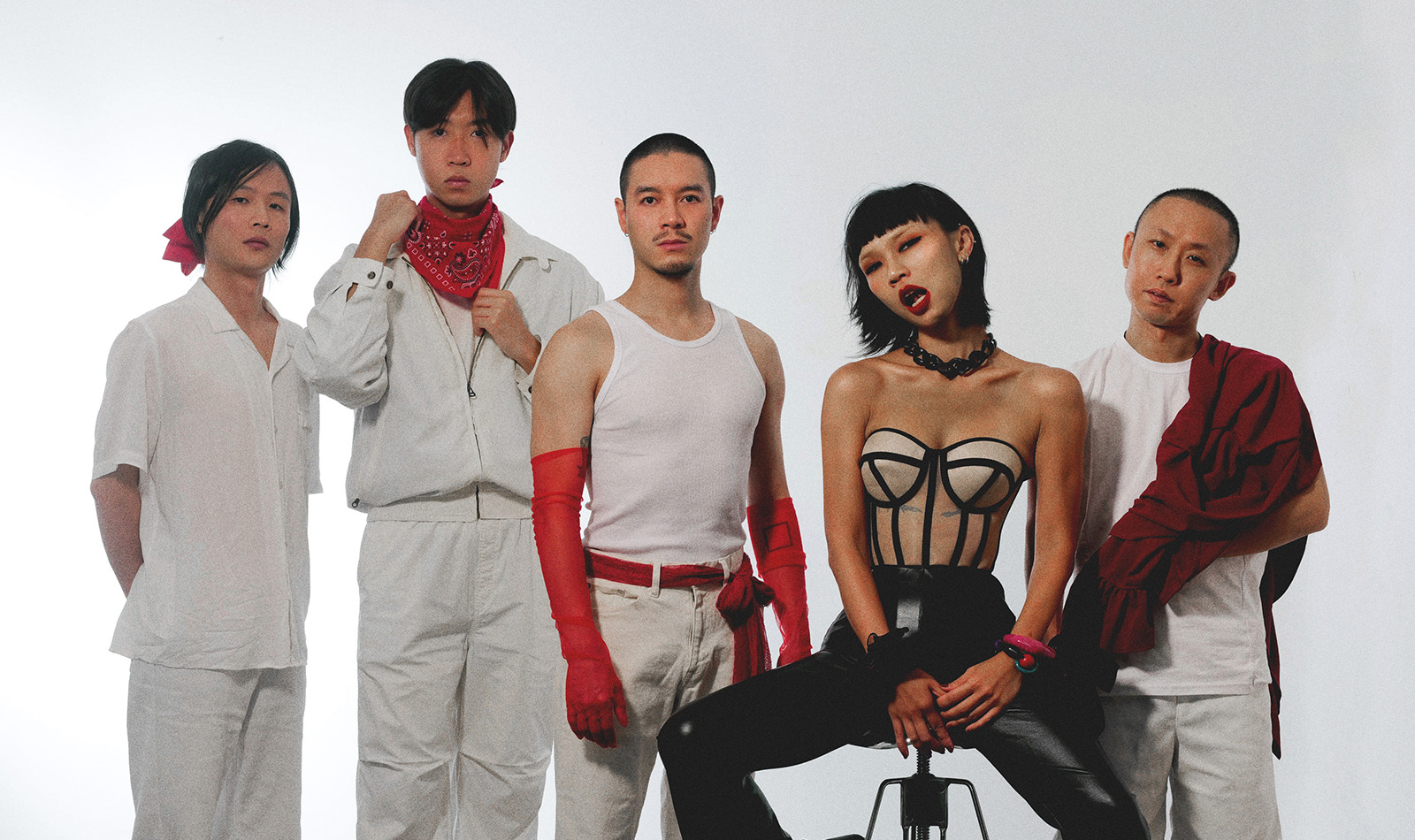
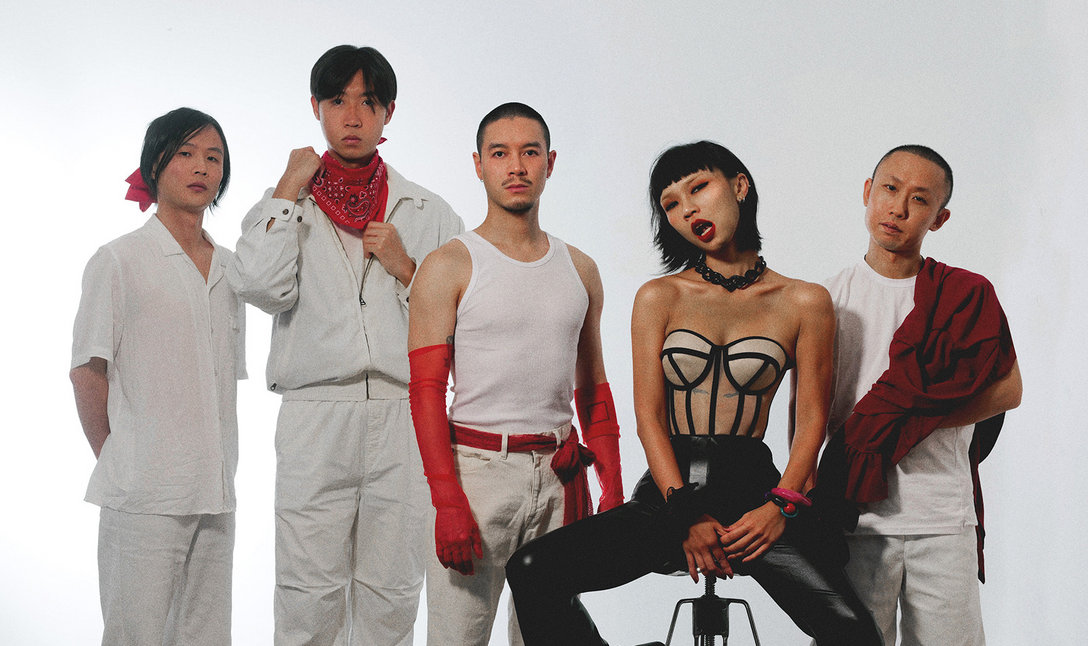
A band always keenly attuned to the nihilistic undercurrents of life in Hong Kong, David Boring has returned after a seven-year hiatus with their second album and a darker, harder, more machinic sound. Their 2017 debut, Unnatural Objects and Their Humans, was a ragged collage of delicate yet crushing post-punk poems driven live by the urgent, confrontational delivery of vocalist Janice Lau. It captures the band’s brash early period, which has morphed as Hong Kong has also fundamentally shifted in recent years, weathering political unrest, a pandemic, and economic pressures that reshaped daily life and the cultural landscape.
Liminal Beings and Their Echoes, released by Damnably and UN.TOMORROW, documents what happens after the intense energy of youth has been spent, metabolized, and lived with uneasy tension. It echoes and expands on some themes present in David Boring’s earlier work—isolation, alienation, trauma, horror—internalizing the recent past and tracing a faint thread of humanistic optimism in moments of unexpected tenderness.
As with Unnatural Objects, nihilism and horror are key touchstones on Liminal Beings. Lau describes the horror genre as being a formative influence on the way the band thinks about texture, mood, and emotional framing—a sensibility that three different filmmakers, though given no brief, organically responded to with horror-coded visuals for the new album, including a low-budget Hong Kong B-horror pastiche for the second track, “Nancy Nightmare.” The band doesn’t see nihilism as a dead end but a condition to work within, a way of naming the pervasive sense of helplessness without surrendering to it. “Our brand of nihilism is very much describing helplessness, but it also tries to embrace whatever form of beauty is possible,” Lau says. That impulse is tempered by dark humor and knowing, tongue-in-cheek music videos that David Boring synth player/keyboardist and UN.TOMORROW co-founder Jason Cheung describes as, “a way to get through the nihilism or the sense of helplessness that’s very pervasive in this age, even more so than in the time when we made our first album.”
Liminal Beings and Their Echoes is also shaped by intensely personal loss. For Lau, the writing process became an internal dialogue after a traumatic period marked by the sudden death of someone close to her, a rupture that seeped into her lyrics. Rather than framing the album as confession or catharsis, she positions it as something broader: Grief, pain, and anxiety surface as shared emotional conditions, folding personal trauma into the album’s wider meditation on nihilism and dislocation. “It’s not about myself, it’s more a documentation of what being human is like,” Lau says.
Those shifts in perspective are mirrored by a dramatic change in sound. Where David Boring’s debut was rooted in sweaty, guitar-and-bass-driven post-punk, Liminal Beings leans into a harsher, synth-heavy palette shaped by EBM, industrial noise, and experimental club music. This is territory Lau had long been orbiting, and which Cheung moved closer to after taking up DJing during the pandemic. Practical realities accelerated the transformation: Half the band relocated after the pandemic, and Hong Kong’s mid-sized venues—a crucial ecosystem for groups operating between DIY rooms and large clubs—have all but disappeared.
On the new album, Lau steps forward as a more central compositional force, her vocals having evolved from an amelodic shout to something more musical and textural, with loopers and octave pedals layered in. The result, as Cheung puts it, is music less concerned with outward catharsis than inward immersion—“dance music for one person”—meant to be absorbed alone, swayed to and felt as a private, interior experience.
That inward turn is based on an embrace of uneasy dualities that gives Liminal Beings and Their Echoes its name and conceptual spine. “Maybe it’s my reaction to balance things out,” Lau explains, “to inject a harmonized contradiction into something that’s more abrasive and bring it back to a place that’s not necessarily nice and beautiful, but adds some complexity to the texture.”
This tension surfaces explicitly in the two versions of the song “Visit Me”—one an incongruously vulnerable, acoustic tune where Lau’s vocal delivery is at its sweetest, the other a syncopated motorik pounder that sounds most like David Boring’s earlier punk era. The two versions of the song reflect, Lau says, “the fact that everyone has an inner, introverted self and then everyone is living as part of society, and sometimes the inner self will become louder than the outside world, sometimes the outside world is louder than the inside world… Everyone is liminal in a certain way.”
Oscillation between opposites reflects a distinctly Hong Kong experience: The rapid flip between dense urban pressure and the restorative pull of nearby mountains, ocean, and hiking trails. “How you experience the city is completely changed in a very short time span,” Cheung says of traversing the island. “The sense of healing, the sense of being in touch with earth, with the ocean, feeling yourself again…that desire to connect I think is very Hong Kong, for anyone who lives in a tiny apartment surrounded by crowds all the time,” Lau adds.
Day-to-day, Cheung and Lau are both solidly situated on the city side of that binary. Lau is an architect, grounding her perspective in real-world systems and social pressures. “My day job requires a lot of discipline, a lot of structure, and it’s also architecture, so you have a deep insight into the system,” Lau elaborates. “I work within the system. I work for the system. I think that provides a lot of added value to talking about the system in the music.”
Cheung’s work as an ER doctor offers a complementary lens: “It brings me very close to society, I see a lot of people, get to try to understand how different people approach their lives or get through the hardship in living in what can be a very, very tense and suffocating society.” Together, these dual vantage points shape an album that hangs deeply humanistic empathy on grinding, metallic bones, lyrics illuminating the inner lives of individuals navigating Hong Kong’s unique machine. Compared to their first album, the sound on Liminal Beings is far more rigid, quantized like a city grid, its hard four-on-the-floor structure corralling the messy, fluid stuff of individual human lives into a coherent form.
For all its hard surfaces, though, the album’s emotional center is unexpectedly soft. Several songs offer intimate character studies of people shaped, warped, or stalled by a broken system, such as “Jenny Rotten,” which continues the band’s practice of hiding surgically precise psychological portraits behind a punny name. “We’re trying to do these character studies of, let’s say, fictional individuals…it’s an exploration of a taboo subject, or an unhealthy thought, but coming from the person’s perspective. It’s a way to give grace and empathy to these usually quite misunderstood and marginalized points of view, without judgment,” explains Lau.
This is the biggest point of departure for the band on their second outing. “Our perspective grew more empathetic towards the subjects that we are trying to explore,” Cheung says. “On the first album, there was a lot of anger that we needed to express, to address. This album, it may still sound very harsh and angry in a lot of ways, but it’s definitely more empathetic, speaking to the person or to that subject directly.”
At its rawest, such as on closer “Coda Lamella,” the album suggests that survival itself is a question rather than a mandate. As Lau puts it, “We’re talking about in order to survive, you need to forego fluctuations. If you want to survive, it’s the price of survival to be flat, to have flattened emotions, experience, state of being…should one just be flat in order to achieve that stable state?” The album doesn’t answer that question, but in tracing a path through nihilism rather than stopping at it, Liminal Beings suggests a more humane way of living with it.
The album ultimately circles back to community, a touchstone the band invokes to counter the banal horrors of everyday life, reflecting their maturation from adversarial newcomers to community leaders themselves. “When we wrote the first album,” Lau recalls, “we were writing about people we immediately knew, and a lot of the discourse at the time was about youth and Hong Kong corresponding to societal change… There was more urgency and restlessness and conviction that suited the more inexperienced mind. There was a lot of, ‘I need to address this right away.’ It’s sobering and touching to see that version of yourself documented. And now [eight years later] you have a very different insight into the same emotions.”
What emerges on Liminal Beings and Their Echoes is a doubled perspective, filtered through accumulated experience but still attentive to a younger generation living through conditions the band now observes at a slight remove. The music may be colder, more mechanical and the lyrics more world-weary, but the gaze is steadier and, paradoxically, kinder. In that contrast lies the album’s quiet conclusion: a record that sounds more brutal but feels more human, less interested in screaming at the void than in learning how to heal and create meaning within it.