The squat wooden building’s green paint is peeling, its windows are boarded up and all approaches are covered with pristine snow drifts.
One entrance has been decorated with penis graffiti; in another, where the door’s window panes should be, two words are sprayed on chipboard: “F**k of [sic]”.
This building in Greenland’s capital Nuuk has seen better days, but it might yet have a future.
Company records suggest this is the official address of Greenland Water Bank, a boutique drinks company with a new co-owner: US billionaire Ronald Lauder.
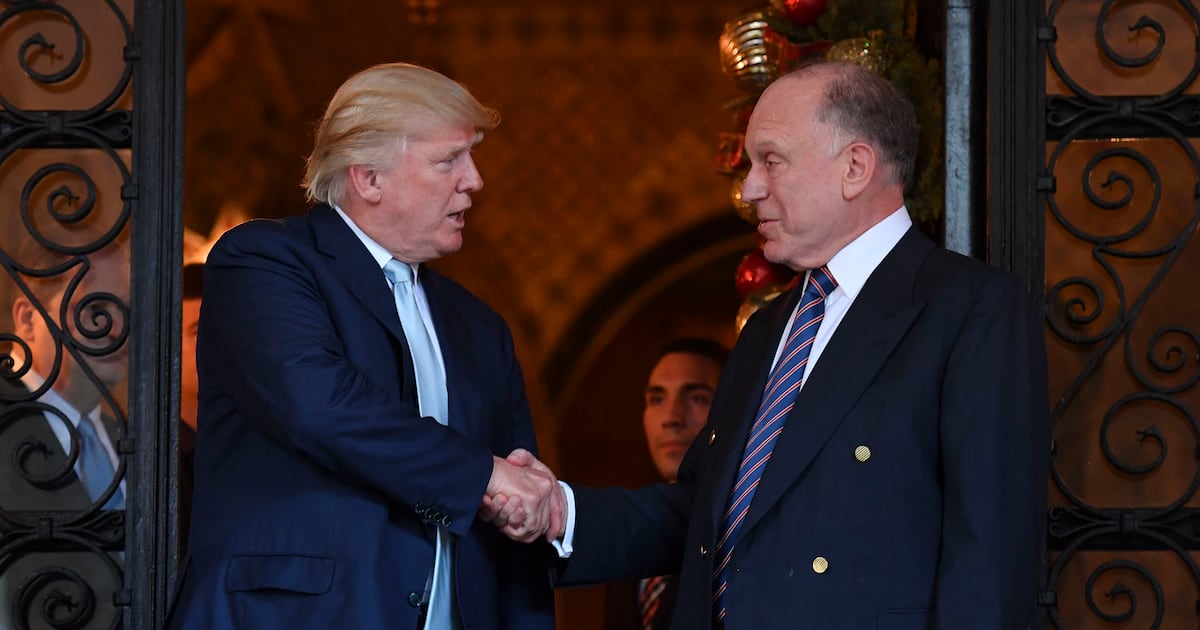
He is not just son and heir of cosmetics queen Esteé Lauder, the 81-year-old lawyer is a close confidant of Donald Trump. And, according to some, he is the one who put the Greenland flea in the president’s ear.
Trump’s promise this week to take Greenland “the easy way or the hard way”, flagging unsubstantiated US security concerns, has sparked outrage and unease in Nuuk, a semi-autonomous part of the Danish kingdom.
Many living on this Arctic island, colonised three centuries ago by the Danes, fear a new era of economic colonisation at the hands of American billionaires.
Some, like tech investor Peter Thiel of PayPal and Palantir, dream of setting up a new post-nation state settlement in somewhere like Greenland; others dream of extracting valuable minerals from beneath the vast, icy territory. But what is Ronald Lauder up to?
Adjacent to the abandoned green building – in fact, a complex of four similar shed-like structures – children are sledding down the hill overlooking the town. What this lacks as a property it makes up for with location: a clear view of Greenland’s red parliament building. It’s an ideal lookout post for arriving ships in the harbour below.
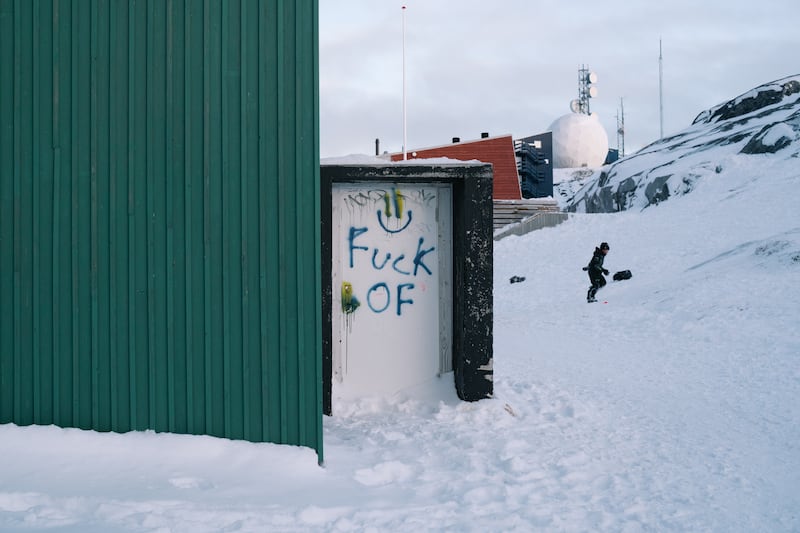 Company records suggest this is the official address of Greenland Water Bank, a drinks company with a new billionaire co-owner: US billionaire and Trump ally, Ronald Lauder. Photograph: Juliette Pavy for The Irish Times
An adjacent telecommunications mast, and two white concrete domes with further communications antenna inside, make this an ideal listening and transmission post.
[ Greenland envy shows size matters to TrumpOpens in new window ]
Walking around, two unusual things stand out. First: the apparently abandoned building is fitted with what looks like new security cameras in small glass domes. Second: footsteps in the snow drifts leading towards one locked, graffitied door suggests someone has been inside recently.
A local Nuuk man who would rather not be named says the school was closed years ago. It was riddled with black mould, then the heating gave up the ghost.
“People who’d been inside kept complaining about how they felt afterwards, they got sore throats and headaches,” the man remembers. “Inside now, the walls and ceilings are sealed in plastic wrap to contain the mould.”
A boutique water company in a mouldy, former school, co-owned by a US cosmetics billionaire?
Across the road, kitchen staff in an older people’s home say they have never heard of Greenland Water Bank or Ronald Lauder.
But security analysts in Copenhagen have. They doubt Lauder’s investment is motivated by a quick profit. After nearly a decade in business, company records show Danish Water Bank remains firmly in the red – though clearly not from renovating its corporate headquarters.
It is likely Lauder – who was approached for comment – sees less value in glacial meltwater than his new local business partners: prominent politicians turned investors, Svend Hardenberg and Jørgen Wæver Johansen.
Hardenberg was, until a decade ago, an influential prime ministerial aide until he was fired. He then headed a national energy company. Judging from local headlines, controversy has followed him throughout his career.
Fans of the hit Danish television series Borgen might remember him as a fictional Greenland minister for mineral resources and foreign affairs.
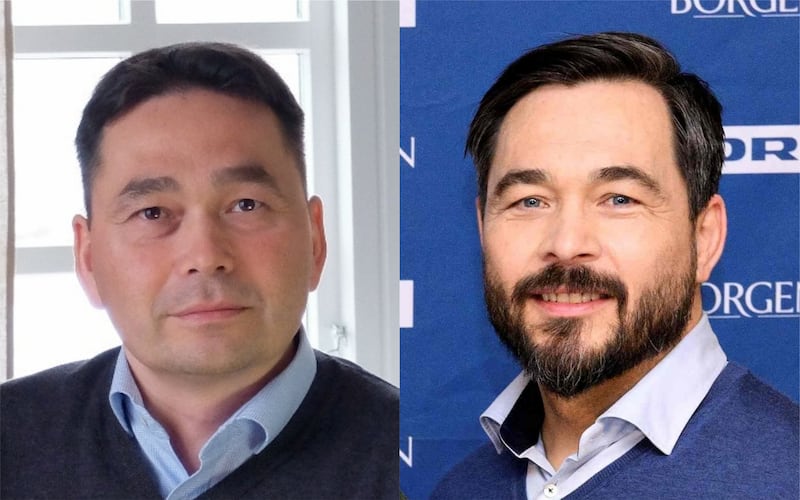 Jørgen Wæver Johansen (left) and Svend Hardenberg. Photographs: LinkedIn & Philip Davali/Ritzau Scanpix/AFP via Getty
His business partner Johansen, meanwhile, is local branch head of Nuuk’s Siumut party and married to Greenland’s actual minister for foreign affairs, Vivian Motzfeldt.
Even before the latest round of tensions with Washington, Johansen was an outspoken cheerleader of the US president, saying the world’s attention was Greenland’s “moment”.
“The world’s eyes are on us, we shouldn’t fool ourselves into thinking it will last,” he told Denmark’s Berlinske newspaper last March. “Now we need to make the best of it.”
At the same time last year, Lauder described Trump’s Greenland ambitions as “never absurd – it was strategic”. Greenland was, as he put it, “America’s next frontier” – a nod to the settling of the so-called Wild West.
As well as the water company, Lauder and his investment partners have expressed an interest in bidding to build a hydroelectric dam on Greenland’s largest lake.
Their Greenland Investment Group has a new chief executive in Josette Sheeran, a former US deputy secretary of state to Condoleezza Rice and ex-director of the World Food Programme.
She did not respond to requests for comment.
Asked by Denmark’s Politiken newspaper last month about Lauder’s investments in Greenland, she pushed her new water product instead.
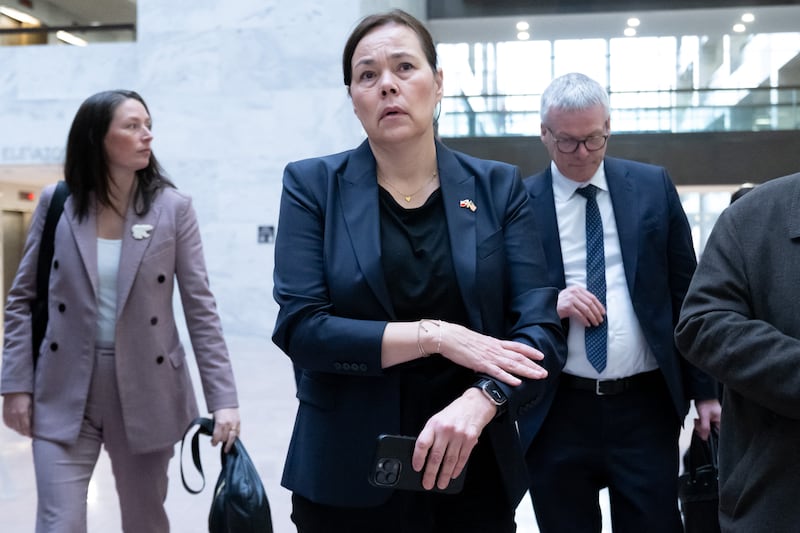 Greenland’s foreign minister Vivian Motzfeldt (centre). Photograph: Saul Loeb/AFP via Getty
“I’m proud to help share this natural gift with the world in a way that strengthens Greenland and its people,” she said.
For Danish security analyst Rasmus Sinding Søndergaard, the investment appears part of Ronald Lauder’s wider investment strategy as a major donor to Trump’s Republican Party.
Having a business partner whose wife is Greenland’s foreign minister, Søndergaard says, does not mean Lauder “will gain any political influence from the investment”.
Søndergaard adds: “But [Lauder] has actively advocated for Greenland to become part of the United States.”
Lauder and Trump have known each other for decades and both attended the same Philadelphia business school.
In their 2022 book The Divider, journalists Peter Baker and Susan Glasser spoke to Trump’s first-term national security adviser John Bolton about Lauder. Bolton said Lauder offered himself as a go-between with the Danish government.
Online and off, Danish analysts fear a growing push by US politicians and allied business people to influence public opinion in Greenland.
Digital rights researcher Signe Ravn-Højgaard of Copenhagen’s Digital Infrastructure think tank says Greenland’s small population of just 56,000, and a reliance on US platforms like Facebook over traditional media, would make it “much easier to subtly shift the discourse than to run overt disinformation campaigns”.
 How do Greenlanders feel about Trump’s ‘psychologically needed’ takeover?
Instead of fake stories or users, she says, “small, opaque adjustments” could be made to prioritise or deprioritise content from real voices and real opinions already present in the debate.
“Such influence would be extremely difficult to detect or prove,” said Ravn-Højgaard, “especially in a small media ecosystem with limited analytical capacity”.
Svend Hardenberg and Jørgen Wæver Johansen did not respond to requests for comment about their business interests and influence.
Asked by a local Nuuk newspaper last month about Ronald Lauder, Johansen said: “I think someone is trying to make something out of nothing.”
Others are not so sure. In advance of Wednesday’s talks in Washington, his foreign minister wife Vivian Motzfeldt asked Danish broadcaster DR: “What would be wrong with us holding meetings with the US alone?”
That caused alarm in Copenhagen, as such meetings would breach Greenland’s agreements that leave foreign policy to with Denmark.
As the geopolitical tug-of-war over the island continues, both Greenlanders and Danes remain alert to US interests on the island, and their local helpers.
“We should not be naive,” said Marc Jacobsen, associate professor at the Institute for Strategy and War Studies at the Royal Danish Defence College.
“Whether these investments ultimately prove profitable is of secondary importance. What matters more is gaining access to the Greenlandic elite and shaping the narrative that the US is a better partner than Denmark.”