The Successor: Boris Nemtsov, Vladimir Putin and the Decline of Modern Russia.
Author: Mikhail Fishman, tr. Michele A. Berdy
ISBN-13: 978-1782277255
Publisher: Pushkin Press
Guideline Price: £35
On September 30th, 1994, Russian president, Boris Yeltsin, failed to exit his plane at Shannon Airport. A confidant scolded him, “You might sleep through Russia too.” Yeltsin forgave this impertinence from Boris Nemtsov, but he didn’t forget. Weeks later, Yeltsin got his companion drunk and made him go on television, telling him afterwards, “I decided to see how you handled it.”
Yeltsin was fond of the brilliant, curly-headed physicist, who had stood shoulder to shoulder with him in the defence of the White House during the 1991 coup. As a reward, he appointed Nemtsov governor of Nizhny Novgorod, a large industrial centre and oblast east of Moscow.
In the months after the Soviet Union collapsed, Nemtsov made the city a model for privatisation, with the help of a team from the International Finance Corporation (of whom my wife Zhanna was a member: Nemtsov’s daughter, also Zhanna, stayed briefly with us in our then-Washington home). He was the golden boy, the handsome star of the new Russia, feted by foreign and state dignitaries, who came to Nizhny Novgorod to be amazed by the first independent cheese shops since Lenin’s time.
Years later Nemtsov would reflect, “We were romantics then. We thought Russia would become the freest, happiest country.”
Nemtsov’s future as the leader of a democratic and sovereign Russia seemed ensured when Yeltsin made him first deputy prime minister in 1997 and introduced him to Bill Clinton as the next president of Russia. However, the catastrophic 1998 financial crisis discredited liberal reformers such as Nemtsov. A communist-dominated Duma demanded more state spending and polls showed a preference for a conservative president. Yeltsin rejected Nemtsov as too free and too idealistic for the times, and chose his prime minister, Vladimir Putin, who guaranteed to protect Yeltsin’s family.
At first, Nemtsov’s relationship with Putin was co-operative. But as the former KGB officer tightened his grip on society, Nemtsov, now a mere Duma member, began organising protests and producing reports on state corruption. He infuriated Putin when he backed Ukraine’s Orange Revolution in 2004 and became an economic adviser to pro-EU president Viktor Yushchenko. Nemtsov believed a free and independent Ukraine was a guarantee of a free and independent Russia, whereas Putin faced the prospect of a democratic and prosperous Ukraine inspiring an Orange revolution in Red Square.
Ukraine became Nemtsov’s project. He returned there in 2013 to support the Maidan uprising, achieving hero-status in Kyiv. His exposure of massive corruption in Sochi Winter Olympics construction projects further enraged the Russian president, as did his revelations about Russia’s secret military interventions in eastern Ukraine.
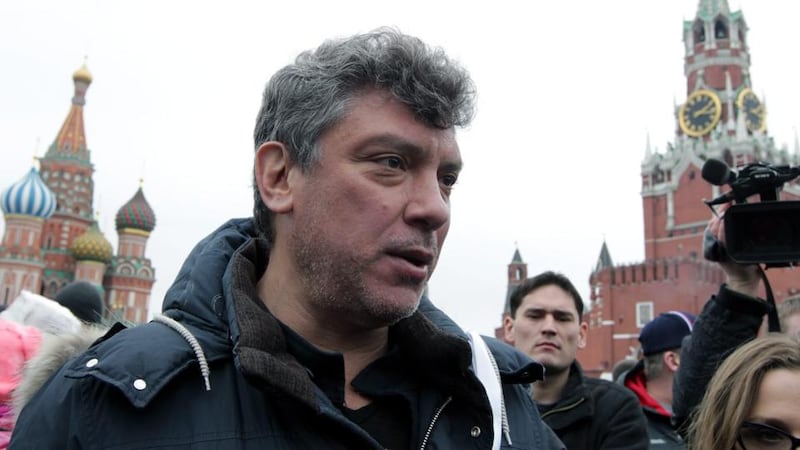 Boris Nemtsov in 2012 taking part in a protest against Vladimir Putin on at the Red square in Moscow. Photograph: EPA
Charismatic and charming, Nemtsov’s personal life was always chaotic. He had a daughter with his wife Raisa and three children with TV journalist Katya Odintsova, and over time he had other partners. For two years he dated a young Ukrainian model, Anna Duritskaya. On February 27th, 2015, after giving a radio interview accusing Putin of lying about military involvement in east Ukraine, he took Anna for a late dinner at Bosco Café on Red Square.
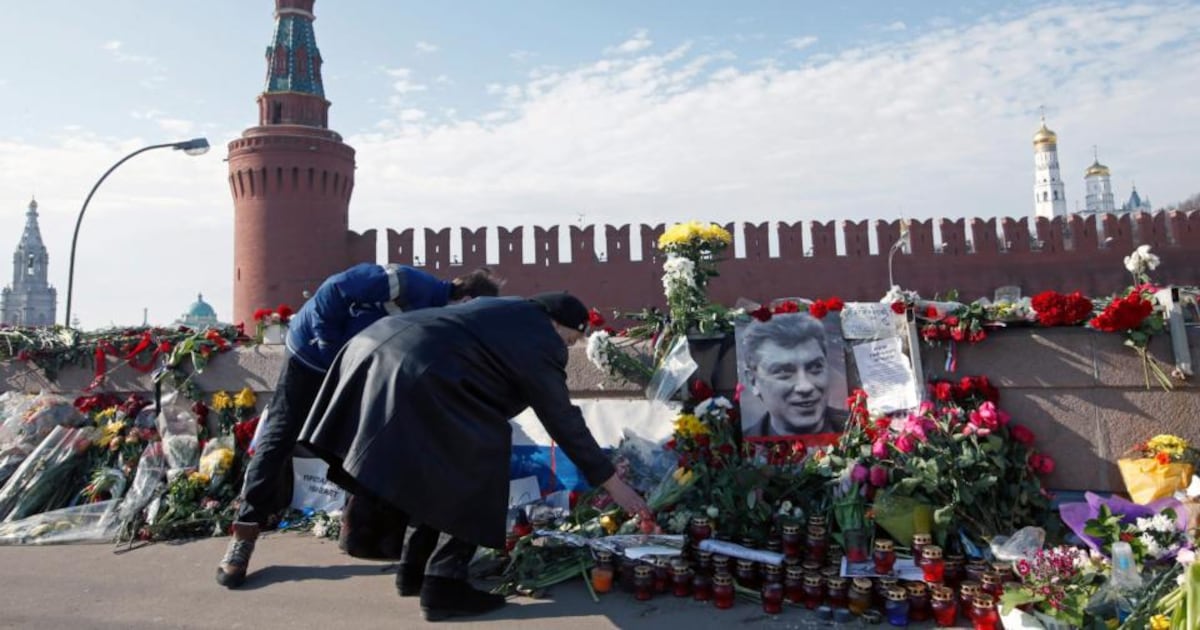
At 11.15 that evening, as Nemtsov and Duritskaya strolled along the deserted Bolshoi Moskvoretsky Bridge by the Kremlin, a car drew alongside. A man got out and shot the 55-year-old Nemtsov several times in the back, killing him.
The assassination was a huge shock: Russians today remember where they were when they heard the news. Friends and activists, at home and abroad, were quick to accuse Putin of directly ordering the killing.
Fishman does not go so far. However, he points the finger at Putin’s sycophantic and brutal ruler of Chechnya, Ruslan Kadyrov, who had clashed with Nemtsov. By his account a team of Chechen assassins with connections to Kadyrov had shadowed Nemtsov for weeks. The gunman was a decorated member of Kadyrov’s Guard, called Zaur Dadayev. He and four other Chechens were convicted of the killing in a Moscow court, but the organiser of the hit squad, Ruslan Geremeyev, a former deputy commander of the Chechen North Battalion, vanished. Kadyrov himself was never questioned.
If the Chechen leader gave the order, the point of the killing was to present Putin, “the suzerain, the supreme ruler, with the head of his enemy as a sign of loyalty and obeisance”. Whatever the case, Fishman holds the Russian president to be “politically responsible”.
Successor, published in Russia two weeks before the invasion of Ukraine, is much more than a biography. Translated by Michele A. Berdy, and with an extra chapter dealing with the death of Alexei Navalny, it is a fascinating insider account of Russia’s descent from imitation democracy to fully-fledged tyranny, with Nemtsov’s life as a connecting thread.
Fishman was editor of Moscow News and one of a generation of impossibly courageous Russian journalists, who, like Nemtsov, dreamed of and fought for a democratic and open society. He now lives in Amsterdam, unable to function safely any more in a country which combines “a mafia code of honour, the Stalinist relationship between a state and its subjects, and a fascist, militarised leadership”.
Having experienced the entire journey with Nemtsov, he still believes in another Russia, “although I am not sure I will still be here when it happens”.
Conor O’Clery is a former Moscow correspondent of The Irish Times