At 11am on Christmas Eve 2014, Pauline Tully heard a loud knock on her front door. She had been up for a few hours, finishing off preparations for the next day and for Santa’s visit. Still in her dressing gown, she and her two sons, Pearse (7) and Eoghan (4), were going upstairs to get dressed when they heard thumping.
When she opened the door, her heart sank. It was Pearse McAuley, her estranged husband from whom she had judicially separated 10 months beforehand. She could tell immediately from his unkempt look and furious demeanour that he had been drinking.
What happened next had no prelude. It was immediate and brutal. “He just barged in, immediately lifted his fist and punched me in the face,” she recalls.
McAuley started rooting around in his pockets for something. Reeling and in pain, she went to protect the children, telling them to go upstairs and hide. She whispered to her eldest boy, Pearse, to ring 999 on the landline in her bedroom. He rang the number but was too young to know to stay on the line.
McAuley pulled a steak knife out of his pocket. He accused her repeatedly of being in a new relationship, which she wasn’t.
She tried to placate him but his veins were throbbing with rage. He began to thrust the knife at her. Initially, she sustained protection wounds to her hands and wrists. Soon after, he stabbed her in the chest. She could hear air rushing out of the wound, and then saw blood seeping out.
“I kept thinking, he’s gone further than he’d ever gone before. I had no idea what damage he’d done, whether he had punctured my heart. There was blood everywhere.”
She was trapped. McAuley ordered her on the ground, to make sure that nobody from outside could see her. She slumped to the floor with her back against the wall.
She could see the damage. “One of the wounds, you could see right inside my hand and the bones. There were little cuts everywhere, on my fingers, my hands, my throat. He had tried to cut my throat a few times, had stabbed me in the abdomen and in the back.
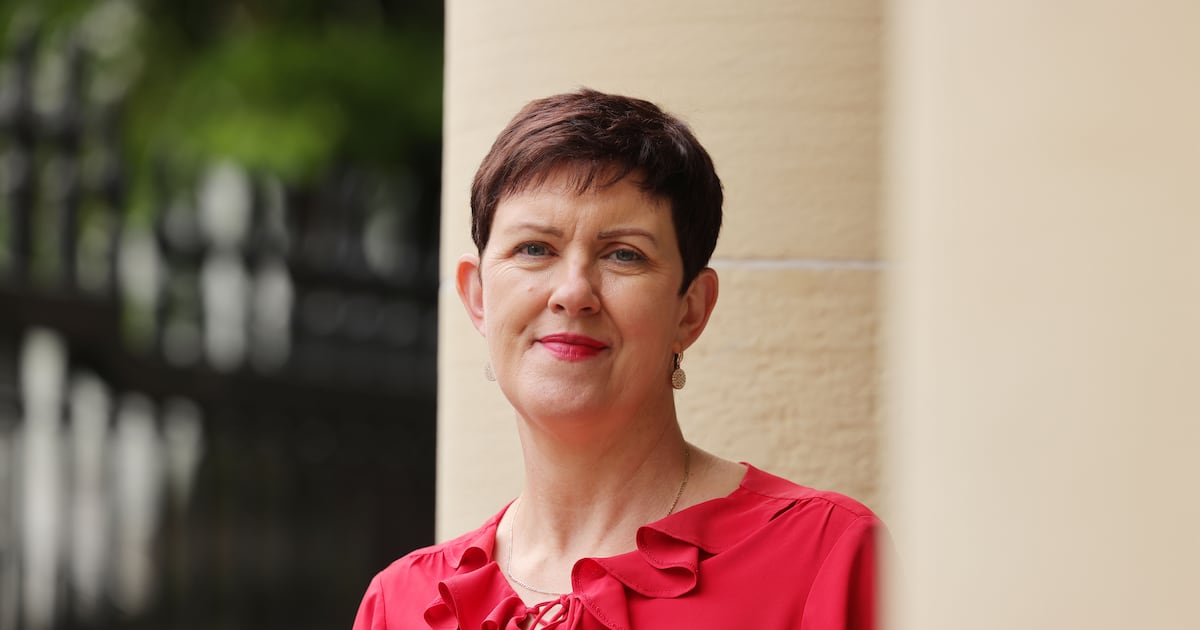
 Pauline Tully: ‘I kept thinking, he’s gone further than he’d ever gone before.’ Photograph: Alan Betson
“He was kicking me on the floor. He had this thing in his head that I was seeing someone, and it was someone he knew, and we were laughing at him.
“He kept on asking who it was. There was nobody. I actually made up a name hoping that that might calm him.”
Her ordeal continued for hours. McAuley shouted and ranted about all his life’s grievances. He came over to Tully several times and stabbed her. She remained on the floor, unsure if she would survive, trying not to antagonise him further.
In his rage, he threatened to kill her and then himself. Every so often he would calm a little and declare, “I am in control”. The boys cowered upstairs, afraid that their mother had been killed.
“When they heard me screaming, they actually knew I was still alive. When it was silent, the thoughts going through their heads was, ‘Has he killed Mammy?’”
At every moment I was thinking he’s going to wake up and stop me
— Pauline Tully
McAuley went into the kitchen, where he discovered a bottle of cream liqueur in the fridge and started drinking from it. After a while he lay on the floor and started a long incoherent monologue asking how they had ever got to this point.
Then, to Tully’s surprise, he fell asleep. She waited for what seemed like an age. She was in considerable pain and wanted to sleep, but forced herself into action.
“I had lost a lot of blood and was seriously injured. I knew I had to get out and would not get another chance. I didn’t even have time to get the children. I remember getting up, shifting over the floor, and getting the door open.
“At every moment I was thinking, He’s going to wake up and stop me.”
She got out the door and made her way to a nearby road. It was deserted. “I live in a very rural area here. I was saying, ‘Oh God, there’s nothing coming’. But the next thing, one of my neighbours came up the road in the car with his girlfriend, and they had a little lad in back.
“I stood in the road. They were not going to get by me. [The neighbour] got out. He told somebody afterwards he didn’t recognise me, I was that badly hurt.
“I remember him saying, ‘Pauline, who did this to you?’ and I said, ‘Pearse’. And he says, ‘Right, I’m gonna get Tommy’. That’s my brother. He says: ‘Get in the car with us’. And I say: ‘I’m not leaving here.’ They went back down to get my brother.”
McAuley’s car was parked outside the house with the keys in it. Tully got into it and locked the doors. At that moment he appeared out the door, having woken up. He shouted that if she didn’t get out he would get the children. “I remember thinking, You f*cking won’t. I’ll run you down.”
She tried to start the car, but failed. It rolled backwards into a ditch. As McAuley looked for a rock to smash the windscreen, her brother Tommy arrived with his son and neighbours. He quickly overpowered McAuley, knocking him to the ground.
It all happened quickly after that. The gardaí and paramedics arrived almost at the same time. Tully was taken to Cavan hospital by ambulance. Meanwhile, McAuley had ran away but was soon caught in a field.
Tully spent Christmas in intensive care, having been stabbed 13 times. Both lungs had filled with blood. She was lucky that none of the wounds had punctured a vital organ.
“My first concern was for my two boys, especially around Christmas time.”
The man who carried out the horrific assault was already well known in Ireland. McAuley had been a notorious IRA gunman. He shot his way out of Brixton Prison in 1991 with a smuggled gun along with Nessan Quinlivan, having been charged for an IRA plot to assassinate a prominent businessman.
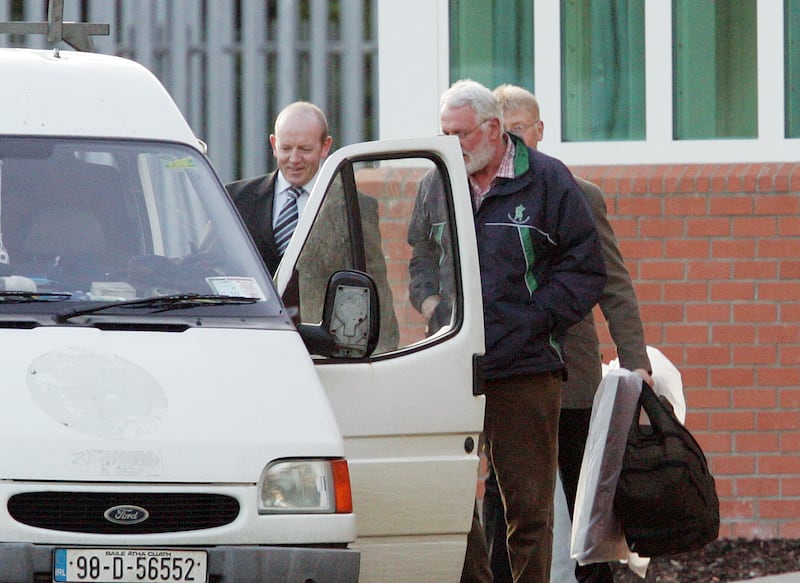 Martin Ferris (centre) of Sinn Féin at Castlerea Prison picking up Pearse McAuley, left, and Kevin Walsh, who were freed after serving their sentences for the killing of Det Jerry McCabe. Photograph: Alan Betson
Five years later, still on the run, he was part of a four-man gang that shot dead Garda detective Jerry McCabe in 1996. All four were convicted of manslaughter and McAuley was sentenced to 14 years in 1999.
The government refused to release the four following the Belfast Agreement. But under a special deal, they lived in houses on the grounds of Castlerea Prison and were given special visiting rights and other concessions.
Tully is the second-youngest of a family of 10 from Kilnaleck, Co Cavan, and she herself eventually settled there. Her family was steeped in the republican movement; her father had an involvement going back to the 1950s.
“I grew up going to commemorations. It was always part of the household.”
She focused on education, not politics. After graduating from University College Dublin, she began work as a teacher of history and maths. Then in 1997 she helped on the campaign in which Caoimhghín Ó Caoláin became the first Sinn Féin candidate elected to the Dáil since 1957, and the first to take their seat since 1922.
He drank to get drunk. When he drank vodka in particular he became aggressive
— Pauline Tully
Having joined the party, she stood as a candidate in the local elections in 1999 and was elected to Cavan County Council. The following year she visited the IRA prisoners in Castlerea. She met McAuley and they got on well. She found him very charming.
She began visiting him regularly, and in 2003 they were married – he was granted temporary release for the wedding. Their first child was born in 2007, two years before his release. Their second son, Eoghan, was born in 2010.
She began to worry about his character even before his release from prison and that preyed on the back of her mind. He was controlling and prone to be suspicious. “It wasn’t okay,” she says. “It probably never was. I remember thinking to myself, before he got out, Will I regret this?”
McAuley had been on the run or in prison for most of his adulthoodand did not easily adjust to settled life. “His drinking was also a problem from day one. He drank to get drunk. When he drank vodka in particular he became aggressive.
“He did not physically harm me in the early years but he would be threatening. On occasion he would take the fist to my face.
“When my son was about 2½, he watched as his father was shouting and throwing things. When he went out of the room, my son said, ‘Daddy’s a bad man.’”
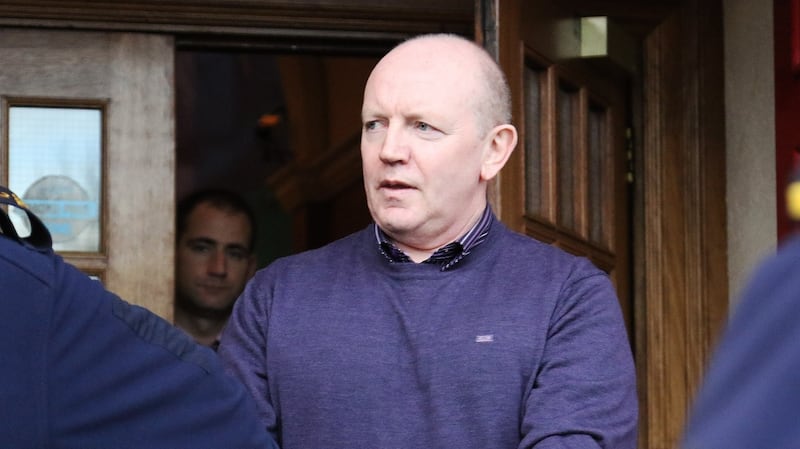 Pearse McAuley leaves Cavan Courthouse following his sentencing for the attack on his wife Pauline Tully. Photograph: Lorraine Teevan
As time went on, his behaviour became increasingly threatening. He would be asked to leave but would come back after a while, sober, and things would settle. But then the cycle would start again. After one long period of separation, he stopped drinking and they got back together in early 2014.
They went to an event and stayed overnight, with his sister looking after their children in her home. McAuley disappeared from the hotel and arrived back to the room drunk. Later that night, he insisted they leave and collect the children.
When Tully tried to stop him from taking the car keys, he tried to choke her, punching her in the back of the head when she sought refuge in the bathroom. Gardaí were called. She collected her children and got a barring order against him and applied for judicial separation, to which he agreed.
Things seemed to settle down in the following months, until the unexpected bang on the door on Christmas Eve.
How did she come back from all that? After a week in intensive care and some days in a hospital ward, she was allowed home. “I was just practical about it. I was the only parent now and had to be there for the two boys. They had witnessed something absolutely outrageous from their father.”
Her family supported her. They lived with her sister while she recovered. But she moved back to her own house sooner than expected. Her thinking was the longer she waited to go back to where it had all happened, the harder it would be.
Her practical mindset kicked in. She had plenty of scars and wounds, a lot of stitches, and a serious injury to one of her fingers. She wanted things to settle down and went back to her teaching job soon after. It was not always easy. “I remember breaking down at school. There were a couple of days when things got uncomfortable.”
She received counselling from the domestic violence service in Cavan-Monaghan, which she found very useful. When McAuley was sentenced to eight years in prison for the attack, she said in her victim impact statement: “I will live a life haunted by what happened to me.”
Living in a Border county, she says she experienced only support and sympathy from everyone she knew in republican circles, even those from McAuley’s home place in Co Tyrone.
Tully had given up politics in 2012 because of the pressures of a teaching career, bringing up her children and her husband’s violence. But her path to recovery saw her agree to stand again for Sinn Féin, not locally, but in the Dáil elections.
“I was very determined. It was my life. I had two children and I needed to make sure they grew up with a good outlook in life,” she says.
She was elected a TD for Cavan-Monaghan in 2020, a little over five years after she had been subject to extreme violence which brought her to the brink of death. It was a remarkable recovery.
Tully loved being a TD, her time in the Dáil and serving her constituencies. She says she was “devastated” when she lost her seat in the November 2024 elections as part of an ambitious plan by Sinn Féin to win three seats out of five. She is now a Senator and hopes to regain her Dáil seat in the next election.
[ IRA killer Pearse McAuley found dead at Co Tyrone homeOpens in new window ]
McAuley was released from prison in 2022 and moved to Strabane. He died in 2024 at the age of 59. When Tully heard of his death she said she was conscious he had a family, but adds: “I am not lying. Part of it was relief because I knew he can’t hurt us ever again.”