We independently select these products—if you buy from one of our links, we may earn a commission. All prices were accurate at the time of publishing.
Many people move to New York City with big dreams — but not necessarily big apartments. Unless you have the means, “living large” usually doesn’t apply to square footage. Still, style shouldn’t have to be sacrificed just because space is limited.
At Apartment Therapy, small, stylish spaces are kind of our bread and butter. But we like to check in with the pros, too; we often speak with designers to get their best tips for small-space styling. So I reached out to designer Brad Thornton, founder and lead designer of Thornton Projects, to get his insight on the topic. His number-one rule? Guide the eye upward!
Thornton says that the secret to making a small space feel expansive is to think vertically. As the eye goes up, there’s an illusion of higher ceilings and a larger space. “Anything that draws attention upward instantly adds a sense of height and breathing room,” he told me. But how do you actually implement these tactics IRL? Ahead, the pro shares tips for how to make the most of every square inch in your own home.
Make the Ceiling the Center of Attention
According to Thornton, most people focus entirely on the floor of a space — considering only what’s at eye level. But if all of your decor is concentrated in the lower two-thirds of the space, it’ll feel even smaller and more cramped than it is. No need to open up the walls or “raise the roof,” though; instead, try actually calling attention to it by accenting your ceiling with wallpaper or a bold paint color. Nothing draws the eye like a pop of color or pattern!
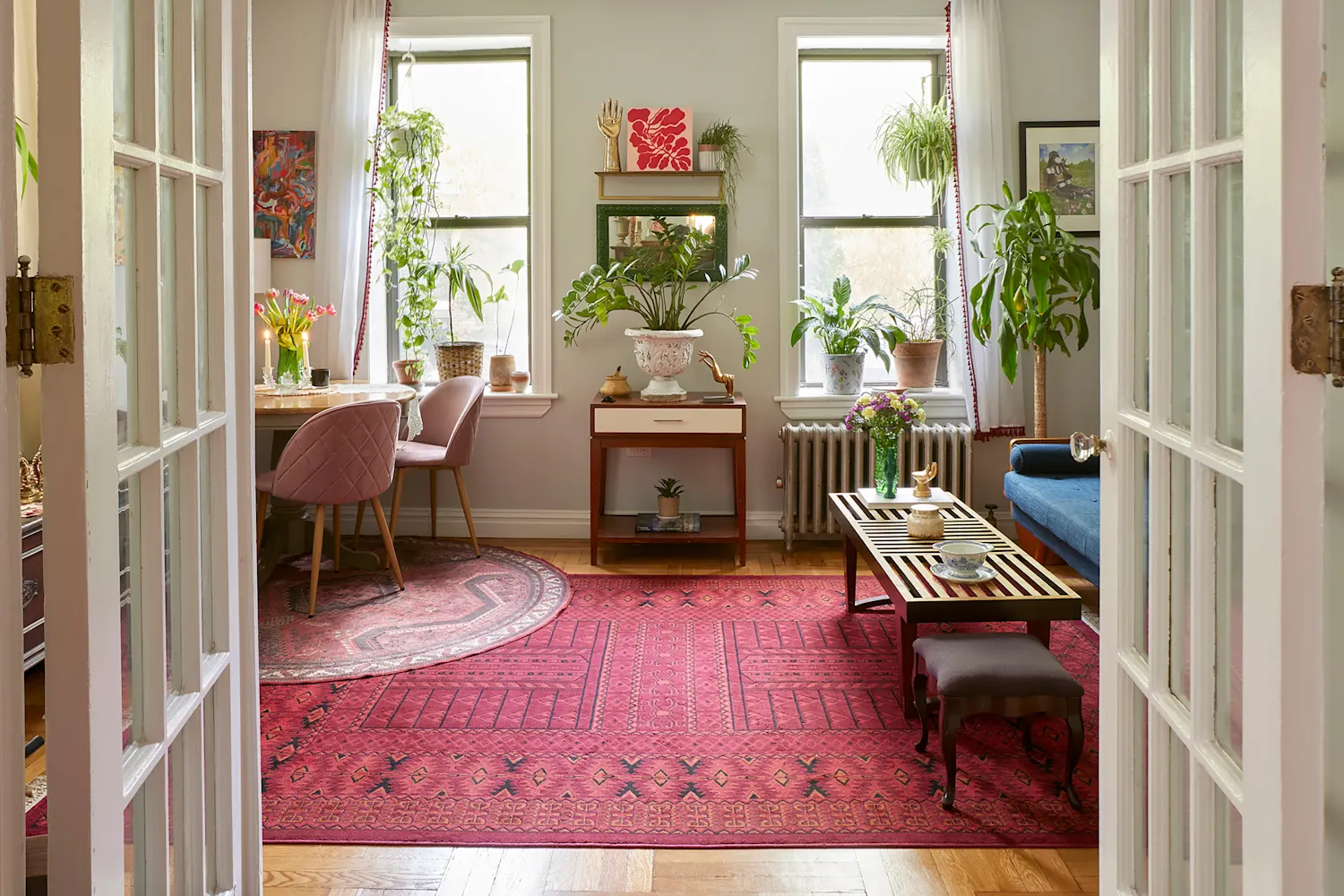
Another good rule of thumb is to always hang your curtains right at the ceiling line, as opposed to just above the window. This gives the illusion of taller walls and, thus, a taller ceiling.
Another of Thornton’s favorite tricks for small-space styling? Mirrors. “Mirrors are another go-to,” he says. “They bounce light around, open up dark corners, and trick the eye into feeling like there’s more space.” Even a single reflective surface can brighten a room and create the illusion of depth. But if you really want to go all-in, try making a mirror gallery wall using several smaller thrifted mirrors for a fun look and maximum light.
Nail Your Proportions and Scale
Many people assume that small spaces require small furniture — but that’s not always the case. Thornton stresses that scale is everything. “Above all, pay close attention to proportion and scale. Furniture that’s too oversized will swallow a room, but pieces that are too tiny make everything feel off. When the scale is right, even a small space can feel intentional, airy, and surprisingly spacious.”
Streamline Storage and Avoid Eye-Level Clutter
Last but certainly not least, Thornton puts it plainly: “Here’s the less glamorous answer: really thoughtful storage.” Small spaces can quickly become cluttered, and feel overwhelming — which is why organization matters just as much as your decor.
“Getting dialed in on organization and reducing clutter creates breathing room,” he says. “And a beautifully edited room always reads better. A cleaner visual automatically makes any space feel larger.”