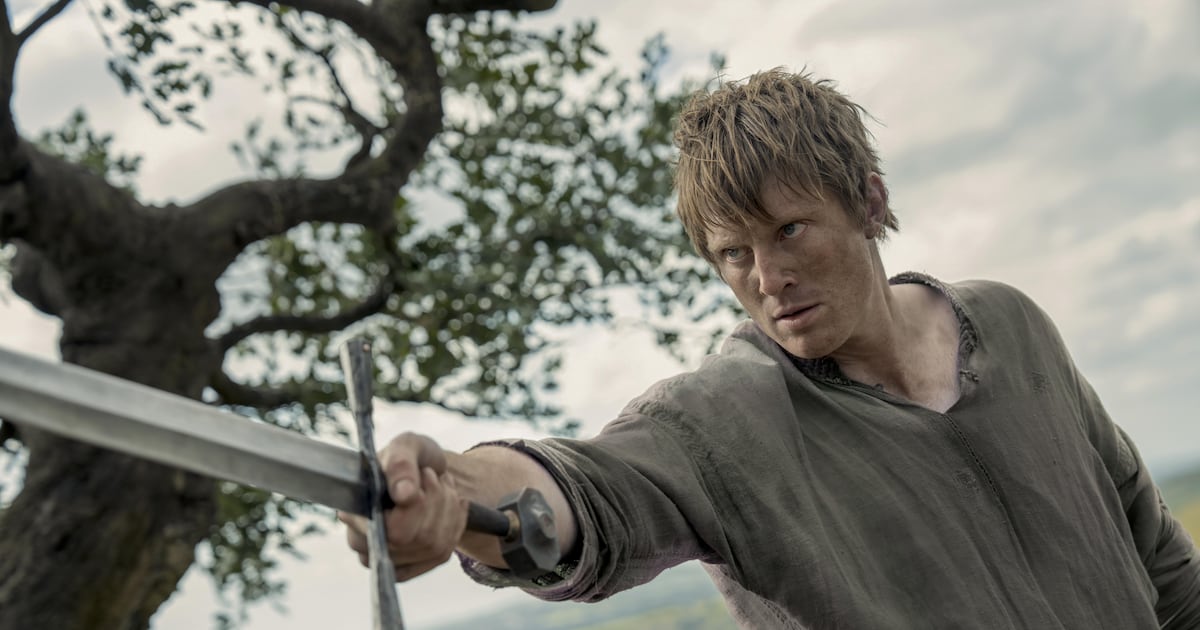
Game of Thrones has come home to Ireland with the new spin-off A Knight of the Seven Kingdoms (Sky Atlantic, 9pm, NOW) – and what a rewarding return to its misty spiritual heartland it proves. As with the original series, it was filmed in Belfast and its environs – and you can tell. The rain feels right, as does the fog rolling in from the hills and forests. The Irish landscape, so evocative of medieval fantasy, was always the unheralded star of Thrones – and it’s great to be back where it all began.
Starting with lead actor and former Connacht rugby pro Peter Claffey, the cast likewise brims with Irish talent. He is joined by Nidge Almighty himself, Tom Vaughan-Lawlor, who plays the steward of Ashford – nothing to do with the castle in Cong, but a town in the south of the Seven Kingdoms where the great and the good have gathered for a jousting tournament. There is also a cameo by Steve Wall of The Stunning, who has been brewing up a storm on screen and who follows his appearance in Dune with this turn as a minor nobleman.
The new series has learned the lessons of so-so Thrones prequel House of the Dragon, which fell asunder in its second season in a blizzard of CGI dragons and a cast of dozens. Working from Game of Thrones author George RR Martin’s likeably slight Dunk and Egg novellas, the tone here is small in scale and big of heart.
It’s set 70 years before the events of Game of Thrones, when Ned Stark has his unhappy run-in with an executioner’s axe and the Night King marches south. An uneasy peace hangs over the Seven Kingdoms, which have been under the domain of the Targaryens since they swept in with their dragons centuries previously. But as the action begins, they are coasting on their reputation – there hasn’t been a dragon in Westeros in generations, and the Targaryens are now just brutal rulers with Aryan-white hair and a cruel curl to their lips. Rebellion feels inevitable – but as we know from Game of Thrones, that uprising brings not peace but merely further instability.
All of that is a long way from the thoughts of hero Ser Duncan the Tall – a beanpole naif played with the perfect mix of innocence and chivalric gusto by Claffey. He comes to the project after smallish parts in Bad Sisters and Jane Seymour’s Dublin cosy-crime series, Harry Wild. On the heels of former Kildare footballer Paul Mescal, he is part of an unexpected streak of former athletes who have moved into top-tier acting and which could be interpreted as our way of apologising to the world for Conor McGregor.
Claffey gives Ser Duncan his own Portumna accent, and you wish the producers had gone all in and made A Knight of the Seven Kingdoms a wholly Irish affair. How easy it is to imagine the privileged Targaryens speaking fluent South Dublin – they could call it “High Dun Laogharian” – while Ser Duncan’s mountain-man mentor, Ser Arlan, could plausibly have sounded like one of D’Unbelievables. As for the mystical and spooky land beyond the Wall, full of the strange and uncanny, where nothing is as it seems … well, Limerick Junction is right there, waiting for its close-up.
Ser Duncan soon teams with 11-year-old “Egg” (Dexter Sol Ansell). He’s a dead ringer for the lead character from cult cartoon Avatar: The Last Airbender, but has a deep secret that will surprise newcomers to the tale. Heading to Ashford for the tournament, they find themselves squaring off against the dastardly Targaryens, for whom a weekend’s joust is merely an excuse for further bullying and butchery.
Game of Thrones brought to the mainstream the popular fantasy subgenre of “grimdark”. It has its roots in the Warhammer war game and in 1980s fantasy novels, but was popularised by Martin and is characterised by shock deaths and horrible violence. A Knight of the Seven Kingdoms is far cheerier, with a feel-good factor that makes for an engaging change.
[ TV guide: the best new shows to watch this weekOpens in new window ]
The only caveat is that the early episodes feature two stomach-churning scenes, presumably intended to “subvert” expectations, but which will only send wavering viewers running for the hills. One involves a fake appendage that takes the vogue for male frontal nudity to extremes; the other is just horrible and best brushed over. What a pity the series reverts to Thrones’ sorriest instincts when so much else about this heartwarming show hits like a breath of fresh air – a return to Westeros that very nearly compensates for the dreadful finale of the original Game of Thrones.