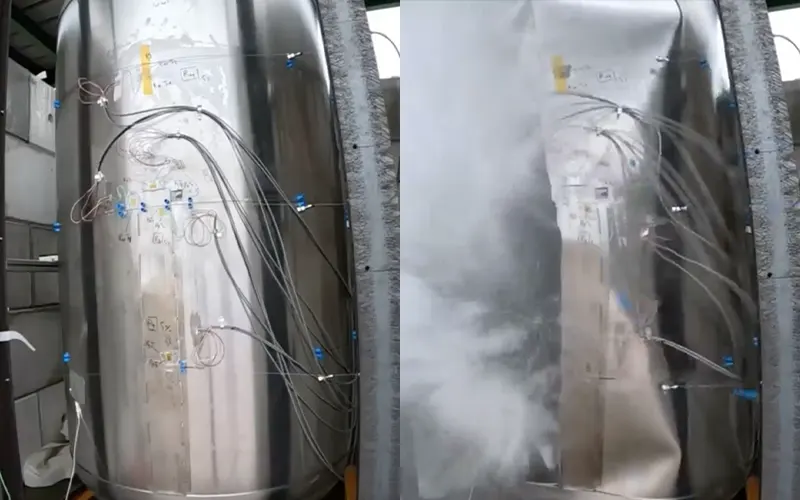
 Credit: MaiaSpace
French rocket builder and ArianeGroup subsidiary MaiaSpace has announced the completion of a months-long test campaign that subjected several subscale prototypes of its propellant tanks to high-pressure burst tests.
In a 27 August update, the company revealed that over the six-month campaign it had conducted 15 burst tests of subscale propellant tanks, which MaiaSpace calls its “baby tanks.” Burst tests push tanks to failure to assess their structural limits and ensure they can safely withstand pressures well beyond normal operating conditions.
According to the company, with the various baby tank prototypes it tested wall thickness, weld types, bulkhead pass-through configurations, doubler designs, and more. The data collected will be used to validate mechanical models that will inform the final design of the full-scale propellant tanks.
The six-month test campaign formed part of the company’s 2025 Mechanical Validation Plan as it works toward the inaugural flight of its Maia rocket. MaiaSpace is expected to attempt an inaugural flight of Maia in 2027 from the old Soyuz launch facility at the Guiana Space Centre in French Guiana.
Colibri Orbital Vehicle
Days before MaiaSpace announced the completion of its burst test campaign, the company published a job listing for an Orbital Vehicle System Engineer. In its listing, the company describes an evolution of its current Colibri kick stage from an optional third stage to an orbital vehicle that will enable it to provide a variety of in-orbit services. According to the posting, a primary application for its Colibri orbital vehicle will be active debris removal.
In addition to the evolution of Colibri, the listing also estimated the kick stage flying between five and ten flights a year. If you consider that the company has projected reaching a maximum launch cadence of 20 flights of its Maia rocket per year, it expects that between 25 and 50 percent of those flights will include the optional kick stage. The company did not, however, specify how the inclusion of an evolved Colibri stage would affect those cadences. At its most basic, Colibri is designed to add roughly 1,000 kilograms of performance, raising Maia’s payload capacity from 1,500 kg to 2,500 kg when launched in its expendable configuration.