The future of the EU–Mercosur free trade deal has been thrown into doubt by a European Parliament decision to refer the landmark deal to the courts, potentially holding up its ratification by two years.
European leaders will now have to consider whether the trade deal between the EU and four South American countries should come into force provisionally, before it has been approved by MEPs, a move that would prove incredibly contentious.
A sizeable majority of EU states backed the trade pact earlier this month, allowing it to be approved despite the objections of Ireland, France, Poland and others.
The trade deal also required approval in the European Parliament. A vote to ratify or reject the agreement was expected in April or May.
However, MEPs on Wednesday first voted to refer the trade agreement to the European Court of Justice (ECJ), to rule on whether it complies with EU treaties. The decision will put the ratification process on ice pending the court ruling, which may take at least a year and a half to issue.
The parliament’s decision to kick the deal to the EU courts passed by a narrow margin of 10 votes.
Fine Gael MEP Sean Kelly criticised the move to trigger a legal review. “I personally do not see any genuine legal reasons for such a referral. MEPs are elected by their constituents to take decisions,” he said.
The vote had taken on greater significance given the latest rupture in transatlantic relations and fears a EU-US trade war may be on the horizon.
Supporters of the trade agreement view the deal as crucial to Europe reducing its economic dependence on Washington, by opening up a big new South American market for trade.
The deal will lower tariffs and other barriers to trade between EU countries and Brazil, Argentina, Uruguay and Paraguay.
The European Commission, the EU executive body that leads on trade, has the power to bring the trade agreement into force provisionally, before it is ratified by MEPs.
However, such a decision would draw fierce backlash from opponents of the deal, including farmers and environmentalists, political parties on the far right and the far-left, and perhaps governments in France, Ireland and Poland.
The European Commission would likely only allow the deal to come into effect provisionally with the backing of national governments. One EU official said, given the political sensitivities, a decision would not be rushed.
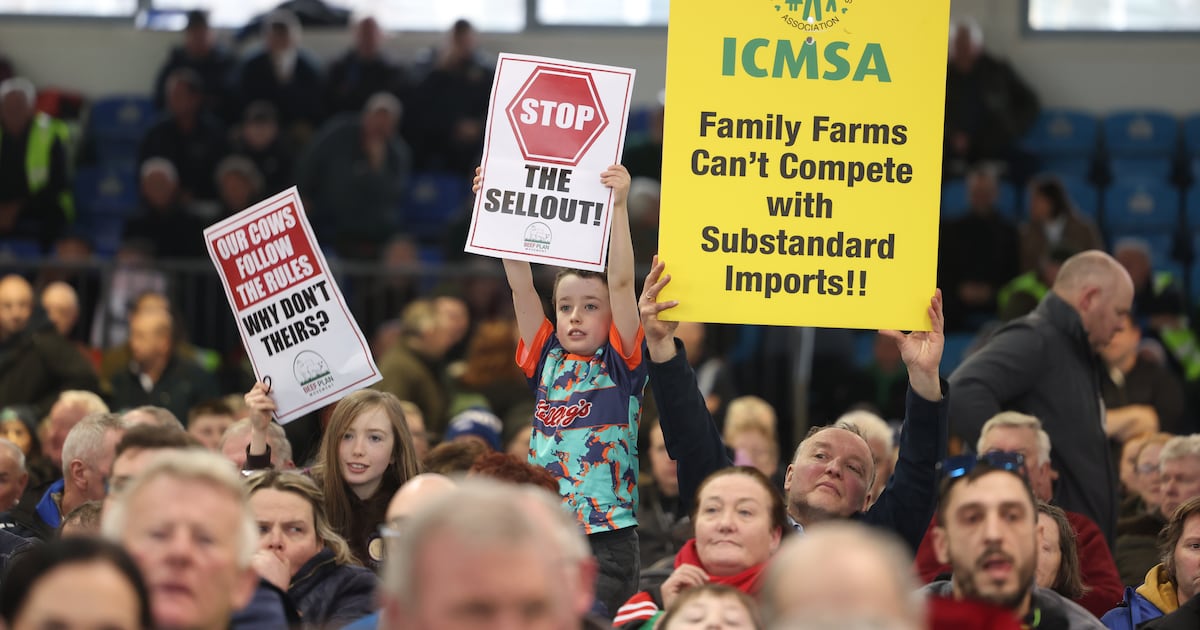
Farmers have fiercely opposed the Mercosur agreement, fearing exports of Irish beef will suffer in the face of competition from cheaper South American products produced to lower standards.
The deal includes an emergency brake allowing the EU to reimpose steep tariffs if South American beef is found to be flooding the market and causing a drop in prices.
A significant delay approving the deal will raise concerns the Mercosur countries could walk away from the table, scuppering the agreement at the last hurdle after 26 years of stop-start negotiations.
Fine Gael’s Regina Doherty and Fianna Fáil MEP Barry Andrews, who support the trade deal, voted against referring it to the EU courts, as did Mr Kelly and Fine Gael MEP Maria Walsh.
Independent MEP Luke ‘Ming’ Flanagan is recovering from a hospital operation and could not travel to Strasbourg for the vote.
The remaining Irish MEPs voted to send the agreement to the courts; Nina Carberry (FG), Barry Cowen (FF), Billy Kelleher (FF), Cynthia Ní Mhurchú (FF), Michael McNamara (Ind), Ciaran Mullooly (Ind Ire), Aodhán Ó Ríordáin (Lab), Lynn Boylan (SF) and Kathleen Funchion (SF).
Fianna Fáil MEP Billy Kelleher said the commission had chosen to “ignore” concerns about low quality beef entering the EU market and deforestation in the Amazon.
“The European Commission must reflect on its own actions, respect the democratic will of the parliament and await the outcome from the European Court of Justice deliberations,” he said.
“Today is a good day, and hopefully will give momentum to the campaign to stop this rotten trade deal,” Sinn Féin’s MEP Lynn Boylan said.