In 2010, future “Spider-Man” auteur Jon Watts was a music video and commercial director struggling to get his first feature or television series off the ground. “ My friends and I spent most of our time and creative energy writing this show for Comedy Central that was called ‘The Fuzz,’” Watts told IndieWire. “We had written the whole season because Comedy Central liked a pilot that we had shot, but they wouldn’t officially green-light it.”
Unfortunately, after Watts and his writing partner Chris Ford put together a bible for the series and wrote the entire first season, Comedy Central passed. “All that work was for nothing,” Watts said. “Out of that frustration, Chris Ford and I said, ‘Let’s go make that clown thing that we’re always joking about.’”


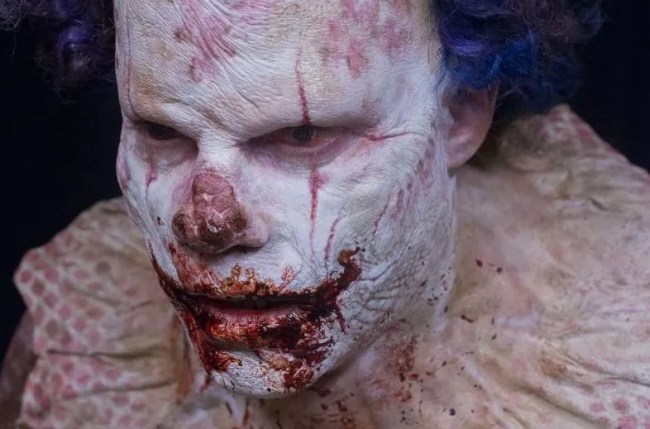
That “clown thing” would evolve into Watts’ first feature, the deeply disturbing and darkly hilarious “Clown,” a movie that barely got a U.S. release when it came out in 2014 but which slowly developed a deserved cult following. Now, it’s available as an excellent all-region 4K UHD release from the German company Turbine Media, with a fantastic new making-of documentary and a half-hour of bonus interviews, an alternate ending, and a concept design gallery.
“Clown” would ultimately become the movie that launched Watts’ directorial career, but when he and Ford first made the short that served as its basis, they had no expectations that it would be anything more than a fun lark. “We had zero goals for it,” Watts said. “It was completely made for fun.” The concept — that of a man tormented by a possessed clown costume that he cannot physically remove from his face and body — grew out of a running joke between Watts and Ford.
“ We would always talk about it in the context of an imaginary scenario that we had created where we’re in Hollywood pitching to a powerful executive,” Watts said. “We pitch all of our brilliant ideas, and they pass on all of them, and then the powerful Hollywood executive says, ‘Do you have anything else?’ And then Chris Ford and I look at each other, we look back at the executive, and we say, ‘Well, there’s ‘Clown.” And in that hypothetical context, we were just trying to outdo ourselves with the absolute most disturbing project that we could think of. That was the creative fire that drove the casual development of ‘Clown’ over the years.”
The initial short that Watts made for fun was a fake trailer for “Clown” that contained many of the elements the eventual feature film would develop in detail, but Watts didn’t really have ambitions to expand his ideas into a longer-form project. As a joke, he listed Eli Roth as a producer in the trailer; Roth was riding high on the success of the “Hostel” films at the time and was a big name in horror. When Watts posted the trailer online, something unexpected happened: Roth saw the short and called Watts to discuss coming on board to produce “Clown” as a feature.
“There’s definitely a moment where you think, is this some sort of prank or elaborate ruse?” Watts said, remembering the call from Roth, adding that it was a bit confusing to begin his feature film career with a movie that grew out of something he had intentionally conceived as a “bad” idea. “Did we really want to make this? Could it ruin our careers? But when you get the opportunity to have someone say, ‘I will totally support and find a way to finance this crazy idea,’ you have to go for it.”
Instead of shying away from the more absurd and uncommercial aspects of “Clown,” Watts leaned into them, creating a film that was incredibly silly conceptually but genuinely horrifying in its execution; the movie’s greatness comes from the fact that it simultaneously feels completely ridiculous and completely convincing. In calibrating that tonal balance, Watts looked to a reference point outside the world of horror movies.
“I had been working at The Onion and directing a lot of their field pieces at the time,” Watts said. “That sense of humor is just the driest, darkest sense of humor, which matches my own. So in a way, ‘Clown’ was the driest, darkest joke I could think of. When you get into the moral complexity of the decisions the characters are making, I was always thinking about treating it as seriously as we possibly could — and I think maybe we overdid it, because it was deadpan to the point where no one thought it was funny or satirical.”
Luckily, the actors got what Watts was going for and pulled off the precise combination of tragedy and goofiness the script required; Andy Powers is particularly effective in the title role, though the financiers went after several bigger names before signing off on Powers as the lead. “You end up in a meeting at a giant agency, and they’re presenting you with all of these actors that could potentially be right for the role,” Watts said. “And then you start to think, wait, would Jason Isaacs really be in this movie? Would Peter Sarsgaard be in it? That would be great!”
Behind the scenes, Watts suspected there was actually zero interest from name actors in starring in his film. “I’m being presented with this list of names, and Eli Roth and I are saying, ‘Let’s try for these guys,’” Watts said. “But then their agent is like, ‘Hey, do you want to play a child-eating clown monster?’ And they all say, ‘No, you’re fired.’ I can’t imagine what those calls must have been like, but needless to say, no one wanted to do it.”
Just as Watts wasn’t privy to many of the casting discussions behind closed doors, he was also never entirely sure what went wrong with the film’s release. With Roth attached as producer, “Clown” had secured a distribution deal with Harvey and Bob Weinstein’s Dimension Films before shooting, but the brothers buried the film when it came time to let it out into the world.
“I remember right around the time of the test screening process, Harvey Weinstein went in front of Congress and said there was too much violence in films and he was going to take it upon himself to stop that,” Watts said. “Meanwhile, we’re in the middle of shooting blood spatter effects to composite onto scenes set in a Chuck E. Cheese.” It was clear to Watts that the Weinsteins had buyer’s remorse. “Once they saw the movie, they were like, ‘Oh, this isn’t what we thought it was going to be.’”
 Jon WattsGetty Images
That led Watts to suspect the executives never even read the script. “They just watched the trailer and bought into Eli’s sales pitch.” Ultimately, “Clown” was dumped in the U.S., though foreign pre-sales ensured a fairly robust theatrical release in some international markets. “It did really well in Italy,” Watts said. “It was the number two English language movie there behind ‘Interstellar’ at the time.”
When it was released, Watts felt that “Clown” had not only done nothing for his career, but it actually set him back. “I had left the commercial and music video world for so long while I was working on ‘Clown’ that when I came back, I couldn’t get work,” Watts said, “and I couldn’t even tell people to go watch the movie because it hadn’t been released in the States.”
Just as he had made the original “Clown” trailer at a low point in his career with no expectations, Watts reacted to the feature’s disappointing release by writing another movie he knew he could make just for the sake of making it. “I wrote ‘Cop Car’ thinking, I’m going to write something I can go make in my hometown for zero dollars, because my career has been completely destroyed by this clown movie.”
When he heard that Kevin Bacon was interested in starring in “Cop Car” but that he wanted to see what else Watts had directed, Watts’ heart sank.
“I thought, well, that’s how I lose Kevin Bacon,” Watts said, but to his surprise Bacon liked “Clown.” “That was the one silver lining in the whole experience, that it got Kevin Bacon on board ‘Cop Car.’” Now, over 10 years after its release, Watts not only embraces “Clown” but dreams of expanding its mythology and turning it into a franchise.
“We have a seven-film arc all planned out,” Watts said. “It’s not a joke. There’s been a little bit of untangling of the rights since the Weinstein Company had owned it, but I’m very, very open to the idea. I would love to keep it going.”
“Clown” is now available on 4K UHD and Blu-ray from Turbine Media.