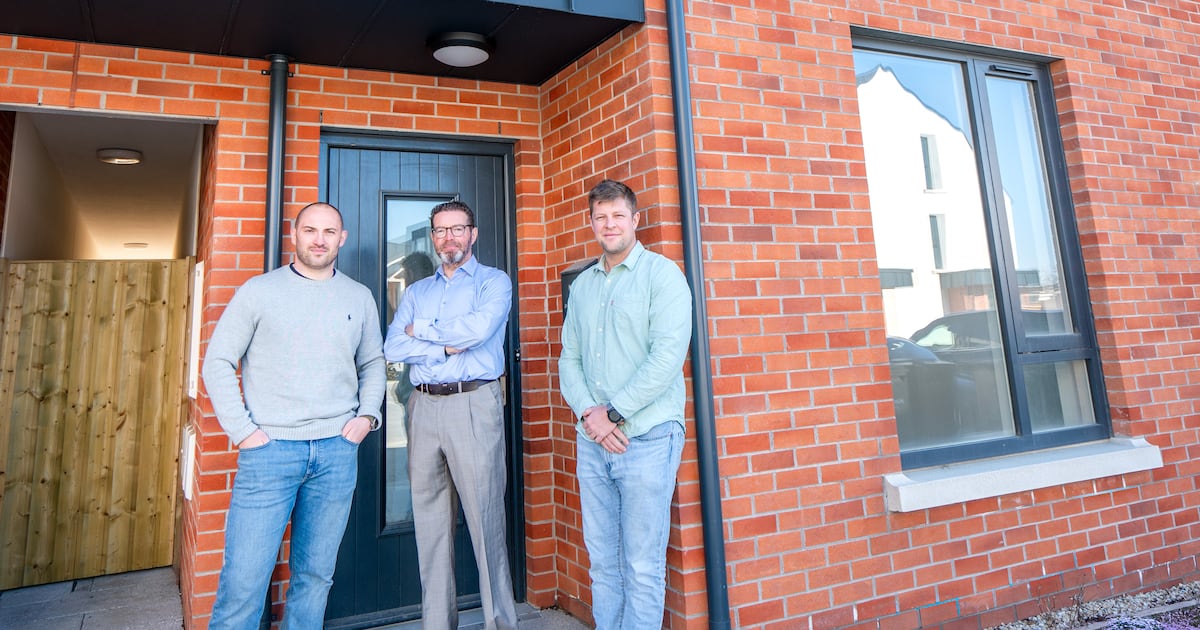
When Andrew Lynch came back from London with his family in 2021, the goal was to quickly buy a home in Dublin.
However, things didn’t quite go to plan, as, although the couple had good jobs and a good deposit saved, they didn’t tick all the boxes when it came to a mortgage application.
“We quickly realised that the system in place wasn’t fit for purpose,” he says, adding that the mortgage application process wasn’t set up for someone who is self-employed or who had been away for some time.
But while house searching may have been challenging, it wasn’t a wholly unsatisfactory time; the experience inspired his new venture, Homely, a rent-to-own platform he cofounded with David Lynch and Richie Carroll, which aims to transform renters into homeowners within three to five years.
“The genesis was our own frustration with the current system in Ireland,” he says.
While still in its early days, Homely has just seen its first set of renters transition to homeowners, and Lynch has big plans to work with developers around the country to offer those who aren’t quite mortgage ready today the chance of starting to save to own their own home while living in it and renting it – and putting money towards a deposit.
“We need more homes across the board. If we can a get people into homes today that really need them, that helps the system, and if we can make building those smaller/bigger blocks more feasible, everyone wins,” he says.
So how does the rent-to-own model work? And does it make sense?
Rent to own
It’s not the first time there have been efforts to introduce rent-to-buy schemes in the Irish market.
Those of a certain vintage might recall previous rent-to-buy initiatives – in the aftermath of the financial crisis, for example, developers looked at ways of selling off new-builds that had almost overnight appeared to be outrageously overpriced.
Easisteps was one such scheme, and it was available at a number of developments around the country, including Belarmine in Stepaside and Rathborne Village in Dublin 15.
And there have also been mortgage-to-rent schemes, another byproduct of the Celtic Tiger, whereby if you can’t afford your mortgage, you can sell your home to an approved housing body, which then buys your home from your lender and rents it back to you.
Rent-to-buy schemes have also been popular in places such as New York – although there have been concerns expressed of late, with the department of financial services in New York state now investigating whether rent to own could constitute “unlicensed, predatory mortgage lending”.
How it works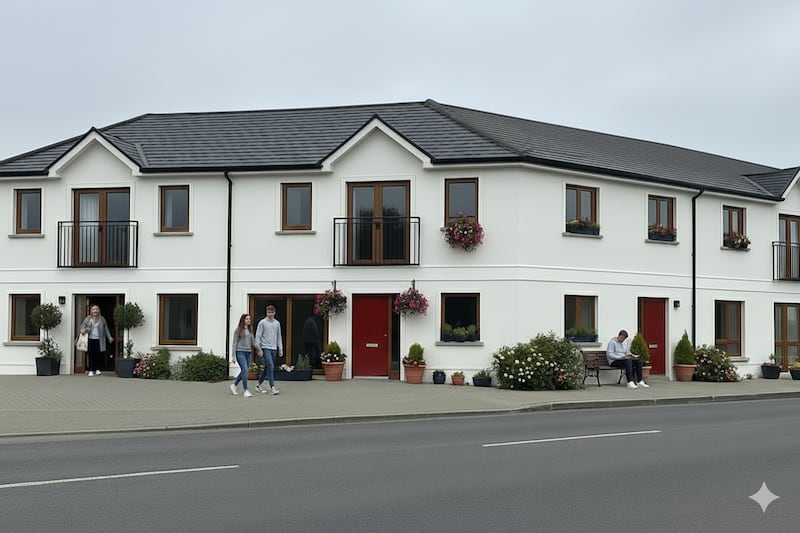 In Ballivor, Co Meath, Homely is marketing a three-bed apartment with rent from €2,200 a month, and a path to home ownership ‘within five years’
But Homely is bringing its own approach to the rent-to-own market. Aimed at those who can’t afford to buy just yet, or who may not secure mortgage approval – but also those who don’t want to be “renting aimlessly” – Homely promises to turn renters into homeowners within five years.
And the demand seems to be there for it; Lynch says they have had about 4,500 applications so far.
“It’s quite staggering,” he says.
Homely says its applicants are typically aged between 22 and 45, earning a steady income, but without a large deposit or family support. It cites examples such a freelancer, or small-business owner; someone who has moved to Ireland for the first time or recently returned home; someone going through a divorce or separation; or a short-term unemployed person with enough funds for rent/living costs.
Applicants should be spending only about 30-40 per cent of their income on rent – any higher than that and Homely will likely turn them down. The goal, after all, is to ultimately buy the property.
“We won’t continue unless there’s a very high likelihood of them securing a mortgage at the end of the term,” says Lynch.
So, people who may not qualify for a mortgage just yet, but who are likely to do so over the short to medium term.
Tenants need to get third-party legal advice to participate, “so that they know what they’re getting into” says Lynch.
[ Mortgage to rent scheme extended to include higher priced homesOpens in new window ]
The model has been adapted from those in use in other countries around the world, fitted to Irish legislation. Funding has come from a “mixed bag” of sources, including the founders, with a family office in the background. It also recently secured debt finance from ICS/Dilosk.
There are currently two approaches.
Firstly, you can approach the firm with a property in mind and, if approved, they will purchase it, you will sign a tenancy agreement and option agreement (after consultation with your lawyer) and pay 2.5 per cent of the purchase price, or a minimum of €10,000.
“If a home meets our criteria, it can become a Homely home; in fact, all our homes to date have been selected by customers in this way,” says Lynch.
Alternatively, you can agree to rent a property in one of the new developments Homely is collaborating with, and pay a similar fee.
At that point, the interested parties will get two documents – one is a RTB tenancy agreement, and the other is a purchase option agreement, which gives the right – but not the obligation – to buy at the end of the set term.
As Lynch explains, customers have the legal right to demand Homely sells to them – “but we don’t have the right to demand they buy the property”.
“We’ve had quite a few lawyers run the rule over that,” he adds.
The option to buy the property cost varies from property to property, but will typically be about €300-€500 a month.
Tenants can pull out at any point – but you will lose your upfront payment and option payments if you decide to do so.
At the end of the tenancy period (typically three-five years), you can exercise your option and buy the home. If you decide to purchase, you’ll receive your rent and value discounts (which can count towards your mortgage deposit) and a monthly payment statement proving your mortgage repayment ability.
“The customer knows the discount at day one,” says Lynch.
[ Only top 20% of Irish earners can afford to rent an apartment, surveyors sayOpens in new window ]
Your discount on the purchase price works out as a combination of what you’ve paid thus far – so part of your upfront payment, rent and option payments, as well as the increase in property prices – or about 20 per cent of everything you’ve paid monthly, and up to 20 per cent of the increase in your home’s value.
In effect, it should either work out as a deposit, or be close enough to it.
“Together, these two discounts could add up to a saving of 8 to 12 per cent off the final valuation, which can effectively count toward your mortgage deposit,” Homely says.
Another way of looking at it is five years of Homely payments works out as one year back, or about 20 per cent.
Remember that your rent may increase each year, in line with RTB rules.
Pros of rent to buy
The big advantage then of rent to buy is that you won’t need a big deposit to buy your first home. It may also mean that you will spend less on rent while waiting to buy, as it may reduce the length of time it takes you to buy a home.
To date, Homely has had three users avail of the platform, its chief aim being to make sure the model works.
“Our main goal over last 12 months has been trying to get someone ‘out’,” says Lynch, adding that this recently happened, when homeowners, who were living in a home bought for €970,000 and paying rent to Homely secured mortgage financing and bought the property from Homely.
Such a property price is not typical, however, with most homes expected to be around €350,000-€400,000.
Where can you rent to own?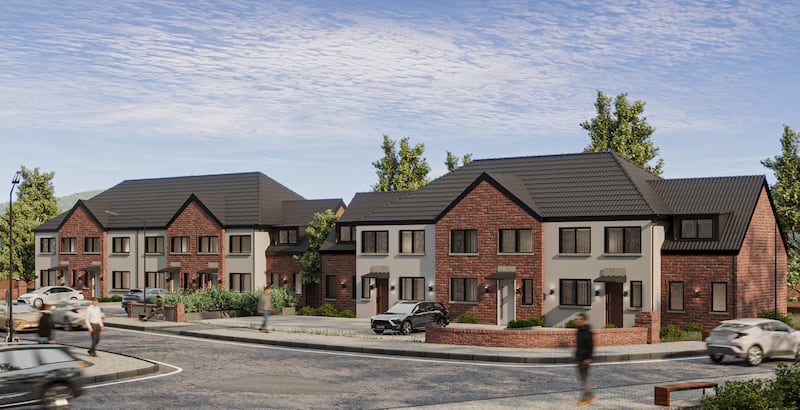 Hazel Mews in Castletroy, Limerick
Homely says it focuses on “good-quality homes in well-connected cities, towns and villages across Ireland”.
Current locations it is working on with developers include Kildare, Meath, Laois and Limerick.
Earlier this year Homely launched in Ballivor, Co Meath, marketing a three-bed apartment with rent from €2,200 a month, and a path to home ownership “within five years”. Clós Na Croise is a newly refurbished collection of two- and three-bedroom houses and apartments. Rents range from €1,450 to €1,850 per month, with an additional €300-€500 purchase option fee.
Next summer, Homely expects to launch its offering in Castletroy, Limerick. Hazel Mews, a development of nine three- and four-bed homes, is just six minutes away from the University of Limerick and is currently taking expressions of interest, with a view to completing construction next summer. Rent will start from €2,650 a month for a three- or four-bed home, and you’ll have to commit to at least a three-year period.
Homely is looking to engage with more developers and has spoken to many, big and small. Lynch sees the proposition as an extra “bolt-on” to what the developers can offer.
The expectation also is that the model will appeal to smaller developers, as a way of boosting margins through generating rent/selling when prices are higher.
Downside
One of the big issues with such a scheme, however, is the volatility of house prices. In effect, you’re taking an option on a property and, as with options on everything from gold and stocks to derivatives, you could find yourself on the wrong side of the deal.
While the structure of the arrangement means that you don’t have to exercise your option – you will still have spent a significant sum on it, money which you won’t benefit from unless you go ahead and buy the home.
If, for example, house prices should fall over the term, and after five years a house across the road is selling for say 20 per cent less than your Homely property, it’s unlikely that you would go ahead with the purchase.
This would also be bad news for Homely, which could either end up with a sitting tenant or a house that may have dropped in value – although Lynch says the company tries to mitigate against this by buying good, solid properties in good locations, in the €350,000-€400,000 range, the prices of which they expect to remain resilient.
A further downside, perhaps, is that if you opt to buy your home through the Homely model, you will be excluded from Government schemes such as Help to Buy, which can offer as much as €30,000 towards the deposit on a new home, or the First Home shared-equity scheme.
This is because if you do go ahead and buy the home, it will be a second-hand purchase – which is something that Homely would like to see changed.
How rent to own worksYear 1
- Purchase price: €400,000
- Initial payment: €10,000 (2.5 per cent)
- Monthly payment: €2,916 (includes rent and option payment)
Year 3
- Potential market value: €443,487
- Monthly payment discount: €21,000 (20 per cent of rent plus option payments)
- Market value discount: €8,697 (20 per cent of price growth)
- Total discount: €29,697
- Purchase price: €413,789
Year 5
- Potential market value: €475,074
- Monthly payment discount: €35,000 (20 per cent of rent plus option payments)
- Market value discount: €15,014 (20 per cent of price growth)
- Total discount: €50,014
- Purchase price: €425,059